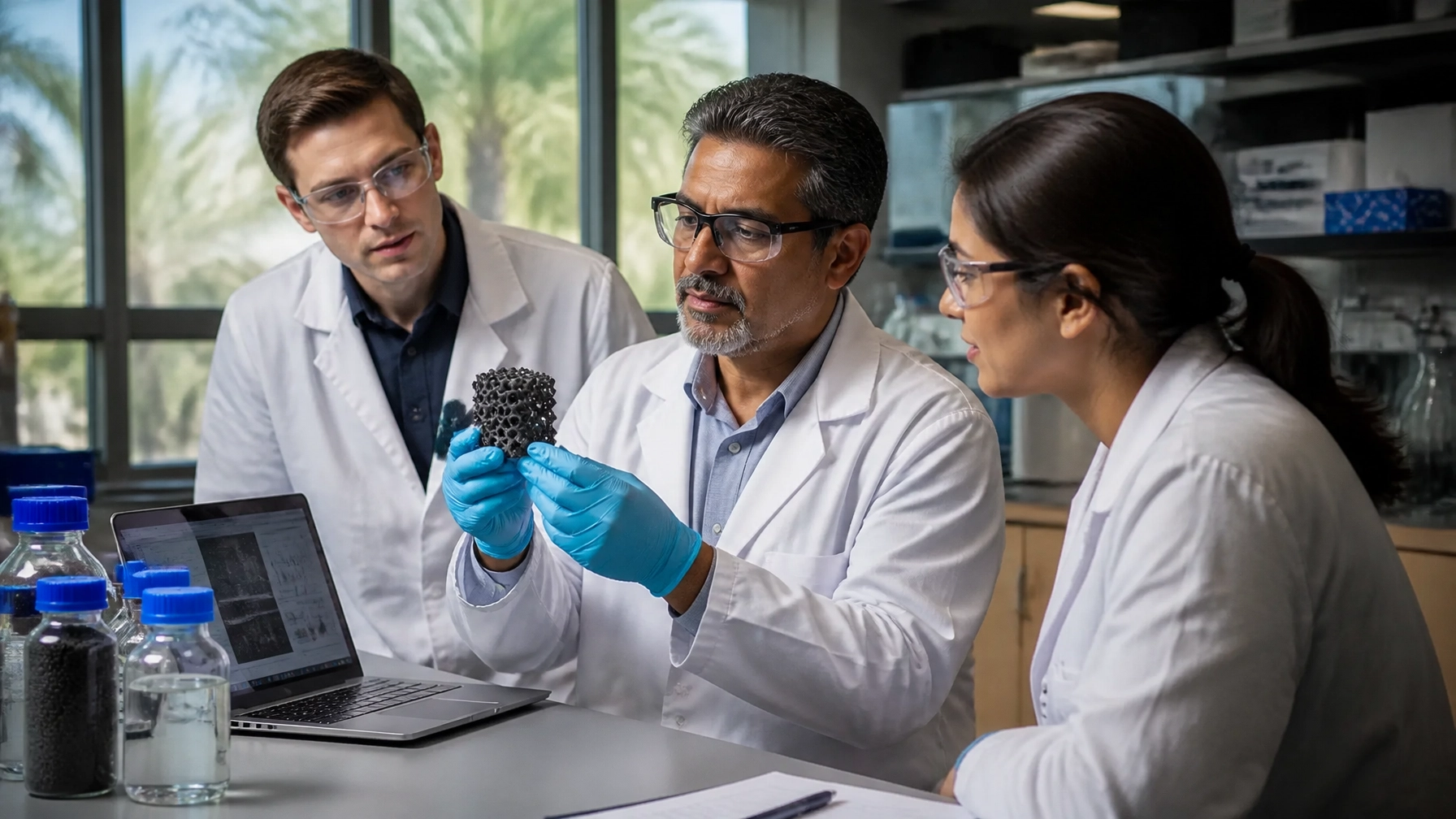
Florida Atlantic University has received an $800,475 grant from the U.S. Environmental Protection Agency to develop an artificial intelligence-guided system designed to remove phosphorus from freshwater and prevent harmful algal blooms before they take hold.
The three-year project began July 1 and brings together engineers at FAU and researchers from Case Western Reserve University. The work will focus on 3D-printed adsorbent structures made from sargassum, a naturally abundant brown seaweed, and modified with lanthanum to capture phosphate.
Lake Okeechobee will serve as the project’s real-world testbed. The research could have implications well beyond the lake, affecting water-quality strategies across South Florida, the Everglades watershed and other freshwater systems across the United States.
The grant was reported by Refresh Miami on Aug. 14 and announced by Florida Atlantic University earlier this month.
Why phosphorus is at the center of the problem
Harmful algal blooms, commonly known as HABs, are fueled by excess nutrients in water. Phosphorus and nitrogen can enter lakes and rivers through agricultural runoff, wastewater, failing septic systems and urban stormwater.
When those nutrients accumulate, algae and cyanobacteria can grow rapidly. Some blooms produce toxins that threaten people, pets and wildlife. Others consume oxygen as they decay, creating conditions that can kill fish and disrupt aquatic ecosystems.
For South Florida, the issue is especially consequential. Lake Okeechobee is a major freshwater resource and a central part of the region’s interconnected water system. Nutrient-rich water leaving the lake can affect downstream canals, wetlands, estuaries and coastal communities.
NASA documented the scale of the challenge in 2023, when satellite imagery showed cyanobacteria covering more than half of Lake Okeechobee’s surface during portions of June and July. The NASA Earth Observatory report noted that phosphorus and nitrogen helped create conditions favorable to rapid cyanobacterial growth.

How FAU’s technology is expected to work
The FAU project, titled “AI-Guided Use of 3D-Printed Adsorbents for Phosphate Removal,” combines environmental engineering, advanced manufacturing and machine learning.
Researchers plan to create durable structures that can be submerged in freshwater. The structures are designed to attract and hold phosphate from both the water column and lake sediments.
That design addresses a limitation of some existing phosphorus-removal methods. Fine powdered materials can be difficult to retrieve after they are released into a water body. They may settle into sediments, create waste or raise concerns about the long-term movement of treatment chemicals.
By contrast, the 3D-printed structures are intended to be:
- Deployed in targeted areas
- Retrieved after absorbing phosphorus
- Regenerated for additional use
- Reused to reduce waste and operating costs
The use of sargassum also reflects an effort to build the treatment system around a plentiful natural material. Sargassum has become a familiar environmental and economic concern along Florida’s coast, where large seaweed arrivals can affect beaches, tourism and marine conditions.
The project will modify the sargassum-based structures with lanthanum, a material known for its ability to bind phosphate. Researchers will study how different formulations, shapes and internal structures affect performance in freshwater environments.
Where AI and machine learning come in
The artificial intelligence component is intended to help researchers make more precise decisions about both the material itself and its deployment.
According to FAU, AI and machine learning will be used to identify effective adsorbent formulations more quickly than conventional trial-and-error approaches. The system will also help determine where treatment structures should be placed to achieve the greatest phosphorus removal and the largest potential reduction in HAB risk.
That means the technology will not simply ask, “What material captures the most phosphorus?” It will also ask:
- Where is phosphorus entering the lake?
- Which areas are most likely to support algal growth?
- How will rainfall and weather affect nutrient movement?
- Where are fertilizer applications, livestock operations or septic systems influencing water quality?
- How could a treatment deployment affect future bloom conditions?
Researchers will integrate environmental monitoring with land-use information, weather patterns, fertilizer data and other watershed variables. Field sampling, publicly available datasets and unmanned aerial vehicles will be used to track water clarity, algal growth and other indicators.

The Lake Okeechobee and Everglades connection
The project’s Lake Okeechobee focus is central to its South Florida relevance.
Historically, water flowed south from Lake Okeechobee into the Everglades, supporting the sheet-flow system that carried freshwater through wetlands toward Florida Bay. Modern canals, levees and water-control structures have changed that pattern, and water managers now balance flood protection, water supply, environmental restoration and the health of downstream estuaries.
The goal of sending more clean water south remains a major part of Everglades restoration. But water quality matters as much as water quantity. Moving water south without reducing its phosphorus load could transfer nutrient pollution into the Everglades, where it could disrupt marsh ecosystems and contribute to additional water-quality problems.
That is why phosphorus removal is an important part of the broader restoration conversation. A treatment system that can reduce nutrients in Lake Okeechobee could help make future southward flows more compatible with the needs of the Everglades.
At the same time, the project is not a replacement for source controls, restoration projects or existing water-management programs. Agricultural runoff, stormwater and legacy phosphorus stored in lake sediments remain complex challenges. The FAU technology is being developed as one possible tool in a much larger effort.
FAU researchers will test the system under real conditions
The project is led by Masoud Jahandar Lashaki, Ph.D., an associate professor in FAU’s Department of Civil, Environmental and Geomatics Engineering.
Co-principal investigators include Yalan Liu, Ph.D., and Mohammed Abdellatef, Ph.D., also from FAU’s civil and environmental engineering program. Huichun “Judy” Zhang, Ph.D., of Case Western Reserve University, will participate as the project’s sub-awardee.
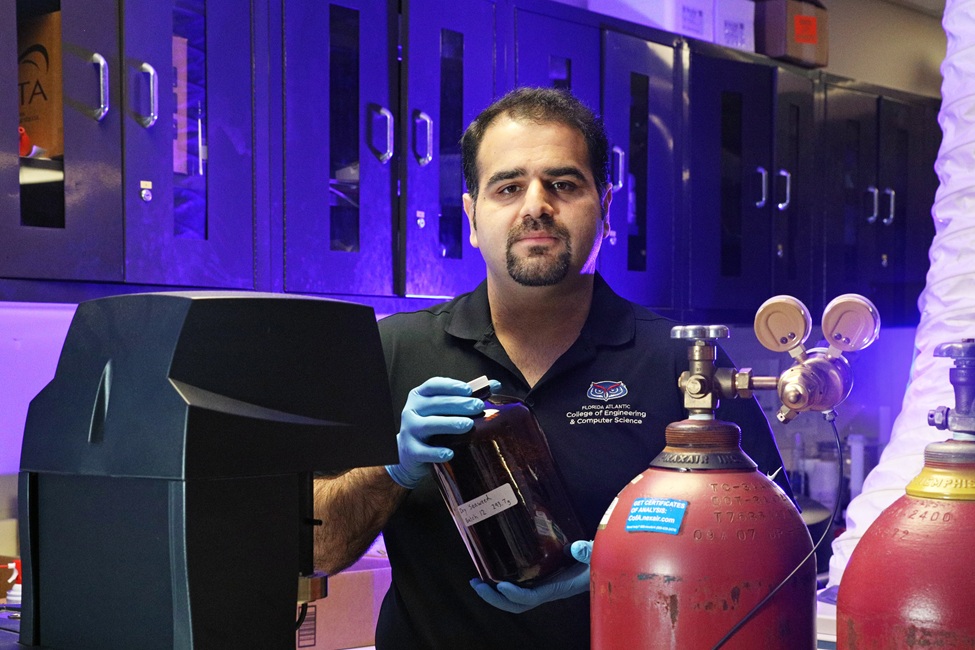
The researchers will evaluate the technology in Lake Okeechobee under real-world conditions rather than relying only on laboratory experiments. They will monitor changes in phosphorus, water clarity and algal activity while studying how the adsorbents perform over time.
The team also plans to share resulting data through the EPA’s Water Quality Exchange. That could make the findings useful to other communities dealing with nutrient pollution, including lake regions, reservoirs and watersheds outside Florida.
What success could mean for South Florida
The immediate objective is to determine whether AI-guided, 3D-printed adsorbents can reduce phosphorus effectively and safely. The longer-term goal is to create a scalable system that can be adapted to other freshwater environments.
If the approach works, it could provide water managers with a more targeted method for addressing nutrient pollution. Instead of applying the same treatment across a large area, managers could use environmental data to identify high-priority locations and deploy reusable materials where they are most likely to make a difference.
That could be valuable in South Florida, where water-quality decisions have consequences across a connected network of lakes, canals, wetlands and coastal waters. A bloom that begins in an inland freshwater system can become an issue for recreation, tourism, wildlife and communities far downstream.
The project also highlights the growing role of Miami tech and South Florida innovation in addressing environmental challenges. FAU’s work connects artificial intelligence and 3D printing with one of the region’s most urgent needs: protecting the water systems that support its economy and communities.
The EPA-funded research will take three years, and the technology is still in development. But the basic strategy is clear: remove phosphorus earlier, place treatment more precisely and use data to anticipate where harmful algal blooms are most likely to form.
For readers following Everglades news, Lake Okeechobee restoration and Miami tech, the project offers a closely watched example of how advanced engineering could become part of South Florida’s environmental future.
Stay connected with South Florida Digest’s latest news coverage for updates on regional science, technology, water policy and the issues shaping life from Miami to Fort Lauderdale and beyond.