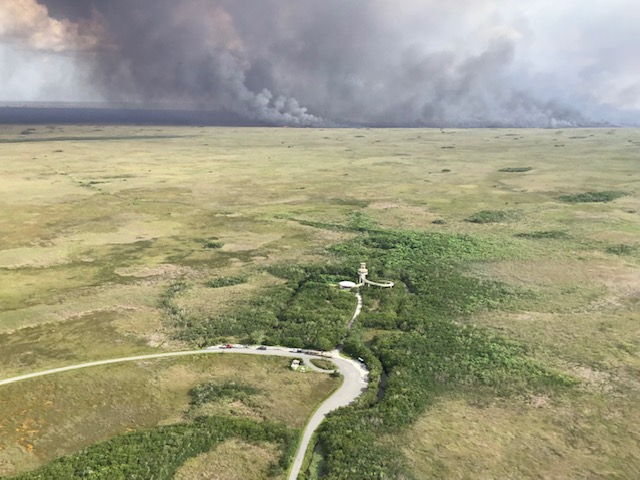
The major wildfire threat in Everglades National Park has eased, but the environmental damage from August’s fires may take far longer to assess: and much longer to repair.
The Chipmunk Fire, which burned approximately 17,000 acres in the central Everglades, reached 100% containment by Aug. 27, according to updated incident information. The Movie Dome Fire, covering about 6,207 acres, was reported 100% contained on Aug. 24. The smaller Vulture Fire burned roughly 347 acres and was also fully contained.
All three fires were lightning-ignited during an episode of extreme drought concentrated in the central Everglades.
For the latest Everglades news, the key point is this: containment marks the end of the immediate spread: not the end of the emergency for the ecosystem.
The fires burned through an unusually dry Everglades
The Chipmunk Fire was first reported Aug. 21, approximately two miles southwest of Shark Valley. It expanded rapidly through dry sawgrass prairie as firefighters used crews, engines, aircraft and indirect suppression tactics to slow its movement.
The Vulture Fire began the following day east of the Shark Valley Tram Road. The Movie Dome Fire, also lightning-caused, grew to more than 6,200 acres before reaching full containment.
The timing and location were significant. While much of South Florida had begun receiving enough rain to ease drought conditions, the central Everglades remained exceptionally dry. According to reporting by WLRN, water levels in parts of the sawgrass marshes had dropped below normal: and, in some areas, below the ground surface.
That left broad stretches of sawgrass, tree islands and organic soil exposed to fire.
In a typical year, water remains in the marsh or close enough to the surface to limit how deeply a fire can burn. This year, the lack of water allowed flames to move through dry vegetation and potentially affect the peat beneath it.
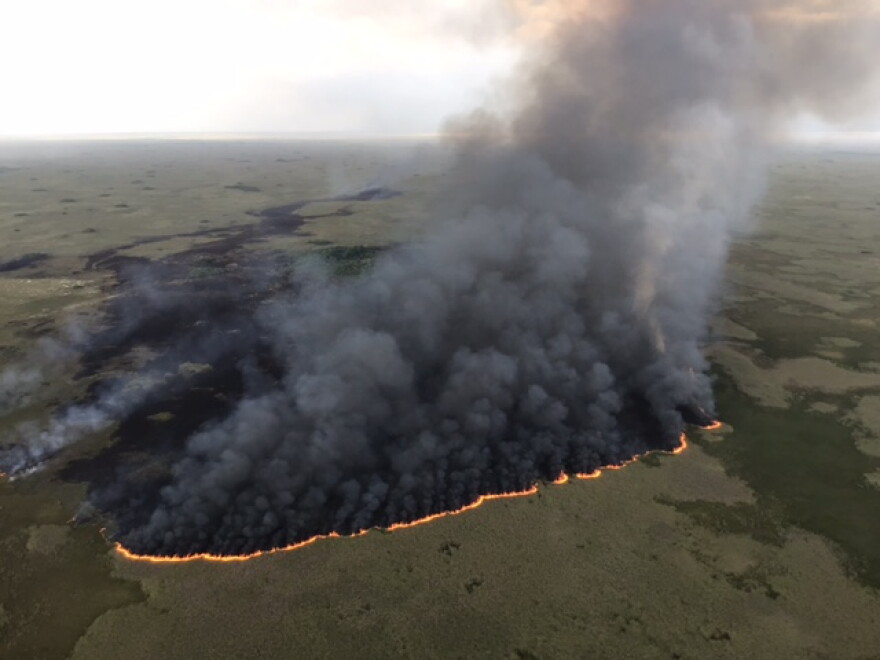
The Vulture Fire burned approximately 347 acres and was fully contained. Photo: U.S. Wildland Fire Service.
Shark Valley has reopened: but conditions remain dynamic
Everglades National Park temporarily closed the entire Shark Valley District on Aug. 22 to protect visitors, park resources and firefighting operations. The closure included the visitor center, trails, parking areas and Shark Valley Tram Road.
The National Park Service lifted the emergency closure at 1 p.m. on Aug. 24. The district has since reopened for public and administrative use.
However, reopening does not mean the surrounding landscape has returned to normal. Fire crews continued suppressing and monitoring the Chipmunk Fire after the Shark Valley closure ended. Interior areas inside a contained fire perimeter can continue to smolder, and conditions can change quickly when dry fuels, wind and heat persist.
Visitors should check the Everglades National Park alerts and conditions page before traveling to Shark Valley or other park districts. Smoke, roadwork, trail conditions and new fire-related restrictions can affect access even after an emergency closure has been lifted.
The main concern is what happened below the grass
Fire is a natural part of the Everglades. Lightning-caused fires periodically move through sawgrass, clear accumulated vegetation and help maintain the balance of wetland habitats. Park managers also use prescribed fire under controlled conditions.
The problem is that a fire burning through wet marsh vegetation is not the same as one burning through dry peat.
Peat is the thick organic soil built over thousands of years from partially decomposed plants. It stores carbon, retains water and helps support the elevation and structure of the Everglades. It also acts as a natural buffer against saltwater intrusion and helps filter water moving through the system.
When the peat dries, it becomes fuel.
A fire that burns hot and long enough can consume portions of that organic soil. The result can be a loss that is not measured in months or even years. Scientists cited by WLRN say rebuilding peat can take decades to hundreds or thousands of years, depending on the depth of the loss and whether water levels are restored.
John Kominoski, a Florida International University biology professor involved in long-term Everglades research, told WLRN that peat loss can also change the physical shape of the landscape. Because peat sits above uneven limestone, burning or collapsing the organic layer can leave areas too deep or irregular for sawgrass to recolonize normally.
That makes the Chipmunk Fire more than a vegetation story. The full impact will depend on how deeply the fire burned, where peat was consumed, and whether future rainfall can keep the remaining soil saturated.
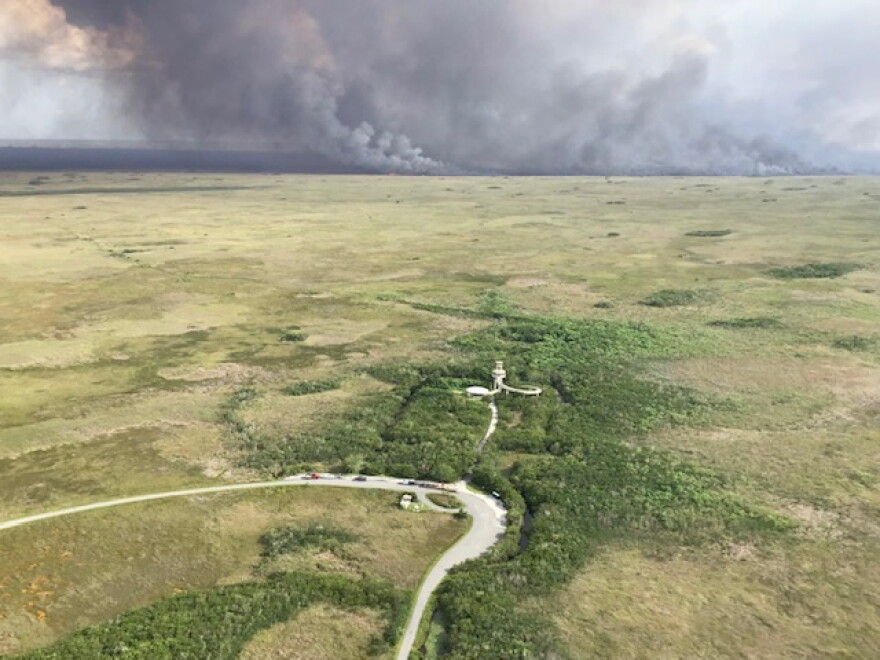
Firefighters used aircraft and ground resources to contain the Chipmunk Fire. Photo: U.S. Wildland Fire Service.
Water levels will determine the recovery timeline
Rainfall is now the most important short-term variable, but a few storms will not erase the region’s accumulated water deficit.
The 2025–26 dry season was unusually dry, and the central Everglades carried that deficit into the 2026 wet season. Water levels in conservation areas north of the park reached their lowest point in early June. Although levels began rising later, they remained far below normal.
The South Florida Water Management District has also reported that parts of Water Conservation Area 3 were hovering near the operational floor elevation. When water levels fall below that threshold, water cannot simply be released southward without new inflows from the north.
Lake Okeechobee remains below average and under water restrictions, limiting the amount of water moving into the southern Everglades. That matters because the park needs sustained water: not simply one heavy downpour: to rewet the marsh, replenish shallow groundwater and protect peat from further drying.
Scientists and water managers are watching several indicators:
- Water levels in the central marshes and conservation areas.
- The depth of the water table below the peat surface.
- Conditions in Shark River Slough and Taylor Slough.
- Salinity levels in Florida Bay.
- The availability of prey for wading birds.
- Whether burned areas show vegetation recovery or signs of peat subsidence.
- The likelihood of additional fires during the upcoming dry season.
Wildlife impacts may emerge later
The immediate images from the August fires show smoke, aircraft and blackened sawgrass. The longer-term effects may be less visible.
Low water levels can reduce the concentration of fish and other prey that wading birds depend on during nesting season. If marsh conditions remain too dry or water moves through the system at the wrong time, birds may have difficulty finding enough food for their young.
Farther south, limited freshwater flow has contributed to elevated salinity in portions of Florida Bay. If high salinity continues during hot, dry conditions, seagrass beds could face additional stress or die-offs.
Peat loss could create another set of problems. Lower land elevations can alter water movement, increase vulnerability to saltwater intrusion and make it more difficult for wetland plants to return. These changes can persist even after the visible fire scars begin to fade.
The Everglades may appear green again after several wet seasons, but regrowth does not necessarily mean the underlying ecosystem has fully recovered.
A wetter winter could help: but not reset the system
Forecasters and regional scientists are watching the development of El Niño, which can bring wetter and cooler winter conditions to Florida. Some climate outlooks suggest that meaningful rainfall relief may not arrive until October or later, with the strongest influence potentially occurring toward the end of 2026 and into early 2027.
That would be helpful, but it would not immediately replace lost peat or eliminate the effects of two consecutive years of water stress.
The likely outlook is uneven. Rainfall could lower fire risk and gradually recharge marshes, aquifers and Florida Bay. At the same time, areas where peat has already burned will remain permanently altered on a human timescale. If rainfall is delayed or weaker than expected, the central Everglades could enter the 2026–27 dry season with low water levels and vulnerable fuels still in place.
The National Park Service, scientists and water managers will continue tracking the landscape after the fires are contained. Their focus is shifting from suppression to measurement: determining how deeply the fires burned, how water moves through affected areas and which habitats can recover naturally.
The Chipmunk Fire is no longer spreading. Shark Valley is open again. But for the Everglades, recovery is only beginning; and the most consequential damage may be buried beneath the sawgrass.