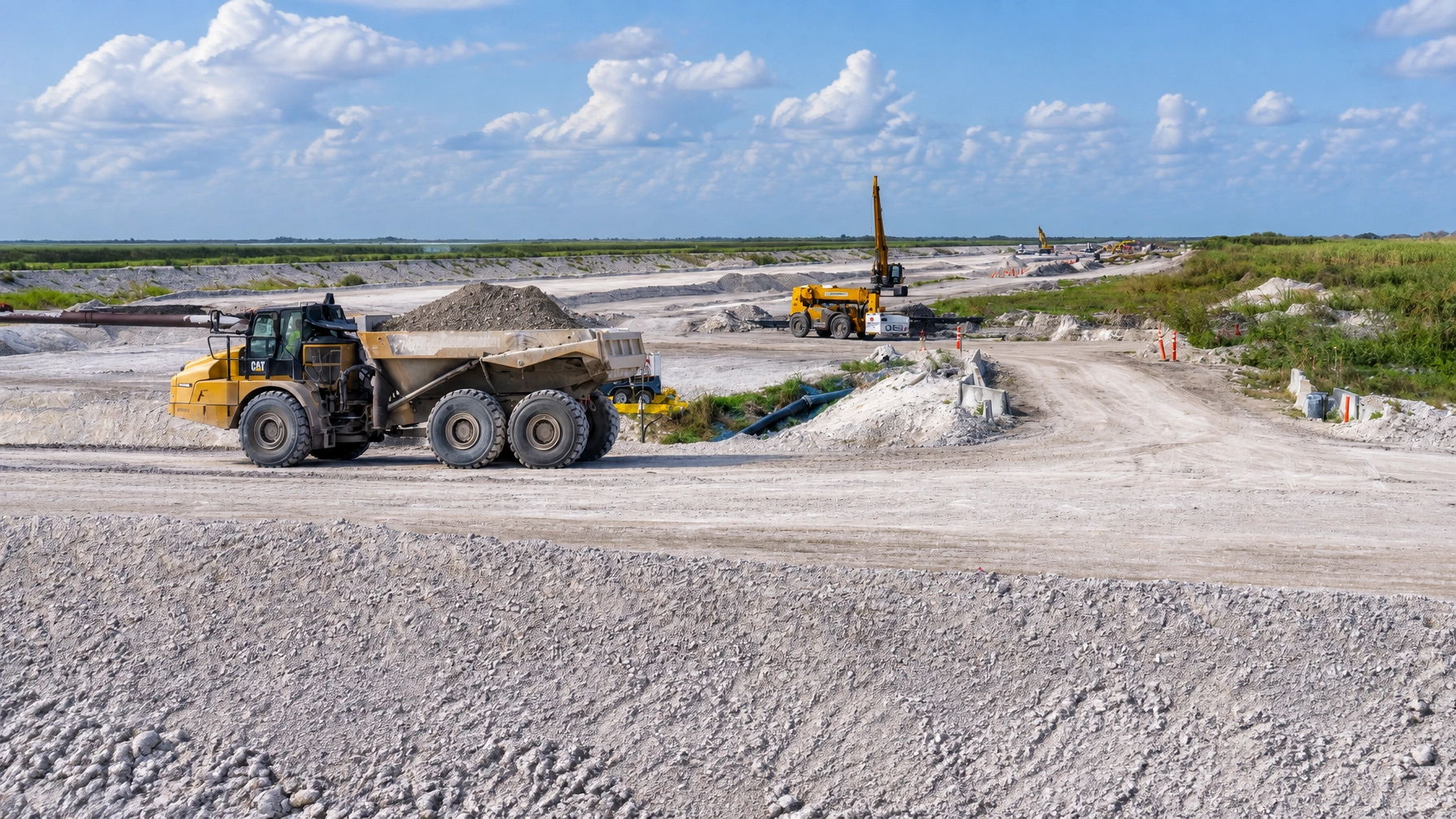
The Everglades Agricultural Area Reservoir has reached another major construction milestone, with the U.S. Army Corps of Engineers reporting significant progress on the project’s foundation and embankment.
The reservoir remains on track for completion in 2029, five years earlier than the schedule previously announced. But a new report from Friends of the Everglades argues that the project is still far too small to provide the storage South Florida needs to restore the River of Grass, protect coastal estuaries and prepare for a more volatile climate.
The dispute comes as Florida celebrates measurable restoration gains. Record freshwater flows reached the Everglades this year despite drought conditions, helping Florida Bay meet salinity targets for the first time in decades. At the same time, regulators are scrutinizing proposed artificial intelligence datacenters near the Everglades because of their potential demands on water, electricity and surrounding communities.
Taken together, the developments show why water storage is becoming one of the defining issues in South Florida news.
Reservoir construction advances toward 2029 deadline
The EAA Reservoir is being built south of Lake Okeechobee as a central component of the Comprehensive Everglades Restoration Plan. The project is designed to capture and store water that can be sent south to the Everglades and Florida Bay, while reducing damaging discharges from Lake Okeechobee to the St. Lucie and Caloosahatchee estuaries.
The South Florida Water Management District says the reservoir will hold approximately 240,000 acre-feet of water, or more than 78 billion gallons. The broader project also includes canals, pump stations and a stormwater treatment area intended to remove pollutants before water moves south.
According to the U.S. Army Corps of Engineers’ update, this year’s work has included:
- Significant progress on the reservoir foundation.
- Continued construction of the embankment.
- Completion of a major controlled construction operation at the site.
- Continued coordination between the Corps and the South Florida Water Management District.
The project is being delivered through multiple construction contracts. Foundation preparation and the cutoff wall are advancing, while embankment work is proceeding as completed sections are turned over to the embankment contractor.
Officials have described the reservoir as the “crown jewel” of Everglades restoration. State leaders have also pointed to the accelerated schedule and other large-scale projects as evidence that Florida is moving faster on water infrastructure than it has in decades.
Construction progress is significant. But the central question is no longer simply whether the reservoir will be finished. It is whether the completed project will be large enough to meet the region’s long-term needs.

Why environmental groups say the reservoir is too small
A new Friends of the Everglades report argues that South Florida needs roughly 1 million acre-feet of additional storage in the Everglades Agricultural Area beyond the reservoir now under construction.
The report was examined in a WUSF report published September 29. It proposes a much larger reservoir concept covering approximately 77,000 acres at an average depth of 13 feet.
By comparison, the current EAA Reservoir covers about 10,000 to 10,500 acres and is designed to be roughly 24 feet deep. Its capacity is approximately 240,000 acre-feet.
Friends of the Everglades contends that the smaller footprint cannot consistently accomplish three major goals at the same time:
- Store enough water during wet periods for use during drought.
- Reduce harmful discharges to the St. Lucie and Caloosahatchee estuaries.
- Send sufficient clean freshwater south to the Everglades and Florida Bay.
The group also says the project’s treatment wetlands may not be large enough to address nutrient pollution from agricultural runoff. That concern matters because water cannot simply be redirected south without meeting water-quality requirements. The Everglades needs more water, but it needs water that is clean enough to protect sawgrass marshes, wildlife and downstream coastal ecosystems.
The report does not argue that the current reservoir has no value. Instead, it presents the structure as one part of a much larger water-management system that will require additional storage, treatment capacity and land acquisition.
Environmental scientist Paul Gray told WUSF that restoration should be viewed as a step-by-step process rather than a project with a single finish line. That view is shared by many restoration planners: infrastructure can produce measurable gains while still falling short of the system’s full ecological needs.
Florida Bay offers evidence that restoration investments can work
The debate over the reservoir’s size is unfolding alongside an important environmental result.
This year, record freshwater flows reached the Everglades despite drought conditions. The additional water moving through major sloughs helped Florida Bay meet its salinity targets for the first time in decades, according to the South Florida Water Management District.
Salinity is one of the most important indicators of Florida Bay’s health. The bay is an estuary, meaning it depends on a balance between saltwater and freshwater. When too little freshwater arrives from the Everglades, salinity can rise sharply. Hypersaline conditions can stress seagrass, fish and other marine life and contribute to ecological die-offs.
The result is particularly notable because much of South Florida experienced serious drought conditions during the year. The flows demonstrate how storage, conveyance and water-control projects can help managers deliver freshwater even when rainfall is uneven.
The achievement also illustrates the limits of relying on a single successful season. A wet-season pulse or a favorable operating year can help stabilize the bay, but restoration planners must prepare for recurring drought, delayed rainfall and rising water demand.
The 2026 South Florida Environmental Report documents progress across the Kissimmee Basin, Lake Okeechobee, the Everglades and South Florida’s coastal areas. The report includes scientific data and an online database tracking restoration projects.
AI datacenters bring a new water-demand question
The reservoir debate is also colliding with a new source of demand: large AI datacenters.
Hyperscale facilities can require hundreds of megawatts of electricity and may use substantial amounts of water for cooling, depending on their design. Even projects that limit direct water use can create pressure on power infrastructure, generate heat and require new transmission or backup-generation capacity.
Those concerns have become especially urgent in Palm Beach County, where commissioners recently approved a one-year moratorium on new hyperscale AI datacenters. The decision followed the rejection of Project Tango, a proposed facility near the Arden community.
According to WFLX coverage of the moratorium, county officials are considering future rules covering:
- Water consumption.
- Electricity use.
- Noise and heat emissions.
- Public disclosure of facility operators.
- The infrastructure costs passed on to residents.
The debate has a direct connection to Everglades restoration. Palm Beach County contains key canals and water-control infrastructure that help move freshwater south. Residents and environmental advocates have questioned whether large industrial facilities should be allowed near those systems without a detailed review of their water, power and heat impacts.

Florida’s new data-center rules also require greater scrutiny of large facilities, including public hearings for projects meeting the state’s 50-megawatt threshold and consideration of reclaimed water where feasible.
The broader issue is whether South Florida can continue adding water-intensive development while arguing that existing storage is insufficient for the ecosystem. The answer will depend on permitting standards, conservation requirements and whether developers are required to fund the infrastructure their projects need.
Smaller restoration projects are part of the same resilience conversation
Large reservoirs are only one part of the region’s response to water stress and climate change.
In Sarasota County, crews have begun work on a $25 million Alligator Creek restoration project. The project is outside the core Everglades system, but it reflects a similar approach: restore natural water movement, improve habitat and give wetlands more room to absorb flooding and changing coastal conditions.
The Alligator Creek project will reshape approximately 2.3 miles of a straightened drainage canal into a more natural, winding tidal stream. The work is intended to reduce nitrogen and sediment pollution, stabilize eroding banks and improve wildlife habitat.
Construction is expected to continue through fall 2028.
Elsewhere, scientists and coastal planners are mapping how wetlands may retreat inland as sea levels rise. That work is important because wetlands cannot survive indefinitely if development, roads and hardened shorelines block their movement. Preserving inland corridors can give marshes and tidal habitats room to migrate as coastlines change.
The same principle applies across the Everglades system: resilience depends on more than moving water through engineered channels. It requires storage, clean water, functioning wetlands, connected habitats and land-use decisions that account for future conditions.
The next test is storage capacity
The EAA Reservoir’s construction milestone is a tangible accomplishment, and the 2029 completion target gives water managers a faster path toward improved control of Lake Okeechobee flows.
But the criticism from Friends of the Everglades raises a question Florida cannot avoid: Is the state building enough storage for the climate and population it will have in the future?
This year’s freshwater flows and improved Florida Bay salinity show that restoration investments can deliver results. They do not settle the question of whether the current reservoir is large enough to produce those benefits reliably through future droughts, storms, sea-level rise and rising industrial demand.
For now, the project is moving forward on schedule. The next phase of the debate will focus on what comes after 2029-and whether Florida is prepared to build the additional storage and protection that scientists say the Everglades will need.