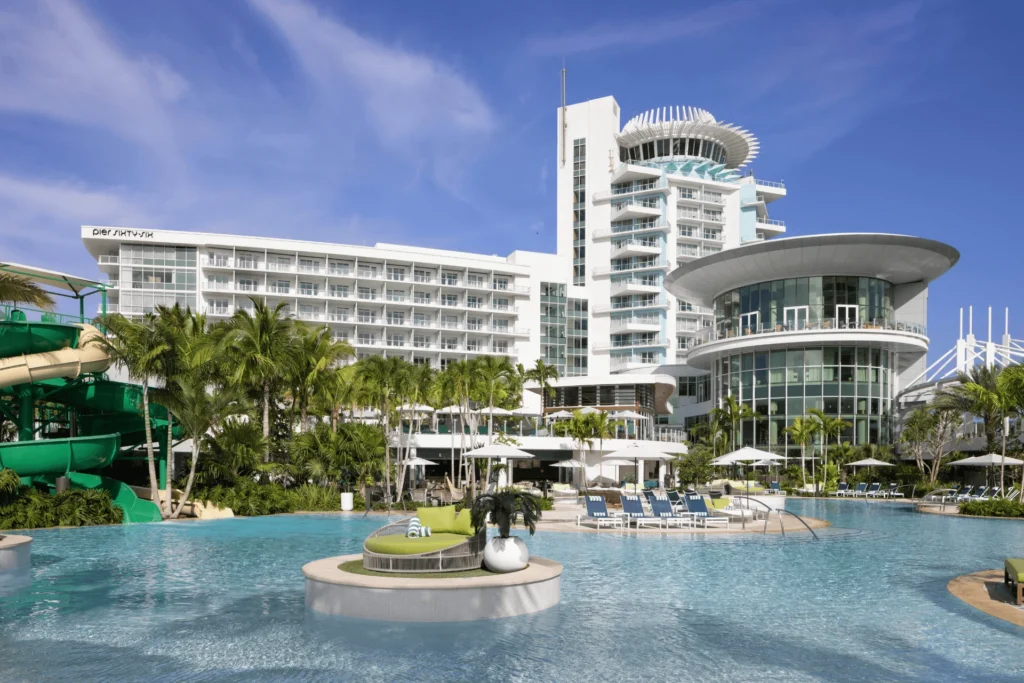
Fort Lauderdale’s waterfront development debate is heading toward another major test.
Tavistock Development Company has proposed four mixed-use towers reaching approximately 270 feet at Pier Sixty-Six, adding 339 condominium residences, retail, restaurants, office space, a boutique grocery store, and a public waterfront promenade. The plan would transform portions of the resort’s surrounding property, but it would also rise more than twice as high as the neighborhood’s existing 120-foot height limit.
That gap is at the center of an increasingly heated fight between the developer, nearby residents, and city officials.
The proposal arrives as South Florida’s luxury real estate pipeline continues to attract buyers, lenders, and global attention. Yet the region is also confronting a very different reality: domestic migration to Miami has slowed sharply as housing, insurance, and everyday costs push middle-income households elsewhere.
For Fort Lauderdale, the question is whether Pier Sixty-Six can expand into a larger luxury district without overwhelming the neighborhoods around it.
What Tavistock is proposing at Pier Sixty-Six
Phase 2 would place four towers on approximately eight acres connected to the Pier Sixty-Six property near Southeast 17th Street and the Intracoastal Waterway.
According to reporting from Haute Residence, the proposed residences would be distributed as follows:
| Proposed building | Location | Residences |
|---|---|---|
| Building A | North side of Southeast 17th Street | 101 |
| Building B | South side | 90 |
| Building C | South side | 75 |
| Building D | South side | 73 |
| Total | 339 |
Three towers would sit south of Southeast 17th Street, while the fourth would be located on the north side near the resort.
The broader development program includes approximately:
- 25,000 square feet of retail space
- 29,000 square feet of office space
- 17,000 square feet of restaurants
- A 14,000-square-foot boutique grocery store
- A new water basin
- Expanded marina-related infrastructure
- A public waterfront promenade stretching roughly 1.5 miles
Tavistock has positioned the proposal as an extension of its broader reimagining of Pier Sixty-Six. The company says the project would create a more connected waterfront district combining residences, hospitality, dining, shopping, offices, and public space.
The developer has also emphasized the towers’ glass-heavy design and the decision to convert approximately one acre of dry land into a water basin rather than use that area for additional towers.
That argument has not quieted residents who say the issue is not simply how many buildings are proposed, but how tall and how intensely concentrated they would be.

Why the height has become the defining issue
The current height cap in the surrounding area is 120 feet. Phase 1 of Pier Sixty-Six was developed at roughly that scale, with the residential buildings reaching about 11 stories.
The proposed Phase 2 towers would rise to approximately 270 feet, roughly 23 to 25 stories depending on the building. That would create a dramatic change in the skyline and establish a new precedent for the area’s waterfront development.
To proceed, Tavistock needs approval for a Planned Development District rezoning. The proposed zoning change would have to be approved by at least four of the city’s five commissioners.
The application remains in the city’s development review process, and additional community meetings are expected before the matter reaches the commission for a vote. Recent reporting indicates that a final decision is likely still several months away.
This is not Tavistock’s first attempt to push beyond the existing height framework. A 2021 proposal called for three towers as tall as 480 feet and would have required much broader changes to city height regulations. That plan was ultimately dropped after residents and city leaders objected.
The current proposal is smaller, but the central conflict remains familiar: Tavistock sees an opportunity to build a major luxury destination, while critics fear the project would permanently alter the scale and character of the surrounding neighborhoods.
What residents and city officials are saying
Opposition has focused on four primary concerns: height, traffic, infrastructure, and the impact on nearby single-family homes.
Residents of Harbour Inlet and surrounding communities have raised concerns that the three towers south of Southeast 17th Street could cast shadows over neighboring homes. They also argue that the additional residences, restaurants, offices, and retail uses could increase congestion along Southeast 17th Street and the 17th Street Causeway.
Other objections involve emergency access, public safety, storm resilience, and the area’s location within a designated Coastal High Hazard Area.
A petition opposing the rezoning reportedly had 545 signatures as of September 30. The resident coalition behind it is asking the city to maintain the existing 120-foot limit.
Mayor Dean Trantalis has not announced how he plans to vote, but he has publicly acknowledged the strength of the opposition. He described residents as “up in arms” and called the proposal a potential example of overdevelopment, while also crediting Tavistock with bringing new restaurants, public spaces, and a higher level of luxury to the existing resort.
Vice Mayor Ben Sorensen, whose district includes the neighborhood, has similarly pointed to concerns about density, traffic, and tower height.
The divide is particularly sharp because both sides agree that Pier Sixty-Six has become an important Fort Lauderdale destination. The disagreement is over what comes next, and how much additional intensity the surrounding area can absorb.

Phase 1 sets the backdrop
Tavistock’s first phase is already complete. It includes the renovated Pier Sixty-Six resort, 325 hotel rooms, four residential buildings with 88 residences, approximately 30,000 square feet of commercial space, and 8,000 square feet of office space.
The final residential building, Indigo, received its certificate of occupancy in 2025. Tavistock also reported the closing of an Indigo penthouse for $14.5 million.
That earlier success helps explain why the developer is seeking to move ahead with a much larger second phase. Pier Sixty-Six has established itself as one of Broward County’s most prominent luxury waterfront projects, offering a Fort Lauderdale alternative to Miami’s more expensive and intensely vertical condo market.
But Phase 2 would be a much more consequential intervention. The proposal would add nearly four times as many residences as Phase 1, while also introducing a larger commercial and public-realm component.
Tavistock has argued that the 2018 development agreement allows up to 575 units on the site and that the proposal should be understood within that existing density framework. Neighbors, however, say the permitted unit count does not resolve the practical impacts of placing four 270-foot buildings next to lower-scale residential areas.
South Florida’s luxury pipeline keeps expanding
The Pier Sixty-Six debate comes at a moment when high-end South Florida development continues to attract substantial capital.
In Miami, the Residences at Mandarin Oriental Miami reportedly booked approximately $1.7 billion in pre-construction sales before breaking ground, according to Insurance Journal, citing developer Swire Properties.
The project includes a 66-story residential tower with 228 residences, approximately 80% of which were reported sold, along with a second building that will include a hotel and additional residences. Two penthouses reportedly sold for approximately $50 million each.
The buyer profile is also notable. About 65% of buyers were described as domestic, with demand coming from high-income purchasers connected to finance and technology. Many buyers are paying in cash, and some are purchasing residences as second homes.
The broader financing market is active as well. The Real Deal reported that major South Florida projects secured approximately $436 million in recent financing.
The deals included a $238 million refinancing for the 631-unit Landmark South multifamily community in Doral, a $127 million loan for The Arcadian, a 502-unit Fort Lauderdale apartment project, and additional financing for projects in Hialeah, Delray Beach, and Coral Gables.
That activity sends an important signal: lenders remain willing to finance well-positioned South Florida projects, even in a tighter capital environment.

The counter-trend: Miami is becoming harder to afford
The luxury market’s strength does not mean the broader housing market is equally healthy.
A Realtor.com analysis found that domestic migration to Florida has fallen substantially from its pandemic-era peak. A June report from the University of Florida’s Shimberg Center for Housing Studies counted 201,191 people moving to Florida from other parts of the country, far below the 598,737 new residents recorded in 2022.
Miami-Dade County has become one of the clearest examples of the shift. The county reportedly led Florida in domestic outmigration, losing nearly 73,000 residents to other counties and states over the measured period.
The reasons are familiar to anyone shopping for a home in South Florida: higher sale prices, insurance premiums, condominium fees, property taxes, transportation costs, and everyday expenses. Realtor.com also reported that Miami’s cost of living reached 14.1% above the national average in 2024, making it one of the country’s most expensive major metros.
That has changed the region’s migration profile. Middle-income households looking to save money by moving from New York or Boston to Miami are finding that the financial advantage has largely disappeared. Some are shifting toward Central Florida or Florida’s Gulf Coast instead.
At the same time, affluent buyers continue to arrive, invest, and purchase luxury homes.
That is the tension shaping projects like Pier Sixty-Six Phase 2. The high-end market can support new towers, but the surrounding community still has to manage traffic, infrastructure, insurance exposure, public services, and housing costs.
What happens next
Tavistock’s proposal will continue through development review and additional community outreach before reaching the Fort Lauderdale City Commission.
The key questions are straightforward:
- Will four commissioners support the required rezoning?
- Will the city impose height, setback, traffic, or design conditions?
- Could Tavistock reduce the scale of the towers to address neighborhood concerns?
- Will the public waterfront and mixed-use benefits be enough to offset the perceived impacts?
For now, the Pier Sixty-Six expansion remains a proposal, not an approved project. But it has already become a defining test for Fort Lauderdale’s waterfront future.
The city must decide how it wants to compete in South Florida’s luxury development race while protecting the neighborhoods that make Fort Lauderdale distinct. The outcome could influence not only Pier Sixty-Six, but also how future developers approach height, density, and public benefits along the city’s increasingly valuable waterfront.
Stay connected with South Florida Digest for ongoing coverage of Fort Lauderdale development, Miami real estate, infrastructure, and the regional projects reshaping life across South Florida.