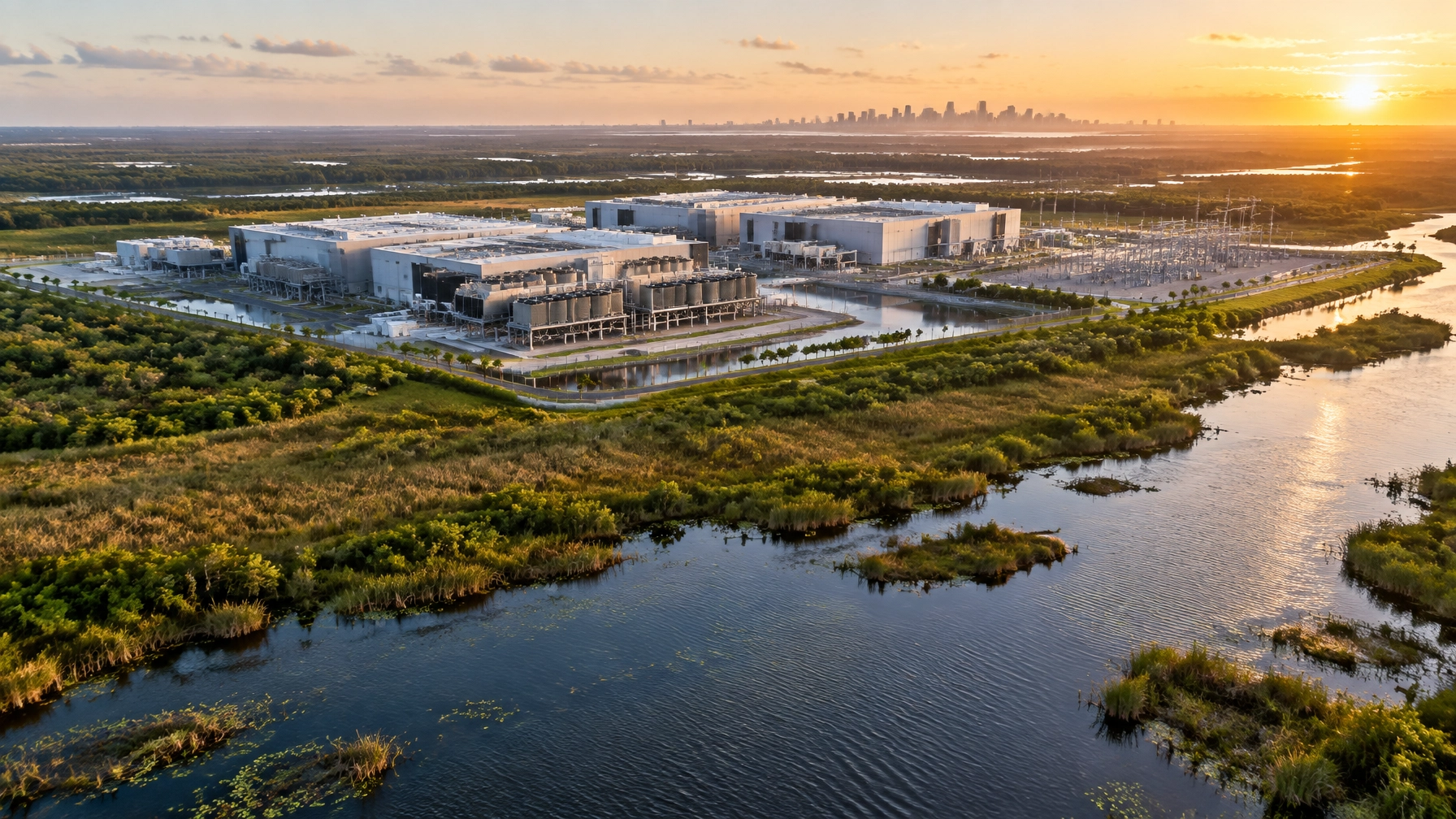
Florida’s race to expand its artificial-intelligence infrastructure is running into an old South Florida question: How much water can the region spare?
Proposed AI datacenters near the Everglades are drawing scrutiny from regulators, local officials and environmental advocates concerned about cooling demand, groundwater supplies and the long-term health of the region’s already engineered water system.
The debate comes as Florida moves forward with major investments in Everglades restoration, including the Everglades Agricultural Area A-2 Reservoir, new water-storage infrastructure and projects designed to move cleaner water south. It also arrives amid separate disputes over airport expansion and conservation funding in Miami-Dade County.
Together, the developments underscore the challenge facing South Florida: supporting economic growth and new technology while protecting an ecosystem that depends on carefully managed water flows.
Why AI datacenters are being examined more closely
Datacenters do not all use water in the same way. Some rely primarily on air cooling or closed-loop systems, while larger facilities can require substantial water for cooling during periods of high heat.
That distinction is central to Florida’s current regulatory debate. Hyperscale AI facilities may draw significantly more electricity and water than traditional commercial datacenters because they operate dense arrays of high-performance computing equipment around the clock.
Recent reporting has focused on large proposals such as Project Tango, as well as smaller AI-oriented facilities proposed in Miami-Dade County. The projects differ in size, design and expected water demand, but their location near the Everglades has made water use a central issue.
Under Florida’s newer rules for large datacenters, facilities reaching a specified electrical-demand threshold must face additional scrutiny before receiving water-use approvals. The process can include a public hearing before the relevant water management district, a water-conservation plan and an assessment of whether reclaimed water could be used instead of potable supplies.
The South Florida Water Management District has also indicated that it had not received water-use or environmental-resource permit applications for Project Tango at the time of earlier reporting. That means the public debate has advanced faster than the formal permitting process for at least some major proposals.
Supporters of datacenter development argue that new facilities can bring investment, construction jobs and high-paying technology employment. They also note that some smaller projects may represent a modest share of the region’s total drinking-water supply.
Critics counter that regional averages can obscure local impacts. A project might account for a small percentage of countywide consumption while still placing pressure on a particular aquifer, utility system or sensitive watershed.

The Everglades context: storage, treatment and timing
The concerns are unfolding against the backdrop of the Everglades’ complicated water-management system.
Historically, water moved slowly south from Lake Okeechobee through a broad “river of grass” toward Florida Bay. Over decades, canals, levees, agricultural development and urban growth redirected much of that flow. Today, restoration depends not only on having enough water, but also on delivering it at the right time, in the right place and at an acceptable quality.
The U.S. Army Corps of Engineers is now preparing a National Environmental Policy Act analysis for initial fill operations at the EAA A-2 Reservoir south of Lake Okeechobee. The planned reservoir covers approximately 10,500 acres and has a storage capacity of about 240,000 acre-feet.
The Corps says the reservoir is intended to capture, store and treat water before sending it south to the Water Conservation Areas, Everglades National Park and Florida Bay. It is also designed to reduce damaging high-volume discharges from Lake Okeechobee to the St. Lucie and Caloosahatchee estuaries.
The initial-fill scoping process is open for public comment through November 2, 2026. Comments may be submitted to the Corps at CESAJEAAReservoir@usace.army.mil. The project website and environmental documents are available through the U.S. Army Corps of Engineers’ Central Everglades Planning Project page.
The timing matters for the datacenter debate. Water used by industrial facilities, farms, cities and conservation projects is managed within the same broader regional system. Even when a datacenter is not directly drawing water from the Everglades, its demand can affect utility planning, groundwater withdrawals and competing conservation priorities.
Advocates say the “crown jewel” is still too small
Florida officials have promoted the EAA Reservoir as a centerpiece, or “crown jewel”, of Everglades restoration. Environmental groups, however, argue that the project is not large enough to restore the system at the scale originally envisioned.
A report highlighted by Inside Climate News and Friends of the Everglades contends that the reservoir’s reduced footprint limits its ability to store and treat the water needed for meaningful restoration.
Critics point to the project’s roughly 10,500-acre reservoir and an associated stormwater treatment area of approximately 6,500 acres. They argue that more storage and substantially more treatment wetlands would be needed to handle the volume of water moving through the system.
Supporters of the reservoir say it remains an important and overdue investment. Its planned capacity, pumping infrastructure and connection to other restoration projects could improve water management and reduce harmful estuary discharges. The disagreement is less about whether storage is useful than about whether the current design is sufficient.
That distinction is important when evaluating new industrial water users. If restoration advocates believe the region needs substantially more water storage, treatment and conveyance, they are also likely to question projects that could add demand before that infrastructure is fully operational.
Billions are going into new water infrastructure
Florida and federal agencies have approved significant funding for Everglades restoration, including new reservoirs, stormwater treatment areas, pump stations and flow paths.
The EAA Reservoir is part of a broader strategy that includes infrastructure to move water south after it is stored and treated. Projects such as the Blue Shanty Flow Way and related pump stations are intended to address the “plumbing” problem: water cannot benefit the Everglades unless the system can move it through the landscape.
The South Florida Water Management District’s EAA Reservoir information describes the project’s role in improving the quantity, quality, timing and distribution of water flowing south.
These investments provide a counterpoint to the datacenter controversy. Florida is spending heavily to repair and modernize its water system, but that does not mean the system has unlimited capacity. Restoration projects, drinking-water supplies, flood control, agriculture and new industrial users will continue to compete within the same hydrologic region.
AI is also being used to fight invasive pythons
The technology story extends beyond datacenters.
New AI-assisted research in Florida is helping wildlife managers identify when conditions are most favorable for finding invasive Burmese pythons. The work uses data on snake size, sex, temperature, humidity, weather and lunar cycles to improve the odds of locating animals with the greatest potential to affect the population.
Research summarized by Florida Today indicates that large, mature females are especially important targets because of their reproductive potential.
The most promising conditions vary by season. Cool, sunny winter days can bring adult snakes out to bask, while warm, humid nights during the wet season may increase movement. Darker lunar phases, including periods around the new moon and waning moon, can also improve detection compared with bright full-moon nights.
The findings do not suggest that AI will eliminate Burmese pythons. Rather, the models can help agencies use limited field resources more strategically in an ecosystem where eradication is not considered realistic.

Separate fights over runways and conservation budgets
The datacenter debate is part of a larger pattern of development pressure around the Everglades, but separate disputes should not be treated as the same regulatory case.
Miami-Dade officials are facing an environmental dispute over plans connected to runway expansion near Everglades-sensitive areas. Concerns raised in coverage of the dispute include potential impacts on wetlands, habitat, stormwater and the compatibility of additional aviation infrastructure with conservation goals.
South Florida has a long history of conflict over aviation development near protected ecosystems. The unfinished Everglades Jetport remains a powerful example of how infrastructure plans can collide with the region’s environmental limits.
At the same time, proposed cuts to Miami-Dade’s conservation budget have prompted criticism from environmental groups and advocates for the county’s land-protection programs. Conservation funding supports land acquisition, habitat management and the protection of areas that also help safeguard water resources.
Those budget debates are distinct from datacenter permits and runway approvals, but they reflect the same underlying question: whether public investment in conservation can keep pace with development and infrastructure demands.

What regulators and residents will be watching
The next phase of the datacenter debate is likely to focus on details rather than broad promises.
Residents and regulators will want to know:
- How much water would each facility use during normal and peak operations?
- Would the water come from a municipal system, groundwater or reclaimed supplies?
- What cooling technology would be installed?
- How would wastewater or concentrated cooling discharge be handled?
- Would the project affect nearby wetlands, aquifer recharge or flood-control infrastructure?
- What happens during droughts, extreme heat or periods of high regional demand?
For South Florida, the stakes extend beyond any single project. The Everglades is a connected system, and decisions made in Palm Beach, Miami-Dade or neighboring counties can affect water quality, flood protection, wildlife habitat and the region’s drinking-water future.
Florida’s technology ambitions and its restoration commitments are not necessarily incompatible. But they will require transparent water-use data, enforceable safeguards and public review before large projects move forward.
For continuing coverage of the region’s environment, business and infrastructure debates, follow South Florida Digest and learn more about our newsroom through our About page.
Sources and further reading
- Florida Times: Florida regulators scrutinize major AI datacenter projects near the Everglades
- U.S. Army Corps of Engineers: EAA A-2 Reservoir initial-fill public scoping
- Inside Climate News: Everglades restoration reservoir criticism
- Florida Today: AI-assisted research on Burmese python hunting conditions
- Florida Times: Everglades restoration funding for storage and flow infrastructure
- Florida Times: Miami-Dade runway expansion and environmental dispute