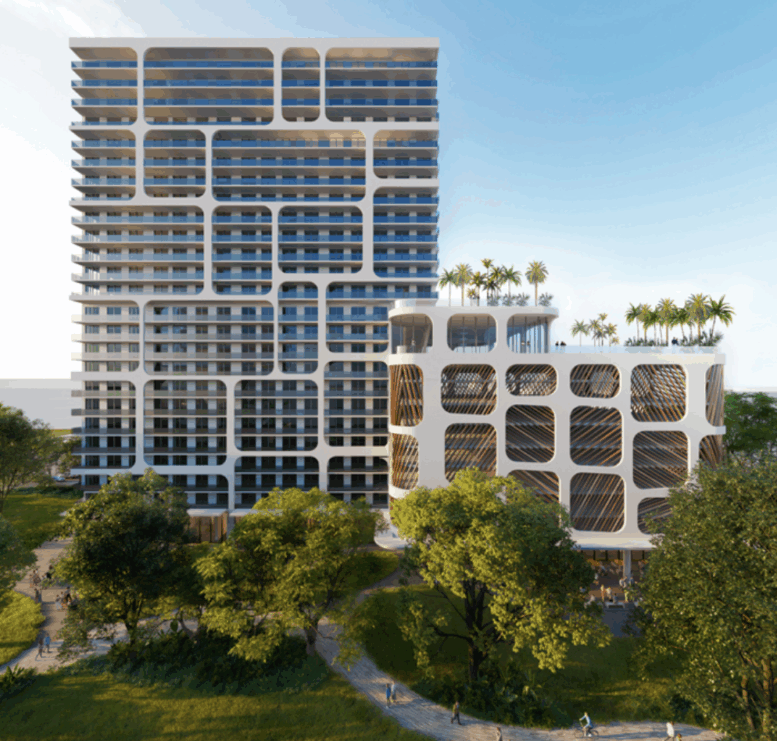
This rendering depicts Sixty Uptown, a separate Parcel 11 project, not the towers proposed in the new Parcels 13 and 15 applications. Image by Arquitectonica, via Florida YIMBY.
Plans filed October 19 call for two residential towers with a combined 553 apartments on Parcels 13 and 15 at the Magic City Innovation District in Little Haiti, according to the South Florida Business Journal.
The applications mark a concrete step for a large project that has faced years of delays: a residential proposal is now moving through the city’s planning process on two identified parcels. But a filing is not a building permit, construction start or guarantee of completion. The report does not specify the proposed towers’ heights, the split of units between the parcels or a construction schedule.
The filings also bring fresh attention to a question that has followed the project since its approval: how its promised community benefits will reach Little Haiti residents.
What the new applications propose
The proposal covers two residential towers totaling 553 apartments. The South Florida Business Journal reports that Plaza Equity filed the plans. Plaza Equity Partners is working with developer Bob Zangrillo’s Dragon Global on the broader district.
The new applications are part of a much larger master plan. The project spans roughly 17.75 acres and is planned to include residential, office, hotel and retail space. The approved plan allows for as many as roughly 2,600 to 2,630 residential units across the district.
The 553 apartments should not be confused with Sixty Uptown, a separate residential phase planned for Parcel 11. Sixty Uptown is designed as a 25-story, 349-unit rental tower at 6001 NE 2nd Avenue, with about 13,200 square feet of ground-floor retail. Florida YIMBY’s coverage identifies Arquitectonica as the architect.
That distinction matters as the development advances in phases. The Parcel 13 and 15 proposal adds hundreds of homes to the district’s potential housing count, but the filing alone does not establish when residents might move in or what rents the apartments will command.

An overview of the broader district, which is planned to combine residential and commercial uses. Image from Magic City, via Florida YIMBY.
The plans are also an early test of the district’s renewed momentum. In June 2026, Zangrillo and Plaza Equity revived the roughly $3 billion, 7.8 million-square-foot vision, pitching it as a hub for artificial-intelligence companies, asset managers and venture capital. That announcement renewed interest in the district’s business ambitions. The latest filings are a more specific measure of progress: applications for residential buildings are now before the city.
The district’s proposed mix of uses is intended to combine homes with workplaces and retail. Plaza Equity describes Magic City as a master-planned community with residential, office, hotel, art, parks and other public spaces. Those are elements of the broader development vision, however; the parcel applications are a particular residential proposal, and the materials available so far do not establish when or how the rest of the district would be built.
The community-benefit agreement remains in focus
The City of Miami approved the Magic City Innovation District in 2019 after contentious public hearings. A central issue was how the development would benefit Little Haiti, a neighborhood where residents and community groups raised concerns about displacement, affordability and cultural change.
Under the development agreement, affordable-housing obligations were shifted to a contribution of about $31 million to the city’s Little Haiti Revitalization Trust. The package is structured as roughly $6 million upfront, with about $25 million more tied to construction benchmarks over as long as 30 years. The future payments are not inflation-adjusted.
The structure has drawn skepticism. Critics argued during the 2019 approval debate that replacing affordable and workforce housing commitments with a cash contribution could leave the neighborhood without the same direct, on-site housing benefits. As WLRN reported at the time, opponents questioned whether promised benefits such as jobs and training would be guaranteed, and whether the package would do enough to address housing affordability and displacement.
The timing and conditions attached to the money are also important. The full $31 million is not an immediate payment: much of it is scheduled over decades and linked to construction progress. Because those later contributions are not adjusted for inflation, their purchasing power could be lower when delivered than the same nominal amount would have today.

The 2019 approval process drew sustained public debate. This WLRN photo documents that earlier hearing, not a response to the new filings. Photo: Aaron Sánchez-Guerra/WLRN.
The trust is a city entity, and its official page provides information on its role and work. The city also lists a Little Haiti Home Buyer Assistance Program. Those resources are relevant context, but they do not resolve the central questions critics have raised about the development agreement: how much of the remaining contribution will ultimately be paid, when it will arrive and how effectively it will address the neighborhood’s needs.
What to watch as the plans move forward
The next milestones are the city’s review of the applications and any subsequent approvals or revisions. Further public information will be needed to establish the buildings’ dimensions, design, unit mix, parking and timeline. Until those details are available, the 553-apartment figure is the clearest measure of what the new proposal adds.
Residents and businesses will also be watching how the district’s phases connect to surrounding streets and services, and whether the promised community benefits are visible alongside construction. The project’s overall scale, thousands of potential homes and millions of square feet of mixed-use development, makes those questions consequential beyond the two parcels.
For South Florida, from Little Haiti to the Everglades, development debates turn on what gets built, who benefits and whether commitments can be measured. In this case, the new applications establish a next step in the planning process. Their real impact will depend on what the city approves, what the developer builds and how the agreement’s neighborhood benefits are delivered.
Residents can follow South Florida Digest’s business coverage and real estate reporting for further updates.