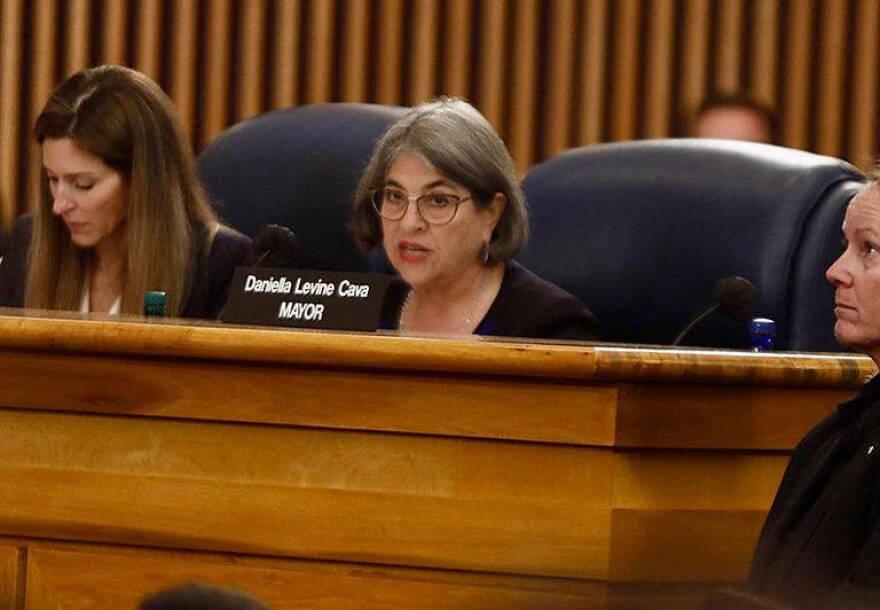
Miami-Dade Mayor Daniella Levine Cava at a county budget hearing in September 2024. Photo: Alexia Fodere for The Miami Herald, via WLRN.
Two of Miami-Dade’s most prominent elected officials made sharply different cases for Amendment 3 on Friday’s edition of WLRN’s South Florida Roundup. Mayor Daniella Levine Cava warned that the proposed property-tax cut could leave local governments short of money for core services. County Commissioner Roberto J. Gonzalez, who represents District 11, argued that reducing revenue is necessary to rein in government growth and return money to homeowners.
Their disagreement comes down to more than the amount of tax relief. It is also about what local governments would do with less revenue, and whether they can maintain services without it. Here are the figures and arguments each side brought to the debate, as reported by WLRN.
The clash on WLRN’s Friday show
Levine Cava opposed the measure, saying local property taxes pay for everyday public services. “Property taxes fund the essential local government services we depend on, from garbage pickup to paramedic response,” the mayor told WLRN.
She also said supporters had not identified a plan to replace the revenue local governments could lose. “A lot of people who support Amendment 3 are under the impression that there’s a plan. There is no plan,” Levine Cava said on the program.
Her concern is that counties could be left to choose between cutting services and finding other revenue. “We don’t have a source that has been identified by the [Florida] Legislature, by the governor, or by the amendment itself,” she told WLRN. “So every local government is going to be on their own scrambling to figure out: do we cut here, do we raise there?”
Gonzalez backed the amendment as a check on government spending. “For many years, government has just continued to grow and grow and grow,” he said on WLRN. “And unfortunately, what we haven’t seen is services or government function better.”
He argued that limiting local revenue could put pressure on governments to spend more efficiently. “The best way to create affordability is by putting money back into people’s pockets,” Gonzalez said. “The only way you’re going to force local governments to do that is by taking the extra money away.”
WLRN’s report did not cite a competing dollar estimate from Gonzalez. His case focused instead on Miami-Dade’s budget and his view that years of government growth have not delivered better services.

Illustrative image: Miami-Dade County government setting.
The numbers behind the argument
Amendment 3 would raise Florida’s homestead exemption from $50,000 to $250,000 of taxable value by 2028. Under the schedule described in WLRN’s companion Amendment 3 polling report, the exemption for non-school property taxes would rise to $150,000 in 2027 and $250,000 in 2028, then be indexed to inflation starting in 2029. The proposal requires at least 60% voter approval to pass.
The potential revenue reduction is a central part of Levine Cava’s warning. If the amendment passes, nearly $12 billion in property-tax revenue could be lost statewide. For Miami-Dade, the mayor estimates a loss of $378 million in the first year and nearly $700 million in the second.
Levine Cava said that could affect services residents see across the county: transit corridors, bus hours, parks, fire stations and libraries. She also predicted that local governments could shift some of the tax burden to commercial properties that do not qualify for the homestead exemption. If landlords and businesses face higher millage rates, she warned, some could pass those costs on to renters.
“There is no free lunch here,” Levine Cava told WLRN. “There will be a cost shift and not really a tax cut.”
The amount of relief for an individual homeowner would depend on their taxable home value and the applicable tax rates. The exemption change applies to homestead property and, under the WLRN companion report, excludes school taxes.
Public safety becomes a fault line
The debate has also divided law-enforcement leaders. The Florida Sheriffs Association opposes Amendment 3, arguing that reduced local revenue could compromise public safety and emergency response. At a recent roundtable with Gov. Ron DeSantis, Miami-Dade Sheriff Rosie Cordero-Stutz argued that “tax relief and public safety are not competing priorities,” according to WLRN.
Levine Cava pointed to the sheriff’s recent request for a 12% increase in her county budget, which WLRN reported on Sept. 18. The mayor said the request did not square with claims that public safety agencies could manage with less.
“She is saying on one hand that we need to give her more money, and on the other, that she can do with less, that she’s already made cuts,” Levine Cava told WLRN. “The math is not adding up.”
Gonzalez rejected the warnings as fearmongering. He said the Legislature had identified public safety as a priority in drafting the amendment. “At the top of that list is going to be public safety,” he told WLRN. “I have advocated for the sheriff to receive more money.”

Illustrative image: Miami-Dade transit and the local services at the center of the debate.
Two new headwinds for Amendment 3
A recent University of North Florida poll suggests the amendment has not yet reached the 60% support required for passage. WLRN reported that finding without specifying a poll result.
A separate survey offers a different snapshot of public opinion, but it covers a distinct group rather than the statewide electorate. In a poll of 760 likely Hispanic voters in Florida, conducted Oct. 14–18 for HispanicsVote.org, 72% said they wanted lower property taxes; about 85% of respondents said they were homeowners. The organization’s founder described support for Amendment 3 among the surveyed voters as “overwhelming,” according to WLRN. That finding does not establish whether the amendment has the 60% statewide support it needs.
Another setback came from Senate President Ben Albritton, who helped place Amendment 3 on the ballot but now opposes it, citing concerns about smaller towns and counties. In a statement reported by WLRN and posted on the Florida Sheriffs Association’s social media page, Albritton said, “As a native of Florida’s heartland, our rural communities are near and dear to my heart. It’s who I am.”
He warned that “Amendment 3 would eliminate up to 30% of resources for Florida’s rural counties, gutting essential services for law enforcement, emergency response services, and critical infrastructure.” Albritton said the Florida Taxation and Budget Reform Commission is scheduled to meet in 2027 and suggested it would be a better venue to examine a proposal of this scale.
What happens next
Florida voters decide on Amendment 3 on Nov. 3. The proposal needs 60% approval to pass. The choice on the ballot is whether to increase the homestead exemption; the arguments from Levine Cava and Gonzalez focus on what that change could mean for homeowners, county budgets and the local services communities rely on.