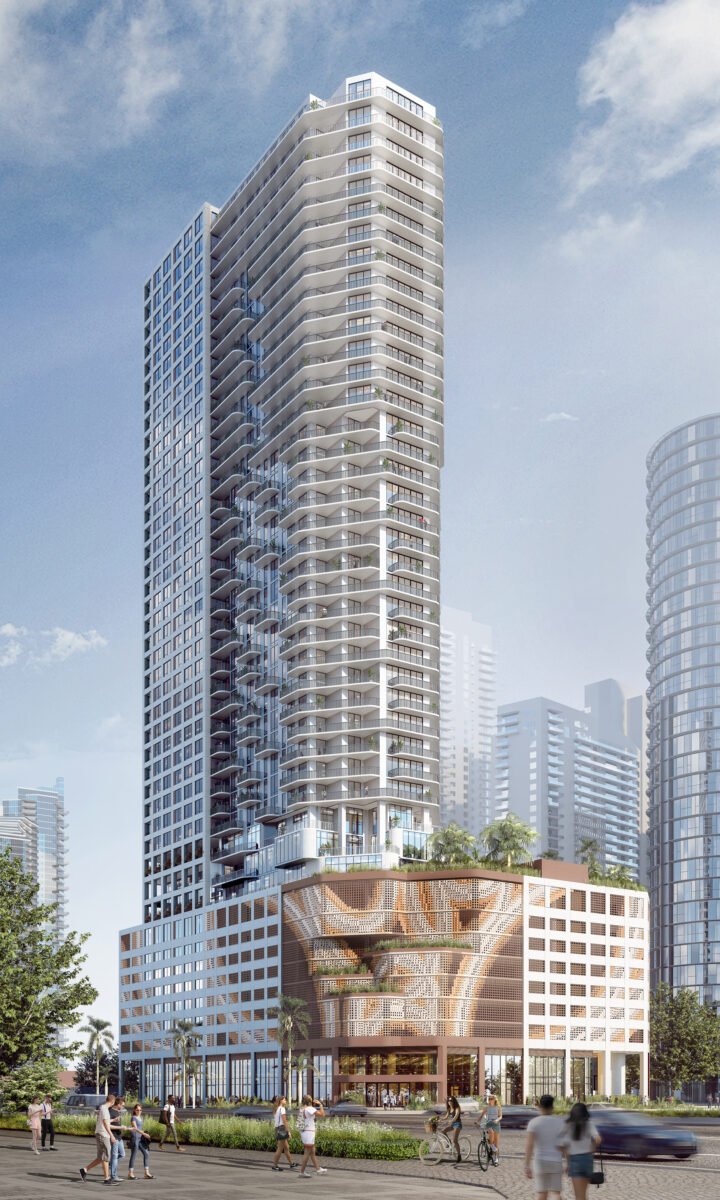
LCOR’s rendering of its planned 1775 Biscayne Boulevard tower. Image courtesy of LCOR.
Edgewater’s development headlines arrived in quick succession this fall: a long-running condominium dispute ended with a reported $50 million settlement, and Miami-Dade County issued a $150 million building permit for a 544-unit rental tower at 1775 Biscayne Boulevard.
The two events point to new momentum in the neighborhood, but they involve separate properties and separate developers. The settlement did not clear a legal obstacle for LCOR’s tower. Instead, it resolved a dispute at nearby Biscayne 21 while LCOR’s own project reached a major construction milestone.
The permit was issued Oct. 19, according to county records reported by The American Developer. The Real Deal’s South Florida permits report identified the filing as one of the year’s largest recent Miami permits.

Illustrative neighborhood image; not a photograph of the 1775 Biscayne Boulevard site or a depiction of the approved project.
What the $150 million permit covers
The permit is for a new multifamily building with 544 units at the site associated with 1775 Biscayne Boulevard. The county filing identifies the construction address as 1700 NE Fourth Avenue and the permit holder as 1775 Biscayne L Cal LLC, a project entity tied to LCOR. Coastal Construction is listed as the general contractor, according to The American Developer’s report.
The permit value is an estimated construction valuation, not a statement that LCOR has already spent $150 million or that it is the project’s full development budget. The American Developer’s account of the county record lists about 840,000 square feet of building area and a $152,453 permit fee. The underlying property can be searched through the Miami-Dade County property search.
There is a discrepancy in published accounts of the tower’s height. The county permit details reported by The American Developer list 39 floors. LCOR’s project materials describe a 42-story building, as does Commercial Observer’s coverage of the project’s construction loan. The difference is worth noting; the consistent details across those accounts are the location and the 544 planned rental homes.
LCOR’s project page describes a mix of studios through three-bedroom apartments, along with amenities including a rooftop pool, fitness center and resident lounges. The company lists ODP Architecture as the architect and Asprea Studio for interiors. Commercial Observer reported that the development is expected to be completed in the fourth quarter of 2028; project filings cited in coverage place substantial completion in that same quarter.
Financing preceded the permit
The permit follows a substantial financing step. In July, LCOR secured a $192.5 million construction loan from Natixis for the tower, according to Commercial Observer and The Real Deal. Commercial Observer reported that LCOR bought the roughly one-acre site for $49 million in 2022.
The loan and permit mark different stages of the project: financing supports construction, while the Oct. 19 permit authorizes work covered by the county filing. Together, they show the tower advancing from land acquisition and financing toward building activity. Coastal Construction’s listing as general contractor also identifies the firm responsible for the construction work covered by the permit.

Illustrative view of the Miami waterfront; not a documentary image of the project site.
A separate lawsuit ends nearby
The other major Edgewater headline concerns Biscayne 21, a condominium at 2121 North Bayshore Drive. After a three-year legal fight with ten holdout owners, Two Roads Development agreed to pay them a reported $50 million, bringing the dispute to a close, according to Bisnow and The American Developer.
The conflict began in 2023, when owners challenged the developer’s effort to terminate the condominium and redevelop the property. Court rulings favored the holdouts, and a Miami-Dade judge later ordered restoration work at the building, Bisnow reported. The settlement enabled Two Roads to move forward with plans to replace the 61-year-old building with the EDITION-branded Miami Edgewater project. The planned development has been reported as a 649-foot tower.
The distinction matters. The Biscayne 21 litigation did not involve LCOR or its 1775 Biscayne project. The settlement was a separate legal resolution at another Edgewater property. Its timing alongside LCOR’s permit helps explain why the corridor has drawn renewed attention, but it should not be read as the cause of LCOR’s construction approval.
What the two milestones mean for Edgewater
The permit puts a 544-unit rental tower into the next phase of development. The settlement, meanwhile, removes the legal impasse at Biscayne 21 and allows Two Roads to pursue its own redevelopment plans. Those projects have different timelines, programs and ownership, but both contribute to a changing stretch of Miami’s bayfront.
For residents and businesses, the projects’ next milestones will be more concrete than the headline figures: construction progress at 1775 Biscayne, and the steps toward redevelopment at Biscayne 21. LCOR’s stated target for substantial completion is late 2028. Neither the permit nor the settlement, by itself, establishes when the surrounding corridor will see both projects finished.
Edgewater’s latest news is therefore a story of parallel movement, not one lawsuit unlocking every project. A major rental-tower permit has been issued, and a separate, costly condo dispute has ended. For more South Florida development coverage, visit the South Florida Digest real estate section.