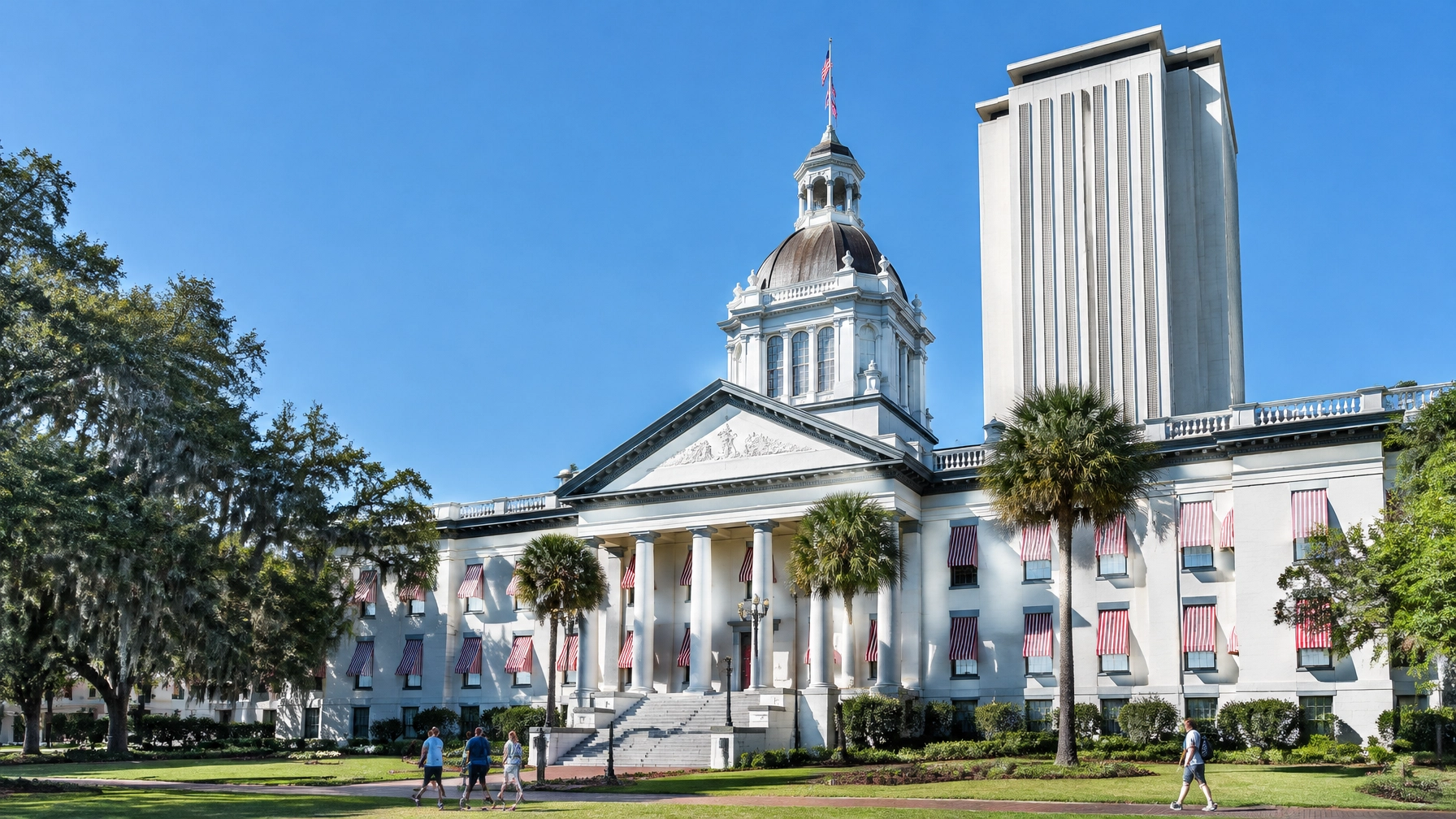
Gov. Ron DeSantis wants Florida lawmakers back in Tallahassee before he leaves office in January to address the rollout of Amendment 3. Incoming legislative leaders, however, have not committed to a special session, and some have indicated that the work could wait for the regular session scheduled to begin in March 2027.
The disagreement is about how to implement a tax cut voters have already approved. Amendment 3 passed with 62% of the vote, or 4,917,482 votes in favor to 3,015,840 against, according to Florida election results. Its first exemption increase is set to take effect Jan. 1, 2027.
DeSantis announced his special-session push on Nov. 4. As the Florida Phoenix reported, he said the session should establish protections for taxpayers and help local governments manage the loss of property-tax revenue. No dates have been set, and the incoming House and Senate leaders have yet to agree to convene lawmakers before January.
What Amendment 3 changes
The amendment expands Florida’s homestead exemption for non-school property taxes. The exemption rises to $150,000 in 2027 and $250,000 in 2028. The amounts are set out in the amendment, which takes effect Jan. 1, 2027. School taxes are not included in the increase.
The changes apply to qualifying homesteads, rather than every property. A home’s assessed value, local tax rates and the share of its property-tax bill owed to different taxing authorities all affect the amount a homeowner may save. The amendment also includes other provisions, including a lower assessment-increase cap for certain non-homestead properties.
That means the basic exemption increase is already in the constitution. The Legislature’s role is to resolve implementation questions and consider rules and safeguards around the change. The amendment also directs lawmakers to create a uniform process for counties and municipalities to increase homestead exemptions beyond the set amounts, up to a home’s full assessed value.

DeSantis’s proposed safeguards and local aid
DeSantis has described his plan as a “taxpayer bill of rights.” He wants lawmakers to prevent local governments from offsetting lost property-tax revenue by adding new fees or taxes, a concern he framed as stopping local officials from making an “end-run” around the amendment, according to the Florida Phoenix.
He has also called for state grant funding to help local governments maintain essential services during the transition. The grant proposal is significant because cities and counties rely on property taxes to fund services and infrastructure, and the reduction in taxable value could put pressure on local budgets.
The full financial effect will not be immediate, but the potential scale is large. State economists estimated Amendment 3 could remove roughly $12 billion in recurring revenue from local government budgets statewide each year at full implementation, a figure the Florida Phoenix reported when the estimate was released. That is a long-term projection, not a measure of revenue already lost or the amount each local government will lose.
For local officials, the challenge is to plan for a lower property-tax base while continuing to fund legally required and essential services. In South Florida, decisions about budgets can touch everyday priorities such as public safety, roads, stormwater drainage and natural-resource programs, including work connected to the Everglades.

Legislative leaders want time to assess the details
Senate President-designate Jim Boyd and House Speaker-designate Sam Garrison have not publicly endorsed DeSantis’s request. In comments recorded before the election, Boyd said some of Amendment 3 appeared to be self-executing, while acknowledging that lawmakers might need to add implementation language. He said he personally believed the issue could wait until the Legislature reconvened so the incoming administration could have a say.
Garrison said the measure would dominate the upcoming session and warned against treating it as a change that could be implemented in a few days. He characterized the issue as complicated and said he would rather get the details right than move quickly. Their remarks were reported by the Florida Phoenix.
Incoming Democratic House leader Christine Hunschofsky has also been non-committal, saying she hopes Republicans will not call a special session. She argued lawmakers should review the law methodically and consider updated information during the regular session beginning in March, the Florida Phoenix reported.
The leaders’ hesitation sets up a choice about timing. A special session could give lawmakers an earlier opportunity to write rules before the exemption takes effect. Waiting for the regular session would allow more time to examine possible effects on counties and municipalities, but would leave less time to settle implementation details before the Jan. 1 start date.
What South Florida homeowners may save
For Miami-Dade homeowners, the change could mean a meaningful reduction in annual property-tax bills, though the amount will differ from one household to another. Axios Miami estimated that the average Miami-Dade homeowner could save roughly $1,700 in 2027. Its estimate is based on local tax rates and home values; actual savings depend on assessed value, millage rates and the taxes applied to a particular property.
Because school taxes are unchanged, the exemption does not reduce every part of a homeowner’s bill. Nor should the estimate be treated as a guaranteed amount for an individual property. Homeowners should review their assessment and tax bill, and check with their county property appraiser for information specific to their homestead.
For local governments, the same tax reduction that benefits homeowners means less property-tax revenue to budget against. A state grant program could help ease the transition, as DeSantis has proposed, but details such as eligibility, funding levels and distribution rules would have to be worked out. The question of whether local governments can use other taxes or fees to replace revenue is also likely to be a point of debate.
What to watch next
The first question is whether Boyd and Garrison will set a special-session date before DeSantis leaves office in January. No date has been announced. Their response will determine whether lawmakers begin work on implementation rules before the regular session or take up the issue in March.
The next is what any legislation actually contains: how the state would structure grants, what limits or safeguards would apply to local fees and taxes, and how the Legislature would establish procedures for any further expansion of exemptions. Local officials will be watching those decisions closely as they prepare budgets and weigh priorities, from public safety and infrastructure to services that support South Florida’s communities and the Everglades.
For homeowners, the core change is clear: the non-school homestead exemption increases to $150,000 in 2027 and $250,000 in 2028 under the amendment. The unresolved question is how lawmakers will manage the transition and address the fiscal pressures that come with it.