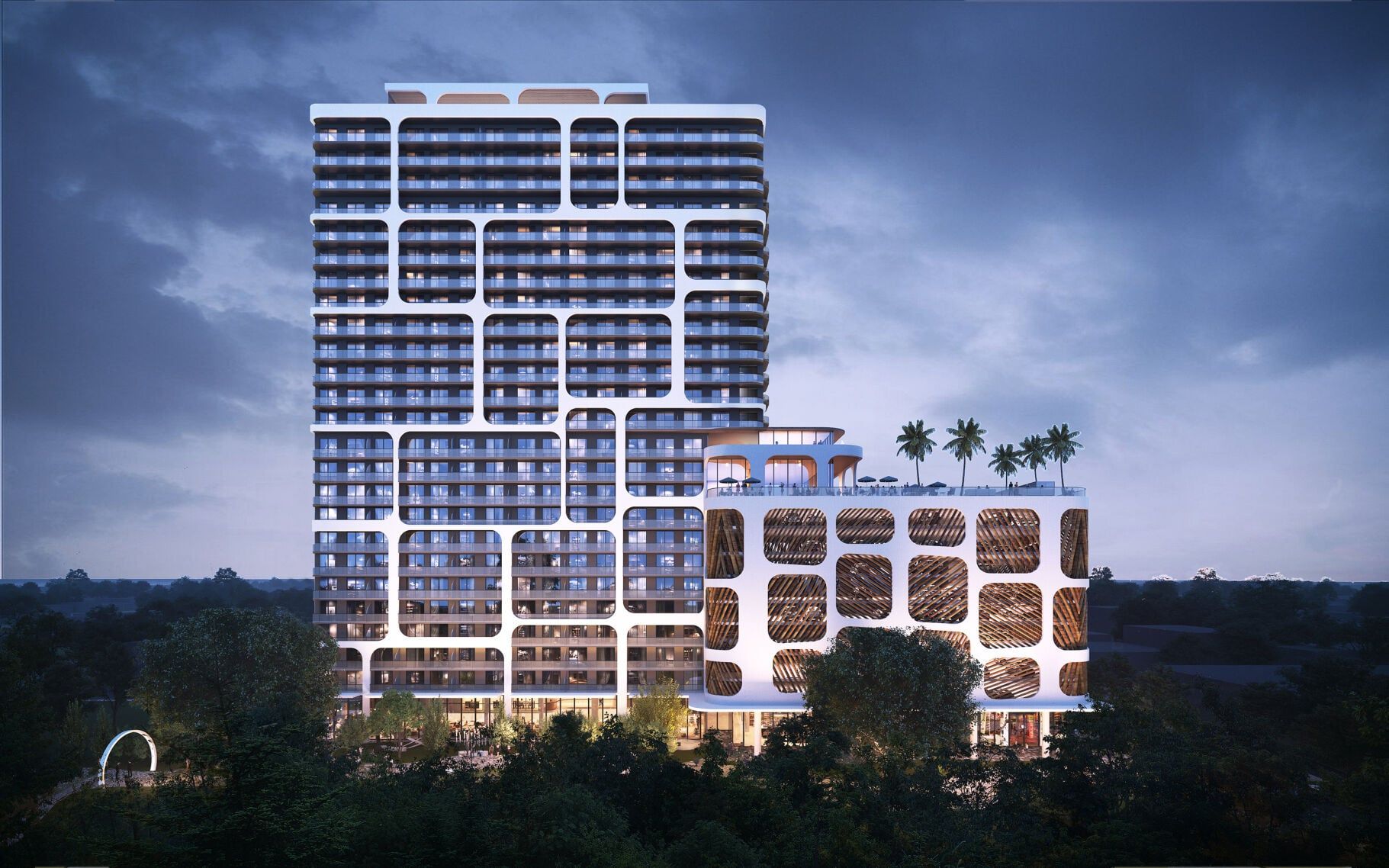
Rendering of Sixty Uptown. Image: Arquitectonica, Magic City Innovation District, via The Miami Times.
November 6, 2026
Magic City Innovation District is pitching a future built around artificial intelligence. In Little Haiti, the first question residents may have is more immediate: as new buildings rise, who will be able to afford to stay?
The district’s first residential tower, Sixty Uptown, is planned as a 25-story building with 349 market-rate apartments and ground-floor retail. It will have no affordable or workforce units. Instead, the developers’ response to neighborhood concerns about affordability is a $31 million commitment to the Little Haiti Revitalization Trust, which has opened its fourth-quarter funding window to eligible residents, businesses and organizations.
That distinction matters. Sixty Uptown’s apartments are not affordable housing. The Trust’s money is intended to support programs elsewhere in the community, and residents must apply and meet eligibility rules to access it.
AI branding, with a neighborhood development attached
Magic City’s website describes the project as a 7.8-million-square-foot mixed-use district on roughly 18 acres. Its stated technology vision is to attract AI companies and founders, alongside investors and large corporations, to develop and scale AI-native businesses. The district also plans residential, office, retail, hospitality and public-space uses, according to its website.
That is a development vision, not proof that the neighborhood already functions as an AI hub. The district’s branding connects a future technology ecosystem to the built environment now moving toward construction. Its first residential phase is Sixty Uptown, at 6001 NE Second Avenue, while a separate 553-apartment project is also advancing through permitting, according to The Miami Times’ November 3 report.

An artist’s rendering of the planned Promenade du Grand Bois. Image: Arquitectonica, Magic City Innovation District, via The Miami Times.
The district says its Special Area Plan allows about 7.8 million square feet of development, including residential, commercial, retail and hotel uses. Its official materials present AI as one part of a broader plan for an urban district. They do not establish that a new AI-specific community grant or funding round is available.
Sixty Uptown: 349 market-rate apartments
Plaza Equity Partners and Dragon Global are developing Sixty Uptown, according to The Miami Times and project coverage by Florida YIMBY. The tower is planned to include studios through three-bedroom apartments and 13,200 square feet of retail. The Miami Times reported that groundbreaking is expected in the second quarter of 2027.
The building’s apartments are market-rate. The Miami Times describes the wider Magic City residential pipeline as upscale housing, with nearly 900 apartments moving forward across Sixty Uptown and the two-tower project at NE 60th Street. No affordable or workforce units are identified for Sixty Uptown in the reported plans.
The developers’ $31 million commitment to the Trust dates to the project’s approval process. The Miami Times reported that $6 million was to be paid upfront, with the remainder delivered as building permits are issued. That commitment is not the same as placing income-restricted apartments inside the tower.
What the $31 million commitment means for residents
The Trust has launched littlehaititrust.com to provide program details, eligibility requirements and application steps. The Trust’s current materials describe eight program areas, including small-business support, housing assistance, scholarships, community education and placemaking, emerging-developer education and community investment.
The Miami Times reported that the Trust has a $6 million budget across its programs. That figure should not be mistaken for a published Q4-only grant pool: the Trust’s funding announcement says fourth-quarter funding is open, but does not specify a separate total for this cycle.

The Trust’s website provides program information and application guidance. Image: littlehaititrust.com, via The Miami Times.
Among the currently listed opportunities:
- Small-business grants: Up to $20,000 for commercial improvements, or up to $10,000 for equipment, operations, technology, marketing or website development. The Trust’s grant program page says applicants must be eligible brick-and-mortar businesses or nonprofits within Little Haiti boundaries and meet program requirements.
- Home rehabilitation: Up to $100,000 through a 10-year forgivable loan for eligible repairs, according to the Trust’s Q4 announcement.
- Homebuyer assistance: Up to $200,000 through a forgivable second mortgage for qualifying purchases within Little Haiti, the announcement says.
- College and trade-school scholarships: $2,500 for eligible residents pursuing college, trade certification or career-focused education.
- Community education and placemaking: Up to $5,000 for eligible organizations providing free, multi-session programs focused on culture, education and community engagement.
These are separate programs with distinct eligibility rules and application requirements. A grant application is not a guaranteed award. For the small-business program, the Trust says businesses must be located within Little Haiti boundaries and meet additional requirements, including City of Miami registration and compliance with applicable regulations.
How to apply during the Q4 window
Residents, small-business owners and community organizations can start at littlehaititrust.com, where the Trust posts program information and application steps. The Trust’s grant-program page links to the small-business application and program manual, as well as the placemaking application and guidance. Applicants should check the program-specific documents before submitting, since the requirements vary.
The Trust’s Q4 announcement lists 305-960-2964 and LHRT@miamigov.com for assistance. The Miami Times also reported that the Trust offers technical help to applicants. The funding window is open as of November 6, but applicants should check the Trust’s website or contact its office for current deadlines and any changes to program availability.

Small-business grant recipient Marie Melissa Shabani. Image: Little Haiti Revitalization Trust, via The Miami Times.
The measure will be who benefits
The development is moving into a neighborhood already facing rising costs. Francois Alexandre, president of Concerned Leaders of Little Haiti/Ti Ayiti, told The Miami Times that a one-bedroom apartment that rented for about $750 roughly a decade ago now rents for about $1,700 to $1,800. He also cited storefront rents rising from about $500 to roughly $2,800. Those figures reflect his account of neighborhood change, not a rent survey, but they underline the concern residents have raised as investment accelerates.
The AI label may help Magic City attract technology companies, founders and capital. The immediate community question is how that growth affects the people and businesses already in Little Haiti. Sixty Uptown will bring market-rate homes and retail, not affordable apartments. The Trust offers a different route for community benefit: grants and assistance that residents and organizations can seek through an application process.
As construction plans advance, the distinction between a long-term developer commitment, a Trust program budget and money awarded to a particular applicant will remain essential. For people in Little Haiti, the open Q4 window provides a concrete step to check now. The broader test is whether the promised investment reaches local households and businesses as the district takes shape.