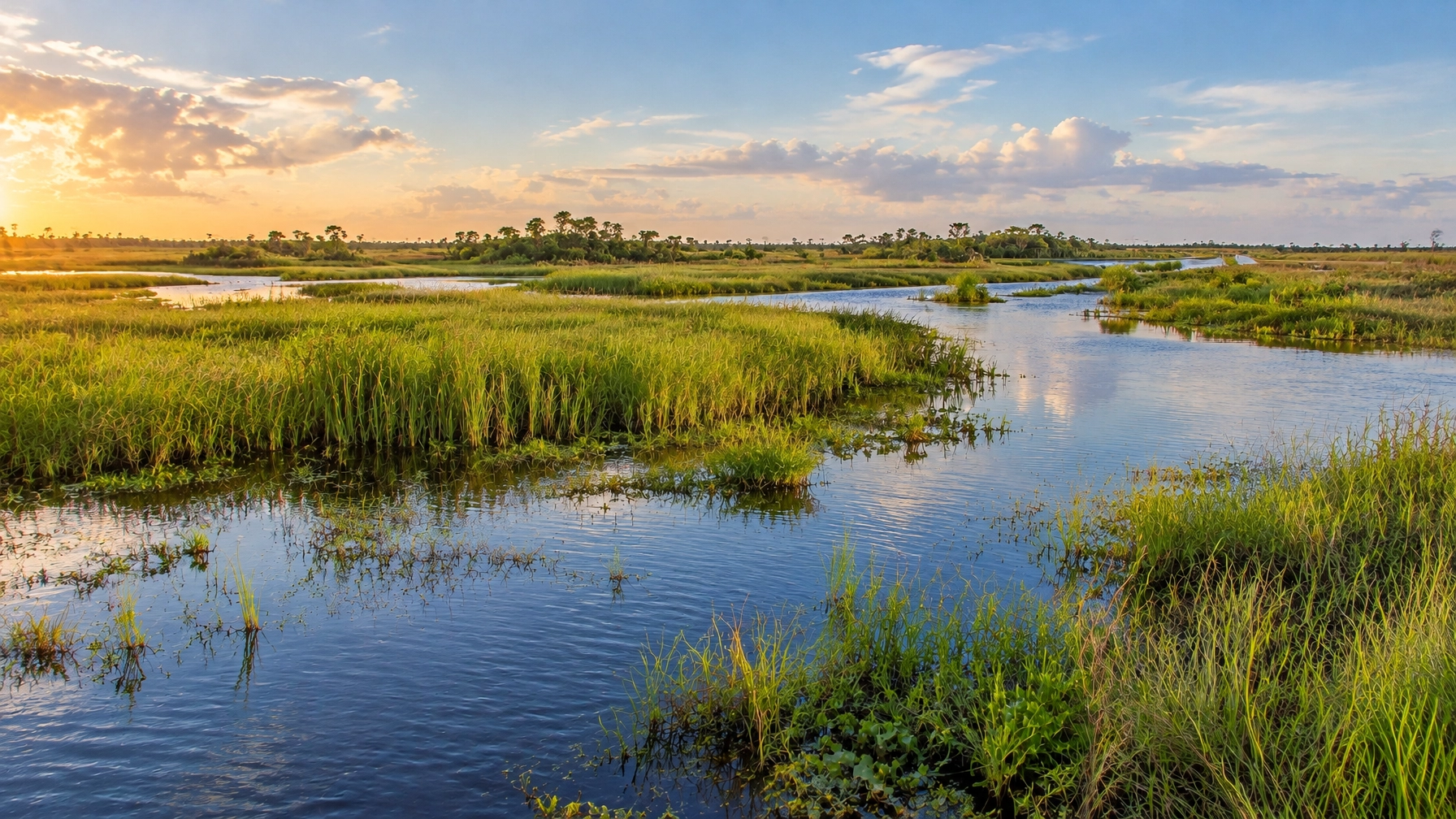
Illustrative image; not a specific parcel or project site.
Important correction: Florida’s Amendment 3 was not an Everglades land-acquisition amendment. It is a property-tax measure that could indirectly affect Everglades work by reducing revenue for the South Florida Water Management District (SFWMD). The $415 million figure is an estimate of potential lost tax revenue over five years, not money set aside for land purchases.
Florida voters approved Amendment 3 on Nov. 3, with about 62% voting yes, according to WUSF’s election follow-up and the Florida Division of Elections results. The measure passed the 60% threshold required for a constitutional amendment.
The next question is not how the amendment will pay for buying Everglades land. It does not establish a land-acquisition fund. The question now is how lawmakers will implement the tax change, and whether they will provide replacement money for local services, including the water-management work that supports the Everglades.
No special-session dates announced
Gov. Ron DeSantis said after the election that he expects lawmakers to meet in a special session before he leaves office in January. But as of Sunday, Nov. 8, no convening dates or detailed agenda had been publicly established in the reporting reviewed.
DeSantis told WUSF that he would work with lawmakers and would “probably let them pick the dates.” The amendment takes effect Jan. 1, adding a short runway for lawmakers to decide how it will be administered. DeSantis has floated state grants to help local governments meet core needs, but the proposal remains a possibility, not an approved funding plan.
That calendar matters for the Everglades because a general promise of grants is different from a written appropriation, a defined funding source and a formula that includes SFWMD. No SFWMD-specific backstop has been confirmed.
What the $415 million figure does, and doesn’t, mean
Amendment 3 expands the homestead exemption for certain non-school property taxes, from $50,000 to $150,000 in 2027 and $250,000 in 2028. It also reduces the annual cap on assessment increases for some non-homestead properties from 10% to 5%, according to WUSF.
The state analysis cited in the Digest’s Nov. 6 report estimates that SFWMD could lose more than $415 million in property-tax revenue over five years. That is a projected cumulative revenue loss; it is not an immediate cut of $415 million, a confirmed list of project cancellations or a land-acquisition budget.
SFWMD’s property-tax revenue supports a range of responsibilities: flood control, water supply, restoration, land management and operations. The district’s FY 2026–27 tentative budget, submitted in August, before Election Day, totals about $1.66 billion. It includes state and federal funding for major Everglades restoration projects as well as district-funded operations and maintenance.
That budget identifies more than $900 million in state and federal funding for the Comprehensive Everglades Restoration Plan, including $475 million in state funding for the EAA Reservoir and related projects. It also budgets more than $97 million for flood-control infrastructure rehabilitation and more than $100 million for operating and maintaining the regional system, treatment areas and conservation lands.
Those budget lines describe planned work, not an answer to the post-election revenue question. The budget says the district had no single land purchase above $10 million or cumulative land purchases above $50 million in its tentative plan. That is another reason not to mistake the $415 million estimate for a new land-buying allocation.

Illustrative image of a South Florida lake and wetland shoreline.
SFWMD’s next calendar marker: Nov. 12
The district’s 2026 governing-board calendar lists its next regular business meeting for Nov. 12. The calendar establishes a date for public board business; it does not itself show a new post-election spending proposal.
As of Nov. 8, the records and coverage reviewed for this follow-up did not show the board moving to approve a $415 million Everglades land-acquisition plan, or any plan that treats that figure as purchase money. The figure describes potential revenue exposure. The next useful evidence will be any agenda item, staff analysis or board action that spells out how the district expects to manage its budget under the new tax rules.
The distinction is important. Land acquisition can be one tool in restoration, but it is not the only work at stake. Treatment areas need upkeep; conservation lands need management; water-control infrastructure requires maintenance. And the district is a major non-federal partner in restoration projects that can involve state-federal cost sharing. If local revenue falls, future commitments may face pressure unless other money replaces it. That is a risk to monitor, not a confirmed set of cuts.
What to watch in the coming days
The immediate questions are practical: When will the Legislature meet? What implementation language will it consider? Will a state grant program be funded, and will SFWMD qualify? At the district level, watch the Nov. 12 meeting agenda and any later budget revisions or public statements.
No new post-Nov. 6 statement from amendment proponents or environmental groups was verified in the reporting reviewed for this update. Environmental advocates’ earlier concerns, as summarized in the Digest’s previous coverage, centered on potential SFWMD revenue losses and the possible knock-on effects for flood protection and Everglades restoration, not on Amendment 3 directly changing land-acquisition authority.
The headline’s premise needs that correction: Amendment 3 did not win a dedicated Everglades land fund. What voters approved was a property-tax change, and its effect on Everglades work depends in part on decisions still ahead. The next milestones are the Legislature’s special-session calendar, the details of any state funding plan and what SFWMD puts before its board.