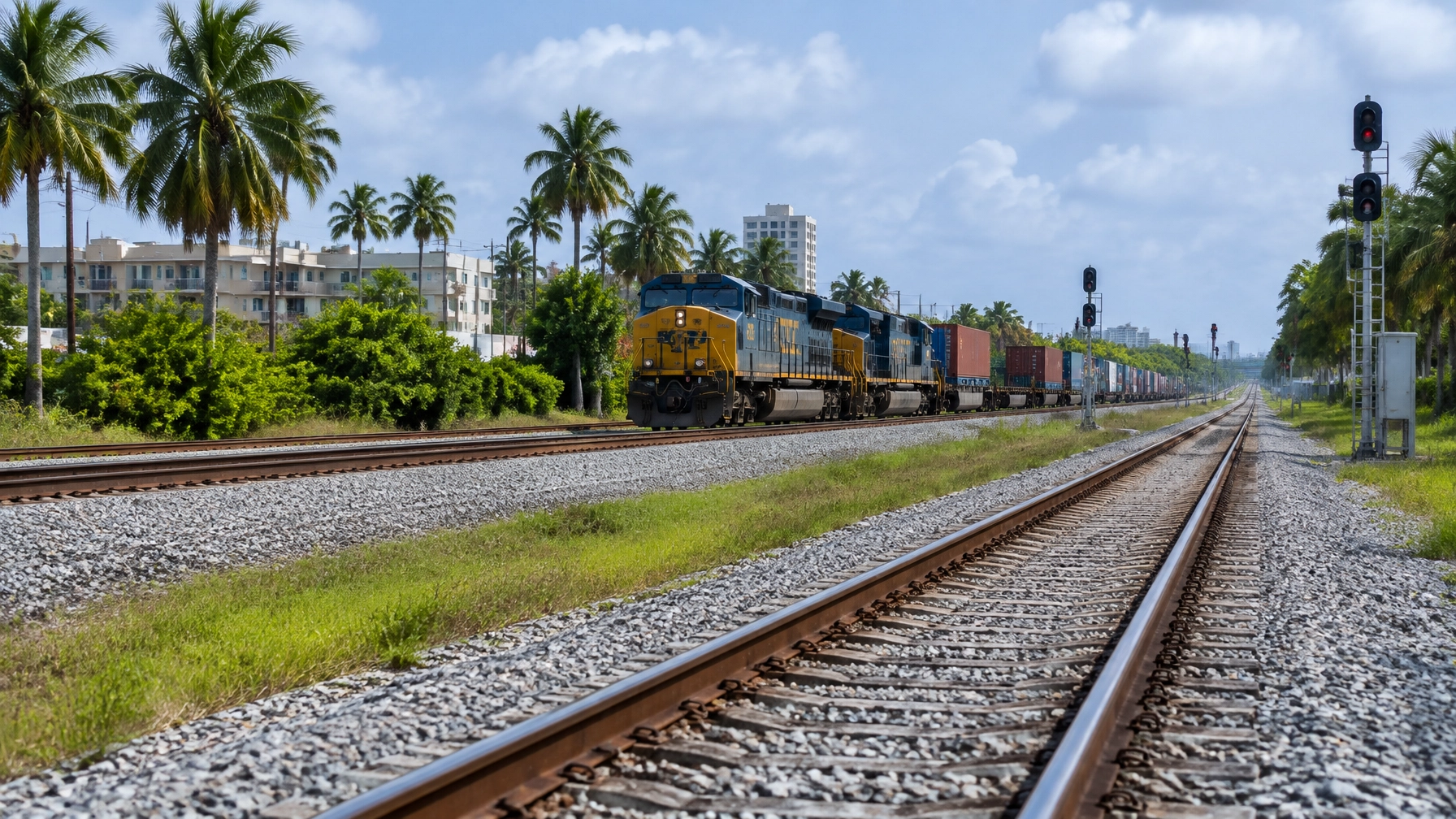
Illustrative image; not a photograph of Broward Commuter Rail South.
Broward Commuter Rail South has cleared an important federal checkpoint, but the project is not under construction, and its full financing is not yet locked in.
The Federal Transit Administration advanced the project into the Engineering phase of its Capital Investment Grants program and identified about $164 million in anticipated federal funding, according to Railway Track & Structures and the FTA project profile. The milestone moves the proposed rail link closer to construction, but it is not the same as a final funding agreement or a green light to begin building.
That distinction matters for a project that would extend commuter rail from Aventura, in Miami-Dade County, north into Broward on the Florida East Coast Railway corridor.
What “Engineering” means, and what it doesn’t
In the FTA’s New Starts process, entering Engineering means the project can advance detailed design and other eligible preconstruction work. Broward County Transit CEO and General Manager Coree Cuff Lonergan called the step a “significant milestone,” telling RT&S it allows the agency to move forward with detailed design and coordinate with project partners.
That work can include refining the design, schedule and cost estimates, as well as preparing for construction. RT&S reports that eligible activities include utility relocation, demolition, property acquisition and procurement of specialized equipment and materials.
It does not mean construction has started. Broward County’s project page lists engineering and design for 2027–2029, construction for 2029–2032, and passenger service targeted for 2032.

Illustrative image of typical rail infrastructure. It does not depict the project’s final design or selected technology.
The technology challenge is sharing a working railroad
The proposed line is not a new, separate railway built solely for commuters. According to RT&S, the project would use about 10.5 miles of the existing FEC corridor and add three stations: Hollywood, Fort Lauderdale-Hollywood International Airport and South Fort Lauderdale.
That shared-corridor arrangement makes the design more than a question of where to put platforms. Commuter service would need to fit alongside freight operations and other passenger trains using the corridor. Engineering is where designers and project partners work through the infrastructure and operating interfaces needed to make that arrangement safe and workable.
That may involve evaluating track capacity, train-control and signaling interfaces, grade crossings, communications, station access and how trains are scheduled and managed. These are the kinds of issues that matter on a shared rail corridor; they should not be mistaken for a published list of final equipment choices. The sources reviewed do not identify a final signaling system or confirm the project’s specific positive train control configuration. Those details should not be treated as settled.
The county’s project materials also describe new rail vehicles as part of the proposal. Selecting and integrating vehicles is another major piece of the work: trains have to meet the project’s operating needs and function within the corridor’s design and safety requirements. The engineering phase is where those specifications and interfaces can be developed in detail, not proof that a particular vehicle or technology has already been selected.
The stations are part of the system, too
A rail service works only if riders can reach it and use it. Station design therefore connects the engineering effort to practical questions about platforms, parking, passenger movement and accessibility.
RT&S reports that station concepts include platform-level boarding, universal design, 24-hour surveillance and improved fare gates. Those are reported concepts, not a guarantee that every detail is final. The upcoming design work will define how stations and related facilities fit the route and serve riders.

Illustrative station scene, not a rendering or photograph of a planned Broward Commuter Rail South station.
The $164 million is a major step, not the whole bill
The $164 million figure is an anticipated federal contribution, not the total price tag. The FTA says that funding remains subject to technical, legal and financial requirements and annual congressional appropriations. The project profile anticipates a Full Funding Grant Agreement in mid-2027-another important step, but one that is still ahead.
Broward County’s PREMO transit program lists an estimated capital investment of about $317 million for BCR South. Because the federal contribution would cover only part of that estimate, additional funding is needed. County materials also note that some costs, including FEC access fees, remain unknown. In short, the project has advanced in the federal process, but the full capital funding picture is not yet final.

Broward Commuter Rail South project map, published by Railway Track & Structures.
What to watch next
The next signals of progress will be less dramatic than a ribbon-cutting, but more revealing: design development, funding decisions, and evidence that the route’s infrastructure and operating arrangements are taking shape. If the current schedule holds, Broward County’s timeline points to engineering through 2029, construction beginning that year and passenger service in 2032.
For now, the news is a project-stage change, not a construction start. The federal commitment brings the proposed rail link closer to reality; the engineering, funding and coordination work ahead will show whether the schedule can hold, and what kind of service Broward will ultimately get.