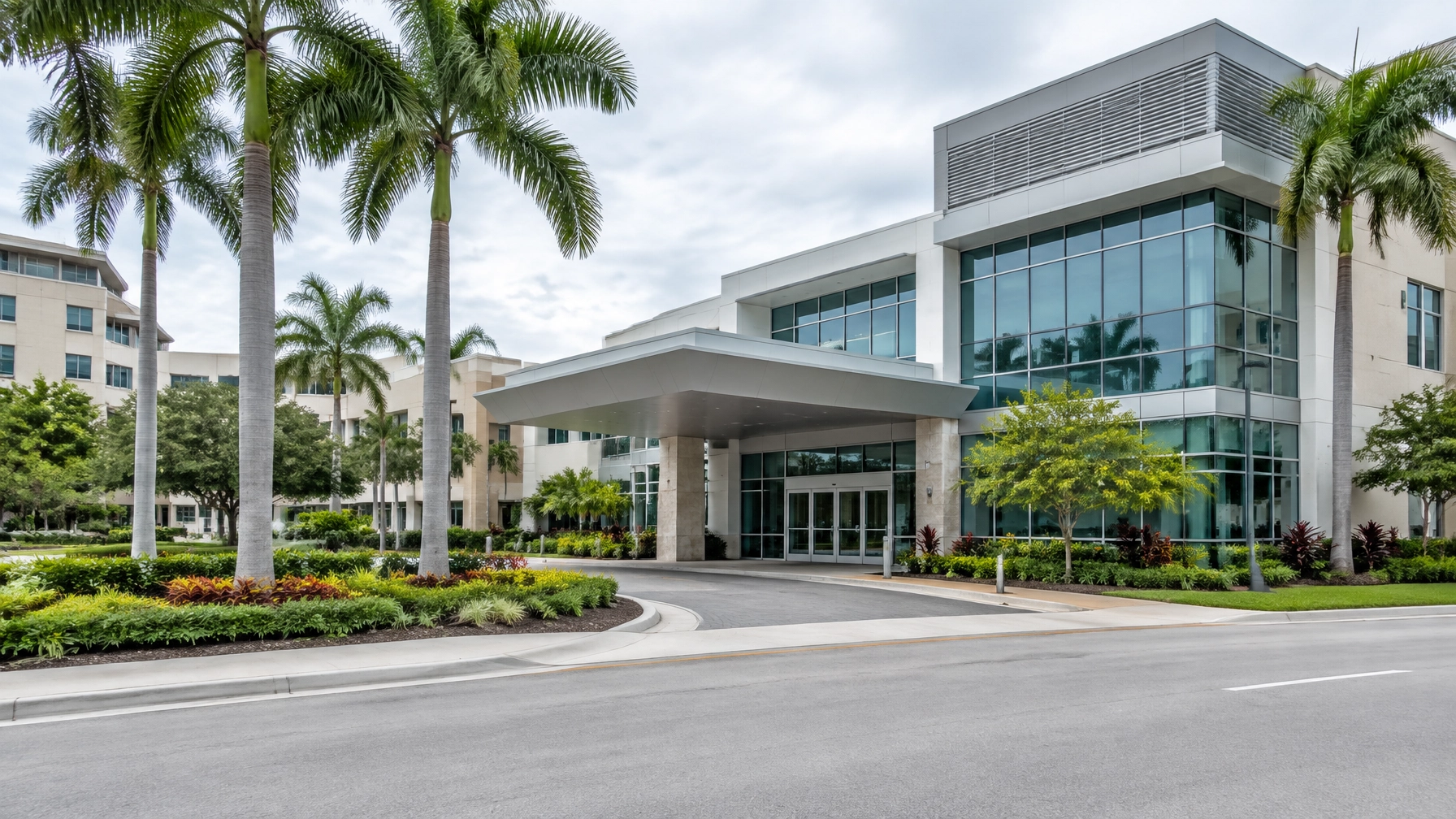
Illustrative image; not a photograph of the South Florida Proton Therapy Institute.
Tenet Healthcare has a deal to buy the South Florida Proton Therapy Institute at Delray Medical Center, a specialized cancer-treatment facility now at the center of a foreclosure case over $81.32 million in bond debt.
The South Florida Business Journal reported Nov. 12 that the transaction represents a discount of nearly $65 million against the facility’s outstanding debt. The purchase price itself has not been publicly disclosed, and the reported discount should not be read as a confirmed sale price. The deal has not been reported as closed.
The case puts a spotlight on the financing behind a highly specialized medical property: who owns the center, who is responsible for its debt, and what happens when revenue from the facility no longer supports bond payments. It also raises a practical question for patients: how might foreclosure affect a treatment center’s operations?

The center sits on land leased from Delray Medical Center. This is a representative campus image, not a photograph of the facility.
A treatment center financed with bonds, not a hospital guarantee
The South Florida Proton Therapy Institute opened at Delray Medical Center in Delray Beach to provide proton therapy, a form of radiation treatment that uses charged particles to target tumors. Its precision can help spare nearby healthy tissue compared with some other radiation approaches. It is a specialized treatment, however, and proton centers have faced financial challenges, including the high cost of operating the facilities and the difficulty of building patient volume.
In 2017, the Public Finance Authority, a Wisconsin-based conduit bond issuer, privately placed $81.32 million in unrated, tax-exempt bonds to acquire, build and equip the center. The borrowing included $67.3 million in senior bonds and $14 million in subordinate bonds. Interest coupons ranged from roughly 5.75% to 8.5%, with final maturity in 2046, according to bond disclosures and the foreclosure complaint.
The financing followed an asset-ownership model. The authority holds title to the financed facility and contracts with other parties to operate it. In this arrangement, bondholders look to revenue generated by the project and pledged collateral, not a corporate guarantor, to support repayment. Tenet, Proton International LLC–Delray LLC and Varian Medical Systems were named in the case because they may claim an interest in the facility. The complaint states that none of the three is a guarantor of the bonds.
That distinction matters. A hospital system’s involvement with the site does not mean it guaranteed the project’s debt. Tenet’s proposed purchase is a separate transaction; it does not turn the center’s past bond obligations into Tenet’s guaranteed debt.
Defaults led to a leasehold foreclosure
The center began reporting events of default under its bond trust indenture as early as 2021, according to the court complaint. Those covenant-related events preceded an outright monetary default on debt service, which began in 2024.
On July 13, 2026, UMB Bank N.A., acting as trustee for the bondholders, filed a leasehold foreclosure and receivership complaint in the Fifteenth Judicial Circuit Court in Palm Beach County. The case is UMB Bank N.A. v. Public Finance Authority. The court filing, posted through the Municipal Securities Rulemaking Board’s EMMA system, sought foreclosure of the leasehold securing the bonds and asked the court to appoint a receiver to sell the property for bondholders.
The collateral described in the complaint includes the center’s two linear accelerators, offices and exam rooms, along with related equipment and rights. The land beneath the facility is leased from Delray Medical Center, so the dispute concerns the project’s leasehold and related assets, not simply a sale of the underlying land.
A leasehold foreclosure is a legal process for enforcing a lender’s or bondholders’ rights against a property interest held under a lease. Here, the trustee sought authority to take control of that interest and arrange a sale. The requested receivership would put a court-appointed receiver in charge of specified project assets and the sale process.
For patients, that legal action does not, by itself, mean the center must close or that treatment immediately stops. But a change in control of a facility and its specialized equipment can affect who manages it and how the site operates. The complaint sought a receiver in part to oversee the property and equipment; it did not establish that patient care had been interrupted.

Proton therapy uses specialized equipment to deliver radiation treatment. The image is illustrative, not a photograph of the Delray center.
What the reported discount does, and doesn’t, say
The Business Journal’s reported discount of nearly $65 million compares the transaction with the center’s $81.32 million in bond debt. Because the purchase price has not been publicly disclosed, it is not possible to state an exact sale price from that comparison. Nor does the debt figure necessarily capture every factor that could affect the value of the property, equipment or operating business.
The reported transaction would resolve a foreclosure dispute over an unusual piece of medical real estate: a proton therapy center built on hospital-leased land, financed through conduit bonds and operated by a separate company. Tenet’s agreement to buy the center is significant because its Delray Medical Center is the adjacent hospital campus and the lessor of the land. The public information does not establish Tenet’s motives for the transaction, or what the final operating arrangement will be.
A wider test for Public Finance Authority’s model
The Delray facility is part of a broader group of proton therapy projects financed through the Public Finance Authority’s asset-ownership model. Since 2017, the authority has financed at least five proton centers nationally, raising more than $700 million in tax-exempt bonds. Nearly all are now in default or facing acute financial stress, including a New Jersey facility with roughly $146 million in debt and a University of Alabama at Birmingham facility with approximately $81.3 million in debt.
Municipal Market Analytics has described the authority as having the worst default record of any conduit municipal issuer in the country. The authority disputes that characterization. The dispute speaks to a larger question for investors and public-finance observers: how risk is assessed when a conduit issuer owns assets and bond repayment relies on project revenues, rather than a corporate guarantor.
UMB has also separately sued the authority over defaulted bonds tied to a portfolio of addiction-treatment facilities financed under the same model. Those cases, like the Delray foreclosure, illustrate how problems at an operating business can reach the property, equipment and revenue pledged to bondholders.

Illustrative image of bond and court records; no document text is intended to represent a specific filing.
For South Florida, the immediate issue is the future of one specialized cancer-treatment facility on a Palm Beach County hospital campus. From Delray to communities near the Everglades’ western edge, patients and providers depend on a regional network of care that includes highly specialized services as well as general hospitals. The proposed purchase may settle the property dispute, but the bond debt’s shortfall and the center’s future operations remain separate questions.
Sources: South Florida Business Journal; UMB’s court complaint and bond disclosure; Bond Buyer’s report on the foreclosure case. Related coverage is filed under South Florida Digest’s Business section.