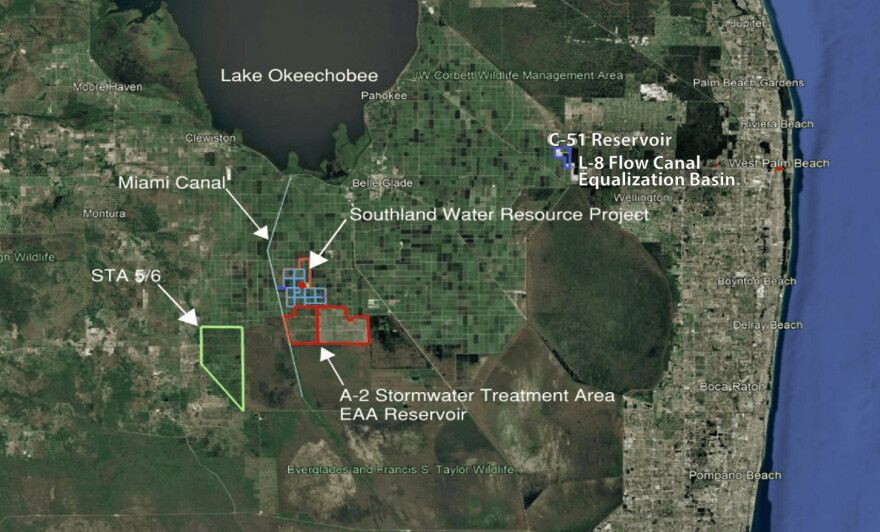
The image is a project-proposal drawing, not a photograph. Image via WLRN and The Florida Trib.
The South Florida Water Management District has given Phillips Heavy until Dec. 1 to provide technical details about a proposed limestone mine next to the Everglades Agricultural Area Reservoir. The company has already missed three deadlines. Each time, the district granted an extension. Now, after its governing board publicly questioned what it is being asked to approve, the next deadline is a key test of whether Phillips can answer the district’s outstanding concerns.
The proposed Southland Water Resource Project would mine several million tons of limestone from sugar land south of Lake Okeechobee, then fill the excavated pits with water. The proposed reservoir would sit less than 1,000 feet from the roughly $4 billion EAA Reservoir, which is expected to store 78 billion gallons when it opens in 2029.
But the Southland proposal is not an Everglades restoration project requested by the Army Corps of Engineers or the water district. It is a mining plan tied to a proposed reservoir. That distinction is central to the questions regulators and conservation advocates are asking.
The board wants answers before a permit decision
Phillips, a Tennessee-based contractor, has been asked since April 2025 to explain how it would blast and mine porous limestone without harming the neighboring reservoir or polluting water. The Dec. 1 deadline is the latest chance for the company to supply technical details.
At an Oct. 8 public meeting, the district’s governing board took the unusual step of asserting its authority to hold a public vote on a separate water-pumping permit application, rather than leaving the decision to district staff.
“Why would you apply for a permit when we don’t know what the permit is for?” board chair Chauncy Goss asked. “I think all of the board is sort of scratching their heads a little bit right now.”
Board member Ron Bergeron said he had received calls from stakeholders with “an awful lot of concerns.” Charlie Martinez urged the district to proceed carefully, saying the time, work and money invested by stakeholders were too significant to risk impacts to the EAA Reservoir.
No vote date has been set. Board members said they want to see Phillips’ technical details first, and the company has not met any of its earlier deadlines.

Illustrative image of agricultural land in South Florida; it does not depict the Southland project site.
A new application seeks permission to pump millions of gallons
In September, Phillips filed an application asking the district for permission to pump 45.36 million gallons of water a day at the Southland site through 2039. The application said the pumping could lower local water levels by as much as 10 feet “to facilitate mining and mitigation at the Southland Water Project.”
That request has sharpened concern about the interaction between the mining site and the nearby reservoir. In a July 2025 letter to U.S. Rep. Brian Mast, Army Corps Col. Brandon L. Bowman said the Corps had concerns about potential effects on Everglades restoration, including seepage. Pumping water to keep deep mining pits dry, he warned, could draw water from a reservoir built on porous limestone.
Steve Davis, chief science officer of the Everglades Foundation, has also raised concerns that blasting could crack bedrock and weaken the reservoir. Mining and crushing limestone, he said, could release phosphorus, chloride, sulfate and radium.
The district has not approved or denied the pumping permit. Its board’s public comments made clear that members want more information before a decision.
Why the project is framed as water infrastructure
Palm Beach County zoning rules prohibit mining in the Everglades Agricultural Area unless it supports public road construction, agricultural activity, or water-management projects tied to ecosystem restoration, regional water supply or flood protection. Courts have upheld the rule and blocked earlier attempts to mine limestone on sugar land in the area.
Phillips submitted its unsolicited proposal to the district on July 1, 2024-the same day a state law took effect streamlining approvals for unsolicited public-infrastructure proposals. Under the plan, the limestone would be mined from 8,632 acres owned by U.S. Sugar and Florida Crystals, sold as road and building material over 34 years, and the resulting pits filled with water.
The mine has received permits from the Florida Department of Environmental Protection and Palm Beach County. The Florida Department of Transportation announced an intent to grant $5.9 million for a railroad to haul rock from the site. Those actions do not resolve the water district’s review or the Army Corps’ concerns.
Phillips declined an interview request. In a statement, senior vice president Matt Eidson said the company was grateful to its partners at the Florida Department of Environmental Protection and would continue working with stakeholders to protect water resources for Floridians.
More storage, or more water treatment?
Water storage is important to Everglades restoration, but experts cited in the reporting say the region also needs more stormwater treatment areas: engineered wetlands where plants absorb nutrients from polluted water. Water managers can send water south only if it meets strict phosphorus limits.
“If we're not able to send that water south to the Everglades because it doesn't meet the legal phosphorus limits, that doesn't do us any good,” said Matt DePaolis of the Sanibel-Captiva Conservation Foundation.
Chris Wittman of Captains for Clean Water said the group would support the land being donated or sold to the state for a filter marsh. “We don't need more deep water storage without the ability to clean the water,” he said.

Illustrative stormwater-treatment wetland; not a specific site connected to the proposal.
The distinction matters: a stormwater treatment area could help clean water before it moves south, while a deep, rocky pit is not the same kind of wetland. And, unlike a reservoir, a treatment area would not provide the stated justification for mining limestone under the local zoning rule.
A changing board is possible, not certain
There is also a political question about who might ultimately consider the permit. U.S. Sugar, Florida Crystals and Phillips donated a combined $955,000 directly to governor-elect Byron Donalds’ political committee this year, according to state campaign finance records cited by The Florida Trib and WLRN; the companies also funded other committees that gave to Donalds.
The current district board could be replaced after Donalds takes office Jan. 5. Ron DeSantis replaced the board after taking office in 2019. That makes a different board a possibility before the Southland permit comes to a vote, not a certainty. The reporting does not indicate that Donalds has taken a position on this permit.
The land-use question beneath the permit
The Southland debate sits within a longer-term challenge for the Everglades Agricultural Area. Drainage and farming have caused the region’s organic muck soils to subside. At a University of Florida research station near Belle Glade, six feet of soil had disappeared by 1924; losses continue at about a quarter-inch a year. UF scientists have predicted that nearly half the EAA could have less than eight inches of soil by 2050, making sugarcane production difficult and costly.
That raises a consequential question: what happens to this land if it can no longer support farming? Casey Darling Kniffin of Friends of the Everglades said restoration experts could help return areas to conditions reminiscent of historic Everglades flow if farming stopped.
For now, the immediate question is more specific: will Phillips provide the technical information the district has been seeking by Dec. 1? The answer could shape what happens next, but the permit remains undecided.
This article is based on reporting by Nicolás Rivero for The Florida Trib, republished by WLRN. For background on other work before the district, see South Florida Digest’s coverage of the EAA Reservoir.

Illustrative limestone and water scene; not a photograph of the Southland site.