

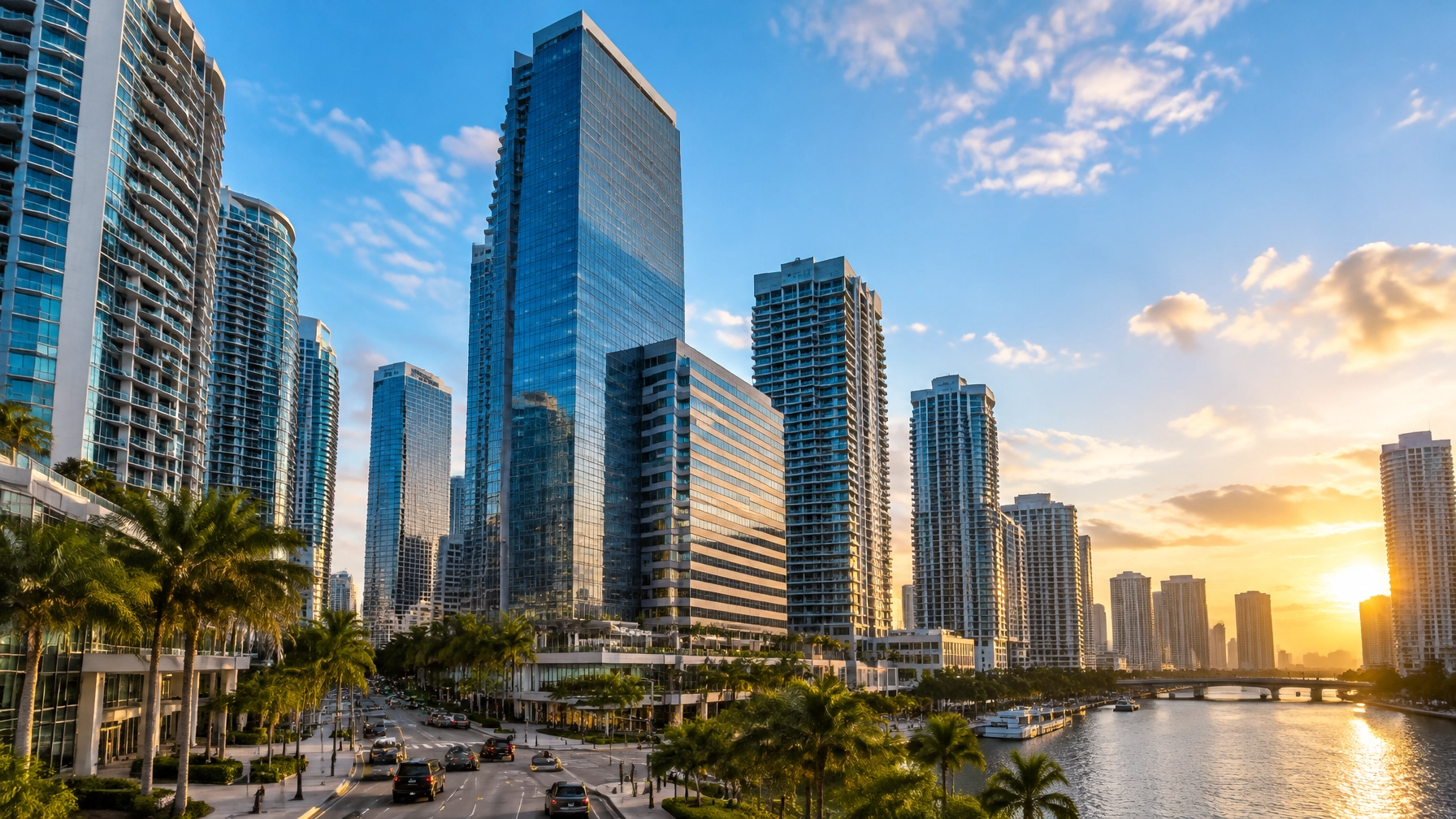
South Florida’s office market delivered a strong third quarter, but the headline comes with an important qualification: demand is concentrating in newer, amenity-rich buildings and in business districts that offer access to talent, transportation, housing and lifestyle.
Across Miami-Dade, Broward and Palm Beach counties, tenants continued to sign leases even as borrowing conditions remained tight and the broader residential migration boom began to cool. The result is a regional office market that looks increasingly established, but also increasingly divided between high-quality urban projects and older or more suburban inventory.
The latest South Florida office market report points to sustained leasing activity across the tri-county region. Miami-Dade and Palm Beach posted particularly strong results, while Broward continued to benefit from demand but faced more pressure in suburban submarkets.
Miami-Dade: Strong rents, smaller deals and a flight to quality
Miami’s office market remained one of the strongest stories in the region during the third quarter.
Savills reported approximately 1.1 million square feet of leasing activity in Miami during the quarter, with Airport West, Brickell, Coral Gables and Downtown Miami accounting for much of the volume. Average asking rents rose to $68.46 per square foot, up 8.4% year over year. Class A rents climbed to $81.39 per square foot.
Those figures show that tenants are still willing to pay a premium for the right space. They are also consistent with a broader pattern: companies may be cautious about expansion, but they continue to prioritize offices with modern infrastructure, attractive amenities and locations that help recruit and retain employees.
The market is not being driven exclusively by massive corporate relocations. Deal sizes have generally become smaller, with many companies taking less space while upgrading the quality of their offices. That trend can make total leasing activity appear uneven from one quarter to the next, particularly when compared with the large-scale commitments that characterized earlier phases of South Florida’s corporate migration.
Still, high-profile projects are creating a substantial pipeline of future occupancy. The 830 Brickell tower, for example, has been fully leased, although many tenants have yet to move in. Citadel, the hedge fund founded by Ken Griffin, is among the financial firms helping anchor the building’s long-term significance.
That distinction matters. Leasing commitments create confidence in the market today, while actual move-ins and buildouts will shape absorption over the next several quarters.
Palm Beach County gains momentum
Palm Beach County posted some of the clearest evidence of market strength.
According to CBRE’s Q3 Palm Beach County figures, the market recorded 39,000 square feet of positive absorption and more than 700,000 square feet of leasing activity during the quarter.
The largest transaction was Fiserv’s 250,000-square-foot commitment in North Boca, described as the largest South Florida office lease since 2020 and one of the largest ever recorded in the region.
The figures are notable because Palm Beach County has added a meaningful amount of new office supply in recent years. Nearly 700,000 square feet of new space has been delivered to the Palm Beach central business district since 2020. Yet demand for premium buildings has remained strong.
Class A direct vacancy stood at 12.4%, while Class A+ direct vacancy was 11.7%. Availability was tighter still, at 9% for Class A and just 6.5% for Class A+ space.
In practical terms, companies looking for high-end offices in West Palm Beach, Boca Raton and nearby submarkets may have fewer options than the overall vacancy figures suggest. Much of the available inventory is older, less competitive or not configured for the needs of growing technology, financial-services and professional-services firms.

Broward remains active, but uneven
Broward County is participating in the region’s office recovery, though its performance is less uniform.
Fort Lauderdale and other amenity-rich coastal districts continue to draw attention from companies seeking an alternative to Miami’s higher rents and denser urban core. However, portions of suburban Broward have more large blocks of available space and fewer obvious sources of demand.
That creates a two-speed market. Newer buildings in walkable, well-connected districts can attract tenants, while older suburban properties face pressure to reduce rents, improve amenities or consider repositioning.
The issue is not a lack of interest in Broward. It is a mismatch between what some properties offer and what today’s office users want. Companies are increasingly looking for upgraded common areas, better food and beverage options, flexible layouts, reliable technology and proximity to residential neighborhoods.
As a result, the strongest Broward projects are competing not only on price but also on experience.
$436 million in new financing adds a capital-markets signal
The leasing figures arrived alongside a significant financing story.
As reported by The Real Deal, lenders provided a combined $436 million for several South Florida projects in recent weeks.
The transactions included:
- A $238 million refinancing for Landmark South, a 631-unit multifamily community in Doral.
- Approximately $127 million for The Arcadian, a planned 502-unit apartment project in Fort Lauderdale.
- A $25 million permanent loan for a workforce-housing community in Hialeah.
- A $25 million construction loan for a Delray Beach condominium project.
- A $20.5 million refinancing for an office-and-retail project at 760 Ponce de León Boulevard in Coral Gables.
The financing package is not an office-market statistic, and the loans are not directly tied to Ken Griffin or Stephen Ross. Its importance is broader: lenders remain willing to commit substantial capital to well-located South Florida projects, even in a more selective lending environment.
That capital supports the physical ecosystem surrounding office demand. New residents need housing. Businesses need mixed-use districts. Workers need transportation, restaurants and services close to employment centers. Financing for multifamily, workforce housing, retail and office properties can therefore reinforce the region’s commercial base even when each individual asset faces a different market.
The technology and research push moves beyond slogans
The long-term case for South Florida’s office market is also being strengthened by major investments in education, research and technology.
Carnegie Mellon University’s planned Miami campus in Wynwood is one of the most consequential developments in that effort. The 35-acre campus is expected to open in 2028, with programs focused on national security, human health, climate resilience and advanced manufacturing.
The project is connected to Griffin’s reported $3 billion donation to Carnegie Mellon, described as the largest individual gift in higher education history. WLRN’s coverage frames the campus as a potential missing piece in Miami’s effort to build a deeper technology and research economy.

Wynwood has already evolved from an arts district into a major office and creative-business destination. A research university focused on artificial intelligence, robotics, advanced materials and engineering could take that evolution further by bringing students, researchers, entrepreneurs and employers into the same physical ecosystem.
In West Palm Beach, Stephen Ross and Related Ross are backing a separate vision built around downtown redevelopment, technology and higher education. A planned Vanderbilt University presence and innovation center would add another institutional anchor to a market already attracting finance and technology companies.
Together, the Carnegie Mellon and Vanderbilt efforts suggest that South Florida’s next phase may depend less on attracting individual companies and more on creating a durable talent pipeline.
A different story from residential migration
That commercial momentum contrasts with a cooling residential migration story.
Florida’s post-pandemic population boom has moderated, especially in high-cost coastal markets. Net domestic migration into the state fell sharply from the levels recorded earlier in the decade, while more middle-income residents have looked elsewhere for lower housing, insurance and living costs.
South Florida is not experiencing a simple collapse in demand. Affluent households, corporate executives and high-income professionals continue to arrive, and driver-license data still point to strong inflows into Miami-Dade, Broward and Palm Beach.
But the composition of migration is changing. The region is seeing more churn, more economic sorting and greater pressure on residents who cannot absorb rising housing costs. That distinction is important for the office market. Commercial demand can remain strong even as the broader residential narrative becomes less uniformly positive.
Pier Sixty-Six highlights the region’s development tensions
Fort Lauderdale’s Pier Sixty-Six height fight offers another counterpoint to the office-market optimism.
The waterfront redevelopment has become a flashpoint over the scale of luxury development, the height of proposed towers and the relationship between large projects and surrounding neighborhoods. Recent coverage reports that opponents are pressing for a 120-foot limit, while the developer is seeking approval for taller luxury towers. The Sun Sentinel has covered the dispute.
The debate reflects a broader question facing South Florida: How much growth can communities absorb, and where should that growth occur?
The office market’s third-quarter performance suggests that companies want modern, connected districts. The Pier Sixty-Six controversy shows that residents and local officials may not agree on how quickly or how intensely those districts should be built.
The outlook: strong demand, sharper distinctions
South Florida’s office market is not returning to the old model of broad-based expansion across every building and submarket. Instead, the region is developing a more selective form of strength.
Miami-Dade is benefiting from finance, technology and high-end corporate tenants. Palm Beach County is attracting large commitments and institutional investment. Broward remains active but must work through a deeper divide between newer coastal assets and older suburban inventory.
The $436 million financing package, Carnegie Mellon’s Wynwood campus and Vanderbilt’s West Palm Beach effort all point to a region building more than office space. They point to an attempt to create a lasting business and research base.
For more reporting on the companies, communities and development projects shaping the region, follow South Florida Digest.

[…] economic center, not simply a residential district. South Florida Digest previously reported on the regional office market’s strong third-quarter leasing demand, another factor supporting long-term demand for well-located […]
[…] with strong activity reported across the tri-county area. South Florida Digest’s coverage of the Q3 office market details momentum in Miami-Dade, Broward and Palm […]
Comments are closed.