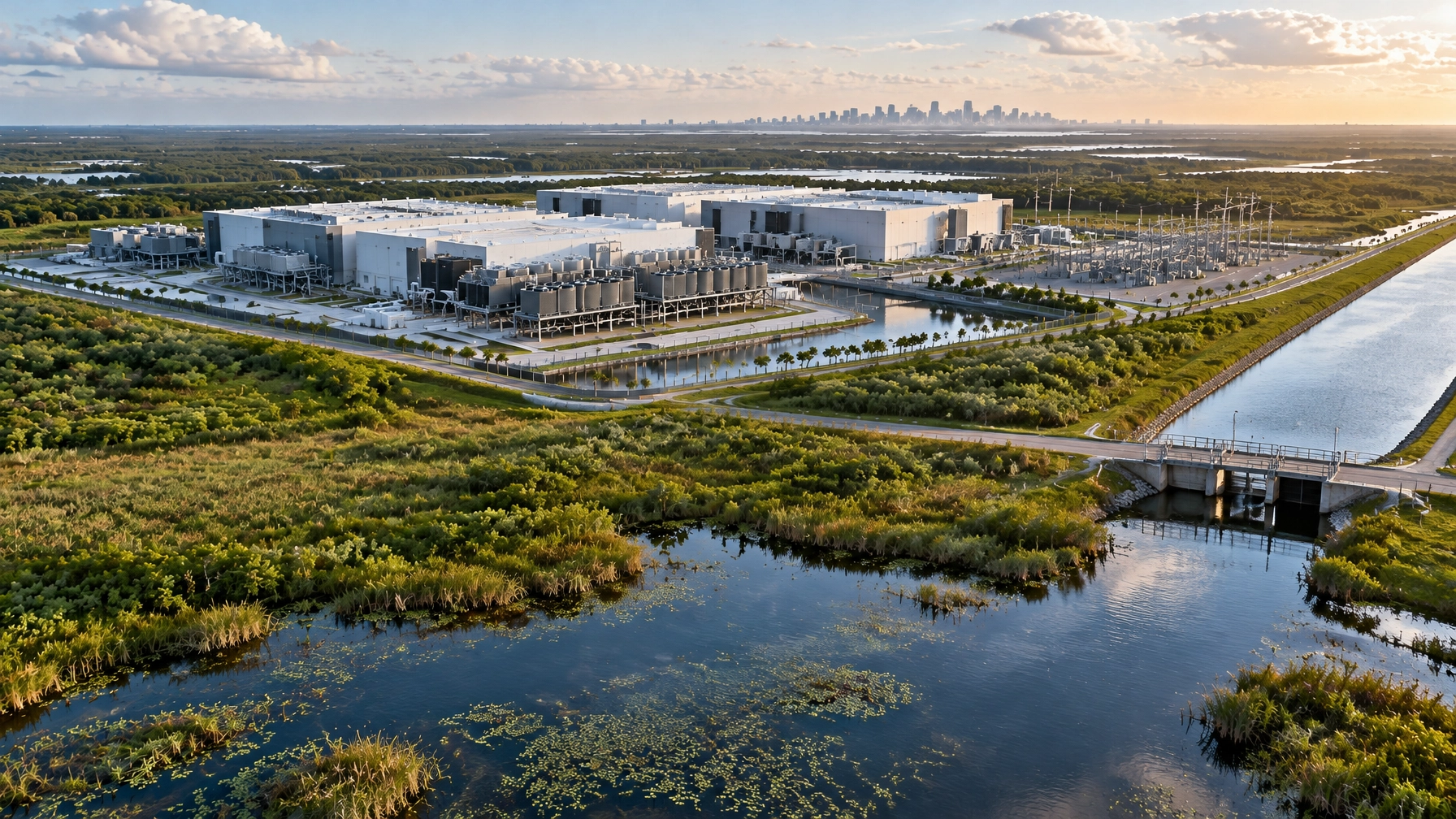
Miami’s AI boom is drawing investment into software and digital infrastructure. But the region’s next technology chapter will also be shaped by power, cooling, land use and the water system shared with the Everglades.
The funding headlines tell one story: investors see opportunity in South Florida’s growing technology sector. The proposals for large AI data centers tell another: the region’s physical infrastructure, and especially its water, sets limits that capital alone cannot remove.
Those stories meet in a place where water is already carefully managed among cities, farms, utilities and restoration projects. In South Florida, the Everglades is not a distant environmental concern. It is part of the region’s water supply, flood control and ecological future. Any large industrial project near its restoration footprint has to answer a practical question: Where will its power and water come from, and what happens to them afterward?
A logistics funding story, with an important date check
A Florida Times article published on October 12 describes a Miami technology company raising funding to expand logistics software. The page does not identify the company, name the round or disclose the amount, and it carries a notice that the content was generated by an AI system.
The matching, independently verifiable financing is Canals, a Miami-based company that develops AI software for wholesale distributors. Canals announced a $35 million Series A on May 28, 2026, led by Base10 Partners, not a new round announced on October 12. The company says it is using the funding to build out software that automates work across sales, customer service, accounting, purchasing and receiving.
Canals says its customers have processed more than 8 million sales orders through the platform and achieved results including faster quote conversions and more automated invoice processing. The opportunity is tangible: distributors manage high volumes of orders, invoices and supplier interactions, much of it traditionally handled through manual work. Software that reduces friction there may help goods move through the supply chain more efficiently without requiring a new hyperscale computing campus next door.

Canals announced its $35 million Series A in May 2026. The company’s announcement describes software for automating wholesale-distribution workflows.
That date distinction matters amid a busy run of regional funding news. Miami fintech company Jeeves announced $110 million in equity funding on September 29 to scale its stablecoin-native banking platform for global businesses. On October 1, Miami-based cybersecurity and networking startup doxx.net announced a $38 million Series A led by Andreessen Horowitz. And AI infrastructure startup TrustedRouter, also based in Miami, announced a $1.25 million seed round on August 31 to develop its model-routing platform.
These companies operate in different parts of the technology stack: finance, networking security and tools that connect users with AI models. Their financing is evidence of investor interest in South Florida companies building software and services. It is not, by itself, evidence that all AI growth requires the same kind of physical footprint, or consumes water at the scale of a data center.
Project Tango put water and siting on the agenda
That physical footprint was at the center of the dispute over Project Tango, a proposed 600-megawatt data center on roughly 200 acres in western Palm Beach County near the Everglades. In July, county commissioners rejected the proposal’s requested expansion by a 5–1 vote, following extended public debate over its size, location and impacts.
A central issue was how much water the facility would need. As WLRN reported, the estimates discussed for Project Tango ranged from about 5,000 gallons of daily use cited by the applicant’s representative to 100,000 gallons a day projected by county staff. The proposed closed-loop cooling system was also described as needing a one-time fill of more than 600,000 gallons.
Those numbers are not interchangeable: estimates can depend on how cooling works, what counts as water use, and whether figures describe daily operations or a system’s initial fill. The gap between them, however, became part of the public concern. Residents and officials wanted a clear account of routine demand, water sources and discharge safeguards, not just assurances about a proposed cooling design.
The South Florida Water Management District told WLRN that it had not received a Project Tango water-use permit application at the time of its reporting. That means the project’s proposed cooling-water withdrawals had not received a district water-use permit decision. The distinction is important: scrutiny and concern are not proof that contamination occurred, nor proof that regulators approved a water plan.
The Everglades is part of the region’s water equation
The Everglades gives this debate its regional significance. The ecosystem has been reshaped over generations by drainage and water-management infrastructure built to support flood control, urban supply and agriculture. The National Academies’ 2024 review of Everglades restoration describes the remaining ecosystem as competing for water with urban and agricultural uses, while also facing the effects of contaminated runoff.
Restoration is not simply a matter of moving more water south. It depends on restoring water’s quality, quantity, timing and distribution. The National Academies notes that phosphorus remains a challenge in the treatment system, and that moving more Lake Okeechobee water south depends in part on meeting water-quality requirements.
Large new water users enter that already complex system. Their effects depend on location, water source, local utility capacity, cooling technology and how wastewater or concentrated cooling discharge is managed. Even a project that does not draw directly from a protected wetland can raise questions about aquifers, nearby wells and competing demand.
Everglades restoration also involves enormous public works. The South Florida Water Management District says the Everglades Agricultural Area Reservoir is designed to store water south of Lake Okeechobee, treat it and support flows toward the Everglades and Florida Bay. South Florida Digest has previously covered the project’s construction progress in this report on the EAA Reservoir.
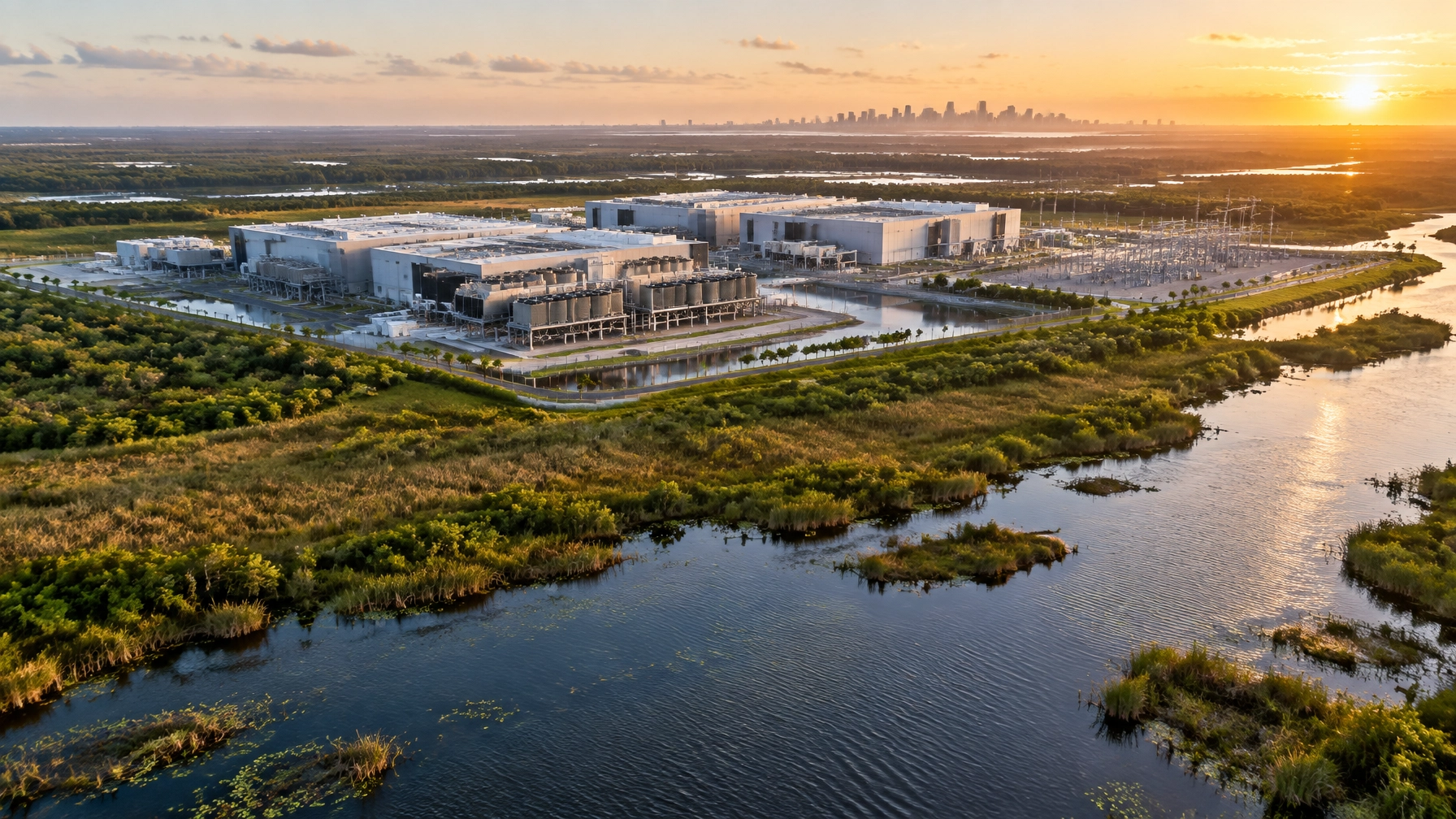
South Florida’s water system includes reservoirs, treatment areas, canals and pumping infrastructure. The Everglades’ restoration needs water that is clean enough and delivered at the right time and place.
The reservoir and other restoration projects do not make the region’s water supply unlimited. They are components of a managed system intended to serve both human communities and the natural environment. New industrial demand has to be assessed within that context, not as though the region had a separate, unused water reserve.
New rules require detailed answers
Florida’s 2026 Senate Bill 484 establishes added requirements for large-scale data centers seeking water-use permits. The law sets a 50-megawatt threshold for the large-data-center category and requires a public hearing before a water-use permit can be issued for a covered facility. Applicants must provide details about water sources and uses, submit a conservation plan, and address whether reclaimed water is feasible.
For a proposed facility, those requirements make the practical questions more specific: How much water would be used in normal and peak conditions? Could reclaimed water serve cooling needs? How will the system recycle, discharge or dispose of water? What protections apply to nearby wells and other legal water users?
Power is part of the same siting conversation. A 600-megawatt proposal is a major infrastructure project, not merely a collection of servers. Grid connections, backup systems, land, stormwater management and cooling arrangements all shape whether a site is workable. A closed-loop design may reduce routine water demand compared with other systems, but its actual impact still depends on project details and enforceable conditions.

The Everglades Agricultural Area Reservoir is part of a broader restoration effort. The water district’s project page outlines its intended role in storing, treating and moving water.
Two kinds of growth, one regional test
Miami’s recent funding announcements and the Project Tango dispute are related, but they are not the same story. A logistics-software company like Canals can scale its product and customer base without building a hyperscale data center beside the Everglades. A major AI facility, by contrast, brings land and infrastructure decisions directly into the local conversation.
For founders and investors, that means South Florida’s technology opportunity is shaped by more than access to capital. Site selection, available power, water supply, cooling plans and public confidence will influence what can be built, and where. For regulators and residents, the task is to evaluate specific proposals with clear, comparable data, while protecting the needs of communities and the Everglades restoration system.
The region does not have to choose between technological growth and environmental stewardship as absolutes. But the terms of growth matter. In a place where the Everglades, drinking-water supplies and development share a connected system, a credible AI infrastructure plan must show its numbers, disclose its impacts and meet the same water-quality and permitting standards expected of any major industrial project.