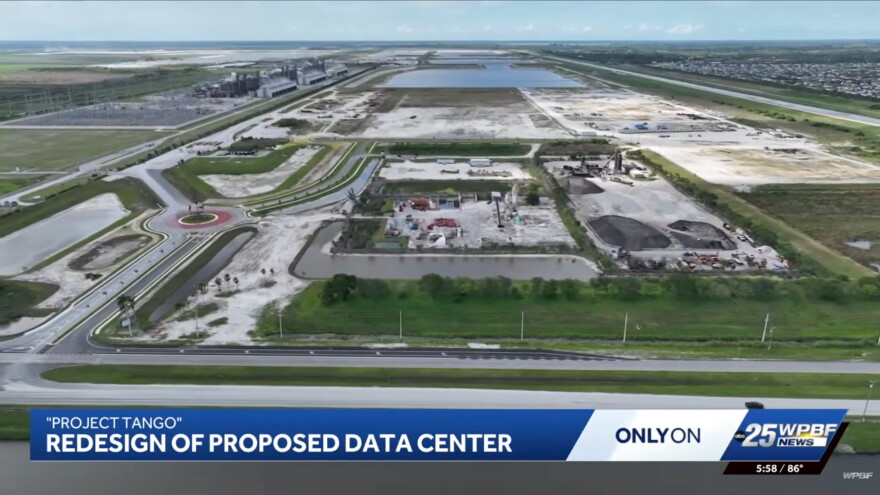
The site proposed for Project Tango is north of Southern Boulevard near 20-Mile Bend. Image: WPBF, via WLRN.
Palm Beach County’s debate over a proposed AI data center has moved from public hearings into court, and the litigation is now part of a broader dispute over who controls development rights at a 202-acre site near 20-Mile Bend.
One date needs clarifying: PBA Holdings’ lawsuit was filed Aug. 6, not today. The complaint, filed in Palm Beach County Circuit Court, names WPB Logistics Owner LLC, Atlanta-based TPA Group LLC, the Central Park Commerce Center Master Association, a law firm and two attorneys. The case is one of two lawsuits tied to the site and to competing proposals for data-center development.
The legal claims remain allegations, not findings. But the dispute exposes the issues that are shaping the region’s AI buildout: which land can be developed, how approvals are obtained, and how projects will meet their power and water needs.
A business relationship that turned into a dispute
The fight stems from a series of agreements involving PBA Holdings and WPB Logistics, a company affiliated with TPA Group. According to reporting by WLRN, the parties signed an agreement in 2021 concerning the Central Park Commerce Center site and potential development in phases.
WPB Logistics bought about 60 acres from PBA Holdings for $36 million in 2023 and held an option involving an additional 75 acres, WLRN reported. The parties’ original plans focused on warehouse and distribution development. The county’s records show the site already has approvals for warehouse and data-center uses.
The companies’ relationship then became more complicated as both pursued different development paths. PBA Holdings advanced Project Tango, a proposed amendment to the overall master plan. WPB Logistics, through an affiliated proposal, explored converting warehouse space on its portion of the site into additional data-center space.
In its August complaint, PBA Holdings alleges that WPB Logistics and TPA Group failed to honor contractual commitments related to Phase 2 entitlements and worked to oppose PBA’s application. PBA also alleges that the master association was used to challenge Project Tango without the required authorization. Its complaint includes claims such as breach of contract, breach of fiduciary duty, tortious interference and abuse of process.
The defendants have not been found liable. As of Oct. 13, no publicly available response to PBA’s August complaint was identified in the materials reviewed.

The proposed development site is near the Arden community and Saddle View Elementary School. Image: Joe Cavaretta/South Florida Sun Sentinel, via CBS 12.
The August case followed an earlier lawsuit, filed in June by WPB Logistics and the master association against PBA Holdings. In that case, WPB argued that PBA had not pursued development approvals in the coordinated manner required by their agreements and had prioritized Project Tango over entitlements connected to WPB’s land. The plaintiffs sought to halt PBA’s application; a judge denied an emergency injunction in July, allowing the county hearing to proceed, according to WLRN’s reporting.
The two cases present competing accounts of the same business arrangement. The court has not resolved those claims.
What the county approved, and what it rejected
The site sits north of Southern Boulevard, west of Seminole Pratt Whitney Road, according to Palm Beach County’s Project Tango page. County records describe PBA Holdings’ application as a request to expand and modify the Central Park Commerce Center master plan.
The revised proposal sought approval for about 3.59 million square feet across the 202-acre property: approximately 2.35 million square feet of warehouse space, 1.03 million square feet of data-center use and 216,000 square feet for minor utilities. County commissioners denied that expanded application 5-1 on July 15, without prejudice, meaning the denial did not prevent a revised application from being filed.
That request was larger than the site’s existing plan. County records list two approved 100,000-square-foot data-center buildings, a 1.2-million-square-foot warehouse with accessory office space, and a 6,000-square-foot office building. The county’s project page also describes an approved master plan totaling 2.02 million square feet.
A separate proposal adds another layer. WPB Logistics asked county staff to confirm the process for replacing an approved 1.2-million-square-foot warehouse with four data-center buildings. Together with two data-center buildings already approved on that portion, the pre-application materials describe approximately 1.36 million square feet of data-center uses. That request is distinct from Project Tango, and the county’s records describe it as a pre-application review, not as an approval to build.
The process matters. CBS 12 reported that the warehouse-to-data-center conversion could be subject to administrative review rather than the same public hearings and commission vote required for PBA’s master-plan amendment. Whether the proposal can proceed depends on county review and applicable approvals.

The county’s Project Tango page includes application details, site information and the project map.
A moratorium pauses some new applications
Palm Beach County has since adopted a one-year moratorium on new large-scale data-center applications, with the threshold set at a projected peak electric load of 50 megawatts or more. The County Commission finalized the moratorium at its Sept. 24 zoning meeting, according to the Town-Crier.
The pause is intended to give the county time to develop regulations for large facilities. The Town-Crier reported that applications already submitted are not covered by the moratorium. The distinction is important in the Central Park Commerce Center dispute: the pause does not, by itself, settle ownership disagreements, determine which existing approvals apply, or decide the status of proposals already in the review process.
The legal battle is therefore unfolding alongside a changing local policy landscape. A court may decide contractual or corporate-governance questions; county staff and elected officials decide land-use applications under zoning rules.
Land, water and power extend beyond one parcel
Project Tango is in western Palm Beach County, near the Everglades region, but the county’s zoning record does not establish that the proposed buildings would be located within the Everglades. The relevant regional concern is how new industrial development fits into South Florida’s interconnected land, water and power systems.
Data centers require substantial electricity, and cooling systems can require water. The details vary by facility design and operating conditions, making project-specific disclosures and permits central to evaluating potential impacts. South Florida Digest has previously reported on regulatory scrutiny of AI data centers near the Everglades over water use.

The Everglades Agricultural Area Reservoir is separate from Project Tango, but it illustrates the scale of regional water-management infrastructure. Read more in our coverage of data-center water scrutiny.
In Miami-Dade, another land-use debate is unfolding around the Urban Development Boundary. Caplin News reported that at least 11 applications involving expansion of, or exceptions to, the boundary are active. The most since 2005, according to its reporting. Those are UDB-related applications, not 11 data-center proposals; they include other types of development such as warehouses, logistics facilities and housing.
The debate has environmental implications because some proposed sites are near wetlands, the Biscayne Aquifer and areas relevant to Everglades restoration. It also echoes the questions facing Palm Beach County: how development boundaries are applied, which projects receive public review, and how local infrastructure can support new demand.
What happens next
The court cases do not determine whether a data center is environmentally acceptable or whether a particular site plan should be approved. They concern agreements, ownership interests and the process used to advance competing proposals. The county’s July denial addressed PBA Holdings’ expanded application, while the separate WPB Logistics proposal remains subject to its own review.
For residents, businesses and local officials, the next steps will turn on both the litigation and the permitting record: what the parties’ agreements require, what development rights remain in force, and whether future applications meet county rules.
The broader South Florida test is already clear. AI investment can bring construction activity and new infrastructure, but the projects must also account for land use, dependable power and water resources. Near the Everglades, those questions are especially consequential, and no court filing or zoning vote can substitute for transparent project details and a clear public review.