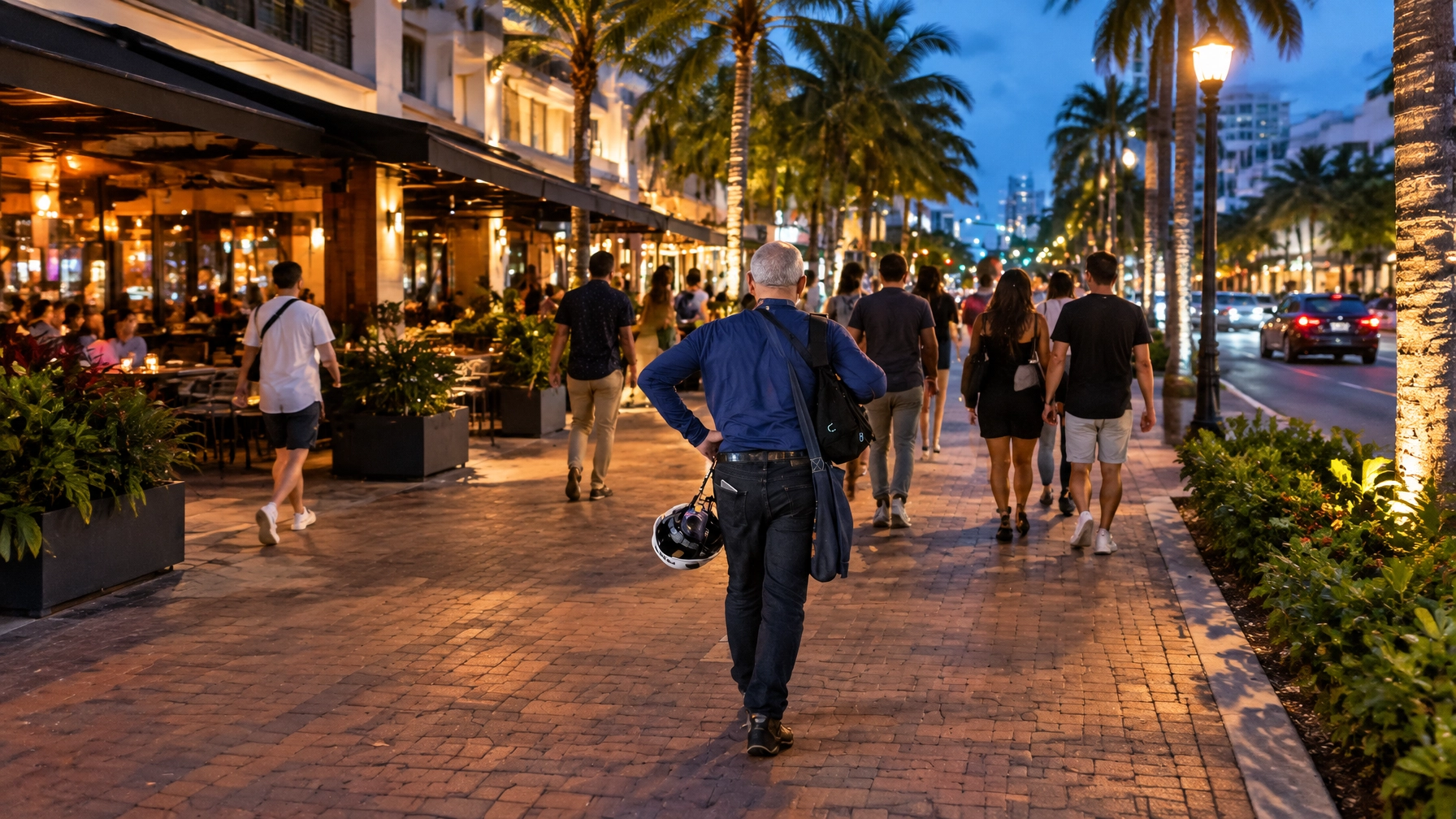
Fort Lauderdale commissioners have advanced a plan that could end Himmarshee’s special entertainment-district status, and shorten the hours some businesses can trade. The final vote is set for November 17.
For a bar or restaurant, an hour on the clock is not just an hour on the clock. It can mean another round of sales, another shift of payroll and another piece of the business plan built around staying open late.
That is the business question now facing Himmarshee, Fort Lauderdale’s downtown entertainment district. On October 20, city commissioners passed the first reading of an ordinance to decertify the district. If it becomes final, affected businesses would lose their current late-hour allowance: weekend closing times would move from 4 a.m. to 3 a.m., and weekday hours from 3 a.m. to 2 a.m.
The proposal is not yet law. A second and final vote is scheduled for the commission’s November 17 meeting. But a separate plan that could have created a new extended-hours permit system was tabled during the same session, leaving decertification as the measure currently advancing.
For operators that have built their business around the late shift, that sequence matters. The permit proposal was a possible path to preserve extended hours under new rules. With it on hold and no return date announced, the more sweeping change is moving ahead first. The commission discussion that produced it centered on crime and safety concerns in the district.
The business impact is real, even if the dollar figure isn’t known
Himmarshee’s late hours have long been a competitive advantage. In a region with plenty of places to eat, drink and stay out, the ability to serve customers until 4 a.m. on weekends has helped distinguish the district from other South Florida nightlife areas.
That advantage is measured not only in the drinks sold between 3 and 4 a.m. It is also part of how an operator plans the night: staffing levels, inventory, security, cleanup and the costs of keeping a venue open. A business that expects late customers may organize its entire closing routine around that final hour.

The available public reporting does not establish a dependable, district-wide estimate of the sales that could be lost. Fort Lauderdale has not published an economic analysis of the proposed hours change, and an individual business’s experience cannot be assumed to represent every operator on the block. The financial effect will vary with each venue’s customer mix, hours, staffing and operating costs.
What is clear is the direction of the change: if the ordinance passes and takes effect, affected venues would have less time to serve customers under the district’s current late-hours arrangement. That makes the question of any replacement permit policy significant for businesses trying to plan beyond this month.
The commission’s decision also sits at the intersection of two competing concerns. City discussions have centered on crime and public safety in the district, while business owners have pushed back against a broad change they say could burden operators that rely on late trade. NBC 6 South Florida’s report covers the safety concerns and the first-reading vote. CBS Miami also reported on the proposal and the impact of earlier closing times on local businesses.
This is not simply a direct ordinance saying every bar in the city must close at a new hour. The mechanism under consideration is decertification of the Himmarshee Entertainment District designation. Under the proposal as reported, removing that status would end the special arrangement that allows affected businesses to stay open later.
That distinction matters. It frames the question as what happens to a designated district and its participating businesses, not as a new closing-time rule that automatically applies to every Fort Lauderdale venue.
The compromise path is on hold
The wider extended-hours permit proposal was tabled at the October 20 session. It would have established a new system for businesses seeking permission to operate later, but commissioners did not advance it alongside the decertification measure. As of the reporting available, the proposal has no return date.
For operators, the tabled plan represented a potential alternative to a blanket rollback: a process that could set conditions for extended hours rather than ending the district’s special status without a replacement system already in place. That does not mean every business would qualify, or that a permit would guarantee continued 4 a.m. service. The terms and eligibility would depend on a proposal that has not advanced.

With the permit measure deferred, the near-term choice is less nuanced. The decertification ordinance has passed its first reading; the broader permit framework has not. The gap between those two actions leaves businesses facing an uncertain transition, with no adopted replacement process to rely on yet.
The city’s October 20 agenda and legislative record show the decertification item advanced on first reading. 22Miami’s account of the agenda distinguishes that item from the separate permit proposal that was tabled. WSVN’s coverage describes the city’s safety focus and the effort to balance it with business interests.
What a late-hours change can mean for a small operator
For a small operator, a change like this can affect a fixed labor schedule, a liquor-license and lease structure built around late hours, and staff whose workday already extends into the night. Even if sales differ from one evening to another, the costs of organizing and staffing a late service period do not necessarily disappear neatly when closing time moves earlier.
The vote is not final
The October 20 vote was a first reading, not a final decision. The commission could approve, amend or reject the measure on November 17. Until then, affected businesses and their employees have to plan around a proposal whose final form, and any possible replacement permit system, remains unsettled.
There is also no city-published economic analysis showing how a one-hour rollback would affect sales, jobs or the district’s wider business activity. That absence makes it difficult to assess the cumulative economic trade-off alongside the city’s stated safety concerns. Any claim of a specific district-wide loss would go beyond the evidence currently available.
For Himmarshee businesses, the practical stakes are nevertheless clear. Weekend service could lose its 3-to-4 a.m. window; weekday service could lose its 2-to-3 a.m. window. Those are potentially valuable trading hours, and the district’s longstanding 4 a.m. weekend status has helped it compete for customers seeking a later night out. How much that distinction is worth to individual businesses is not established by published financial data.
For Himmarshee operators, employees and customers, the date to watch is November 17, when Fort Lauderdale commissioners are scheduled to take up the decertification ordinance for a final vote.