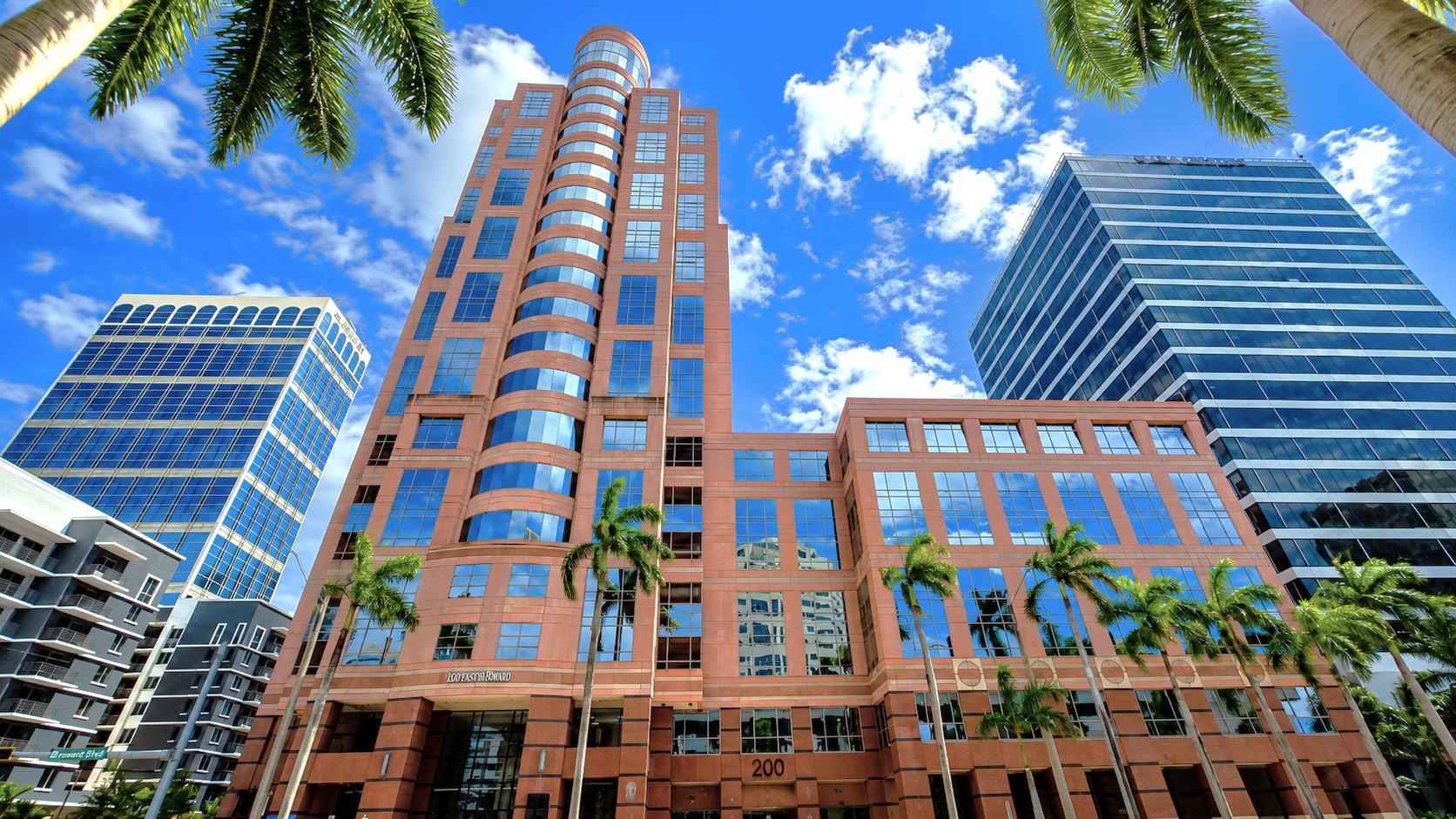
Image courtesy of Grover Corlew.
A downtown Fort Lauderdale office tower has changed hands for $11.8 million less than its previous owner paid nine years ago. In the same week, the city advanced plans for more than 4,000 homes across three residential projects.
The contrast is striking: the office buyer is betting on improving a partly vacant building, while residential developers are planning thousands of new apartments. Together, the transactions offer a snapshot of a city adding housing even as office properties face tougher pricing. They are a signal of changing investment priorities, not proof that Fort Lauderdale’s office market is collapsing.
A discounted sale, and a plan to reinvest
Boca Raton-based developer Grover Corlew paid $69.7 million for 200 East Broward, a 21-story office tower near Southeast Third Avenue and across from a federal courthouse. The seller was a joint venture that included Banyan Street Capital and Oaktree Capital Management. Banyan Street paid $81.5 million for the property in 2017.
The difference is $11.8 million, or about 14.5 percent of the earlier purchase price. That’s a nominal comparison between two sale prices; it does not account for costs, income, financing or any capital invested during the years between transactions.
The building, completed in 1991, contains 235,211 square feet of office space and is part of a 447,253-square-foot property. It is 75 percent occupied, meaning roughly one-quarter of the building is vacant, based on the reported occupancy figure.
A simple price-per-square-foot calculation offers another way to frame the deal: $69.7 million divided by 235,211 square feet of office space works out to about $296 per square foot. That calculation uses the office area, not the property’s larger total square footage.
Grover Corlew plans to invest $20 million over two years, including an amenity deck with a gym and conference facilities. The company has also described plans to modernize the lobby and elevators and upgrade tenant finishes. The bet is that an improved workplace can attract and retain tenants in a building where a quarter of the space is currently unoccupied.
JLL’s Hermen Rodriguez and Ike Ojala brokered the sale. In a company announcement, Grover Corlew described the purchase as part of its investment in downtown Fort Lauderdale.

Downtown Fort Lauderdale. This illustrative city view does not depict a specific development.
The transaction follows another discounted office sale in the city: in September, investor Moishe Mana bought the 30-story 110 Tower for $89 million, about 21 percent below the $112.9 million its seller paid a decade earlier. Two trades are worth watching, but they are not enough to draw a verdict on the whole office market.
They do, however, highlight the work facing owners of existing office buildings. At 200 East Broward, the purchase price is only one part of the investment. Filling empty space and making the building competitive will matter, too.
More than 4,000 homes move forward
While the office deal focused attention on occupancy and upgrades, three residential projects advanced in Fort Lauderdale during the same week. Combined, they account for 4,257 proposed homes: 3,144 at the Galleria mall, 773 at 317 North Federal Highway and 340 at 400 North Corporate Drive.
That total should be read with two important qualifications. First, the Galleria is not in downtown’s central core; it is a separate Fort Lauderdale location. Second, an approval is not a completed building. None of the three projects has announced a construction start.
Galleria: 3,144 homes approved administratively
The largest proposal is an eight-tower redevelopment of the Galleria mall. Fort Lauderdale granted administrative approval for eight 30-story towers with 3,144 residences, including 1,273 workforce-housing units, as well as 170 hotel rooms.
The consequential detail is how the plan was approved. Because it qualifies under Florida’s Live Local Act, it did not require a City Commission or planning-board vote. The city’s conditions require revised plans tied to the approved traffic study before the first building permit. The project also needs Florida Department of Transportation permits for Sunrise Boulevard improvements before it can receive its first certificate of occupancy.
The administrative approval moves a major proposal forward, but it does not erase those requirements, or guarantee that construction will begin.

Illustrative image of urban residential development; not a rendering of the Galleria proposal.
Federal Highway: a unanimous vote for 773 units
On October 20, the City Commission voted 5-0 to approve an amended site plan for Merrimac Ventures’ project at 317 North Federal Highway. The revised plan calls for 773 residential units, up from 716 in the developer’s original 2021 filing.
That earlier proposal described two towers of 42 and 45 stories, totaling about 1.4 million square feet, with 8,700 square feet of commercial space and 1,083 parking spaces. The approved amendment is identified as Case No. UDP-A26061; the applicant of record is 616 SE 4 Avenue, LLC. No construction timeline has been disclosed. The project’s approval and earlier plan show how the proposal has changed over its years in the city’s review process.
Corporate Drive: 340 apartments, including 136 affordable units
The city also approved Affiliated Development’s 340-unit, eight-story apartment project at 400 North Corporate Drive. The plan now includes 136 affordable units. Further details were limited in the available reporting, so the approval is best understood at that level. The Real Deal reported the project’s approval.
A bet on living downtown, and a test for offices
The week’s developments point in different directions but are connected by one underlying question: what kind of city is Fort Lauderdale becoming?
The residential approvals add to a pipeline of housing in the city, including projects near downtown and a major proposal at the Galleria. Meanwhile, 200 East Broward’s new owner is preparing to spend $20 million to make an existing office property more appealing to tenants. The combination suggests a bet on urban growth and on attracting people to live in the city, even as office owners work to make their buildings stand out.
But proposals and spending plans are not outcomes. The apartments still need to move through permitting and, eventually, construction. The office renovation still has to help address the building’s vacant space. And the discounted tower sale, alongside the 110 Tower transaction, is a pattern to monitor, not a market-wide conclusion.
For readers following South Florida’s development choices, the broader issue is where the region accommodates growth and how it balances new housing with the places that define it, from urban neighborhoods to the Everglades. None of this week’s approvals is a finished building. For now, Fort Lauderdale has a discounted office tower slated for reinvestment, and thousands of proposed homes waiting on what comes next.