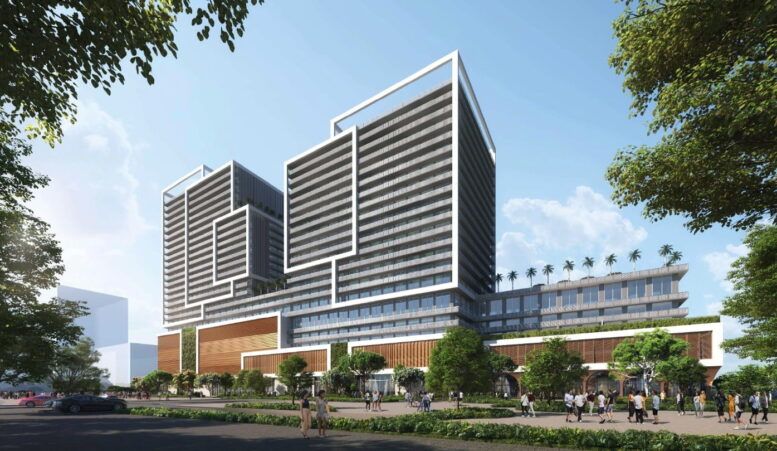
Rendering by Arquitectonica, via Florida YIMBY.
Two new rental towers planned for Little Haiti’s Magic City Innovation District have cleared Miami’s design review, moving 553 apartments one step closer to construction. Combined with the 349-unit Sixty Uptown project nearby, the plans put 902 upscale apartments in the district’s current residential pipeline.
The city’s Urban Development Review Board voted 4-0 on Oct. 21 to recommend approval of the two towers, subject to design and construction conditions, according to The Miami Times and Miami Lookout. The board’s action is a design review recommendation, not final city approval or a building permit.
The proposal comes as residents and neighborhood advocates have raised concerns about displacement and rising housing costs in Little Haiti. The project’s scale, expected timeline and affordability commitments are now central questions as the district advances.
What is planned at 255 and 275 NE 60th Street
The two buildings, identified as Parcels 13 and 15, are planned for 255 and 275 NE 60th Street. Arquitectonica designed the complex for Plaza Equity Partners and Dragon Global, according to Florida YIMBY’s project report.
The design calls for a 25-story tower and a 20-story tower sharing a parking podium. Together, they would contain 553 rental apartments, ground-floor retail and 718 parking spaces, based on project figures reported by The Miami Times. The unit mix is planned to include studios and one-, two- and three-bedroom apartments, Florida YIMBY reported.

Project rendering by Arquitectonica, via Florida YIMBY.
The site covers about 80,000 square feet, just under two acres, and the towers would share a garage podium with additional underground parking, according to Miami Lookout’s account of the city review. The plan also includes about 25,000 square feet of retail and a pedestrian promenade connecting the buildings with future parts of the district, Florida YIMBY reported.
The project is part of the roughly 18-acre Magic City Innovation District. The Miami Times reported that the larger development received city approval in 2019 for a phased plan that included 2,630 homes, 2.2 million square feet of office and retail space, and 432 hotel rooms. The two towers are among the residential components now advancing, but the wider district remains a multi-phase project.
The board’s conditions focus on the facade and pedestrian space
The UDRB’s 4-0 vote came with requirements for changes to the plans. According to Florida YIMBY, the conditions call for adjustments to facade articulation, removal of faux planting from exterior screening, and construction of the full-width proposed Les Bureaux Promenade at the same time as the buildings.
Those conditions address both how the project will look from the street and when its pedestrian space is delivered. The promenade is planned as a connection through the development, rather than an amenity left for a later phase. Miami Lookout reported that board members also discussed the long interior corridor and timing of the walkway during review.

Project rendering by Arquitectonica, via Florida YIMBY.
Despite the board’s recommendation, the project still has steps to clear. Miami Lookout reported that the planning director must make the next decision, followed by permitting. The board’s design review vote does not authorize construction on its own.
The schedule also remains prospective. The Miami Times reported that the development team has started the permitting process and that groundbreaking for the two-tower complex could occur as early as 2028. That is a possible start date, not a confirmed construction schedule.
Sixty Uptown brings the pipeline to 902 apartments
The other project in the 902-unit tally is Sixty Uptown, planned at 6001 NE Second Avenue. According to The Miami Times, the 25-story building is planned to contain 349 apartments, ground-floor retail and 393 parking spaces. The paper reported that developer Plaza Equity Partners expected to begin construction there in the second quarter of 2027.
The two projects would add different amounts of housing at different stages: Sixty Uptown is the first residential building expected to move toward construction, while the towers at 255 and 275 NE 60th Street remain subject to further review and permitting. Together, their planned apartment count is 902, or nearly 900.
But the unit total does not indicate how much housing will be within reach of existing residents. The Miami Times reported that Sixty Uptown’s apartments are not designated as affordable or workforce housing, and that the Magic City apartments are planned as market-rate rentals.
The affordability tension remains
The developers’ stated community-benefit mechanism is a $31 million commitment to the Little Haiti Revitalization Trust, according to The Miami Times. The paper reported that $6 million would be paid upfront, with the rest tied to building permits, to support affordable-housing preservation in the neighborhood.
The fund is part of the response to concerns that a major new development could intensify displacement pressure. It is not the same as setting aside affordable apartments within Sixty Uptown or the new towers. The Miami Times reported the distinction plainly: the project’s apartments are market-rate, while the trust commitment is intended to support neighborhood preservation.
The surrounding pressures are already visible in local housing costs. Francois Alexandre, president of Concerned Leaders of Little Haiti/Ti Ayiti, told The Miami Times that a one-bedroom apartment that rented for about $750 a month roughly a decade ago now goes for around $1,700 to $1,800. He also said commercial storefront rents had climbed from about $500 to roughly $2,800 a month. Alexandre attributed growing attention to Little Haiti to a mix of development interest and other factors, and said the neighborhood was not ready for the pace of change.

Project rendering by Arquitectonica, via Florida YIMBY.
For Little Haiti, the decision ahead is not simply whether new apartments will be built. It is also whether the district’s growth can deliver housing and public space without leaving longtime residents and local businesses further behind. The design board’s vote advances the towers, but the affordability question will remain as the project moves through city review and toward a possible 2028 groundbreaking.