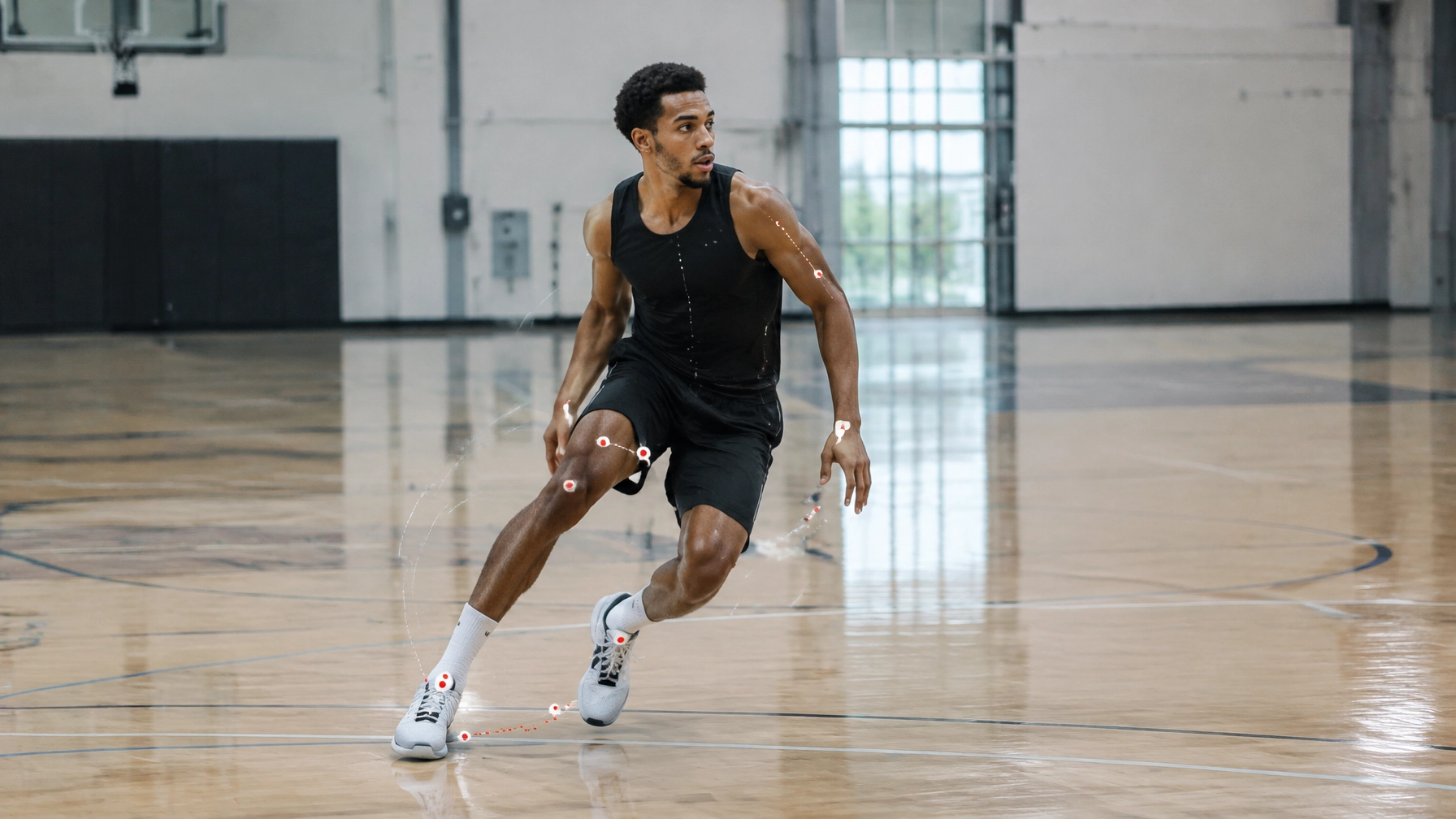
Illustrative image: a computer-vision system analyzing an athlete’s movement. It is not an image of OnSport AI’s product.
Brett Burman had a question he could not answer when he owned the London Lions basketball team: why were players, including athletes with NBA experience, suffering non-contact injuries, and what could the team do before the next one happened? As reported by Refresh Miami and Sports Business Journal, that problem helped inspire OnSport AI, a Miami startup developing software to identify changes in how athletes move.
“There was never an answer as to what was going on with these guys and how do we actually do anything to stop it and to make these guys healthier,” Burman told Sports Business Journal. “Really, I needed an alarm.”
On November 5, OnSport announced a $2 million pre-seed round led by undisclosed overseas basketball-team owners, according to Refresh Miami and Sports Business Journal. The funding gives the company resources to develop its product and expand partnerships. But the larger question is whether movement analysis can offer sports teams a useful warning before an injury occurs, and what evidence will show whether those warnings make a difference.
Looking for a change in an athlete’s own movement
OnSport’s system uses computer vision and machine learning to analyze how an athlete moves. Instead of comparing a player against a broad standard, it compares the player’s movement over time with that individual’s own history, looking for deviations from their usual patterns, according to Refresh Miami and Sports Business Journal.
The system can use league player-tracking data or, when that data is unavailable, video, the publications reported. OnSport says its assessments can be made during live play and through later review. The intended users are the coaches, medical staff and performance teams who make decisions about athlete workload and availability.
That individual baseline is central to the company’s approach. A movement pattern that is typical for one player may be unusual for another; the system is designed to flag a change relative to the athlete’s own past movement, rather than declare that a player falls outside a universal norm, according to Refresh Miami and Sports Business Journal.

OnSport AI co-founders Ahmad Ishaq (left) and Brett Burman (right). Photo via Refresh Miami.
Burman has argued that teams need more than data points; they need information they can use in a decision. “People like to give raw numbers and they like to give data, but when you’re sitting in a position where you need an answer, raw data actually becomes significantly irrelevant,” he told Refresh Miami. “You need something tangible in order to incorporate it.”
The distinction matters because injury-risk analysis is not the same as a diagnosis or a guarantee that an injury can be prevented. The reporting by Refresh Miami and Sports Business Journal describes OnSport’s product and its development, but does not provide published results showing that its alerts have reduced injuries. Whether the warnings translate into fewer injuries remains an open question.
Building the system around patterns, and time
Burman developed the company with Ahmad Ishaq, an entrepreneur with defense-technology experience who co-founded NFL-licensed virtual-reality company StatusPRO, according to Refresh Miami and Sports Business Journal. Adam Petway, a founding member who previously worked in biomechanics for the Washington Wizards and Philadelphia 76ers, leads OnSport’s biomechanics work, the publications reported.
Burman and Petway spent more than a year reviewing game film and research and feeding their findings into the company’s AI systems, according to the two reports. Their work focused on movement patterns that may precede serious injuries and on the mechanics of what happens at the moment of injury.
Petway cautioned against treating a single instant as the whole story. “Real-time feedback is important, but you have to look at the totality and the chronicity of the signature as a whole,” he told Refresh Miami. In practical terms, the company’s approach is intended to account for changes that may develop over time, as well as movement during a particular play.

Illustrative image of sports-performance staff reviewing movement. It does not depict OnSport AI’s software.
That creates a difficult technical and operational task: identifying which changes matter, then presenting the information in a form staff can interpret. The company’s founders bring experience in basketball, biomechanics and technology, but the reports do not disclose detailed performance metrics, independent validation results or the specific thresholds the system uses.
Pilots and partnerships, with details still private
OnSport says it has been working with an unnamed NBA team on a pilot for more than a year. Refresh Miami and Sports Business Journal also reported that the company has agreements with organizations across the NBA, NCAA, international basketball and professional soccer. The partners were not named, and the reports did not disclose financial terms.
The company’s initial focus is basketball, while its reported work extends to professional soccer. Sports Business Journal also reported that OnSport is expanding into golf. The company has an office in Orange County, California, in addition to its Miami base, and plans to advance military-related work, according to Refresh Miami.

Illustrative image of an athlete and performance specialist discussing movement on a training court.
Ishaq has described the potential applications beyond professional sports. “The same insights that help protect a professional athlete can help protect any worker, whether in the military or the labor sector,” he told Refresh Miami. That is a stated direction for the company, not evidence that the product has already been deployed or validated across those work settings.
What the new funding is meant to support
OnSport plans to use the $2 million pre-seed funding for product development, engineering and biomechanics hires, and additional sports partnerships, according to Refresh Miami and Sports Business Journal. The investors were described as overseas basketball-team owners, but were not identified.
The round also arrives as Miami’s technology scene continues to attract companies working beyond conventional software categories. South Florida Digest has covered other local technology ventures, including a Miami TikTok Shop agency that announced an eight-figure Series A. OnSport’s focus is different: it is trying to turn athletes’ movement data into information that team staff can act on.
For now, the company’s core proposition is an earlier, more individualized signal, not a proven reduction in injuries. The next important measure will be whether teams can use that signal in real decisions, and whether later evidence shows that doing so improves athlete outcomes. As the Miami startup develops its product and adds partners, those results will determine how far its “alarm” can go.