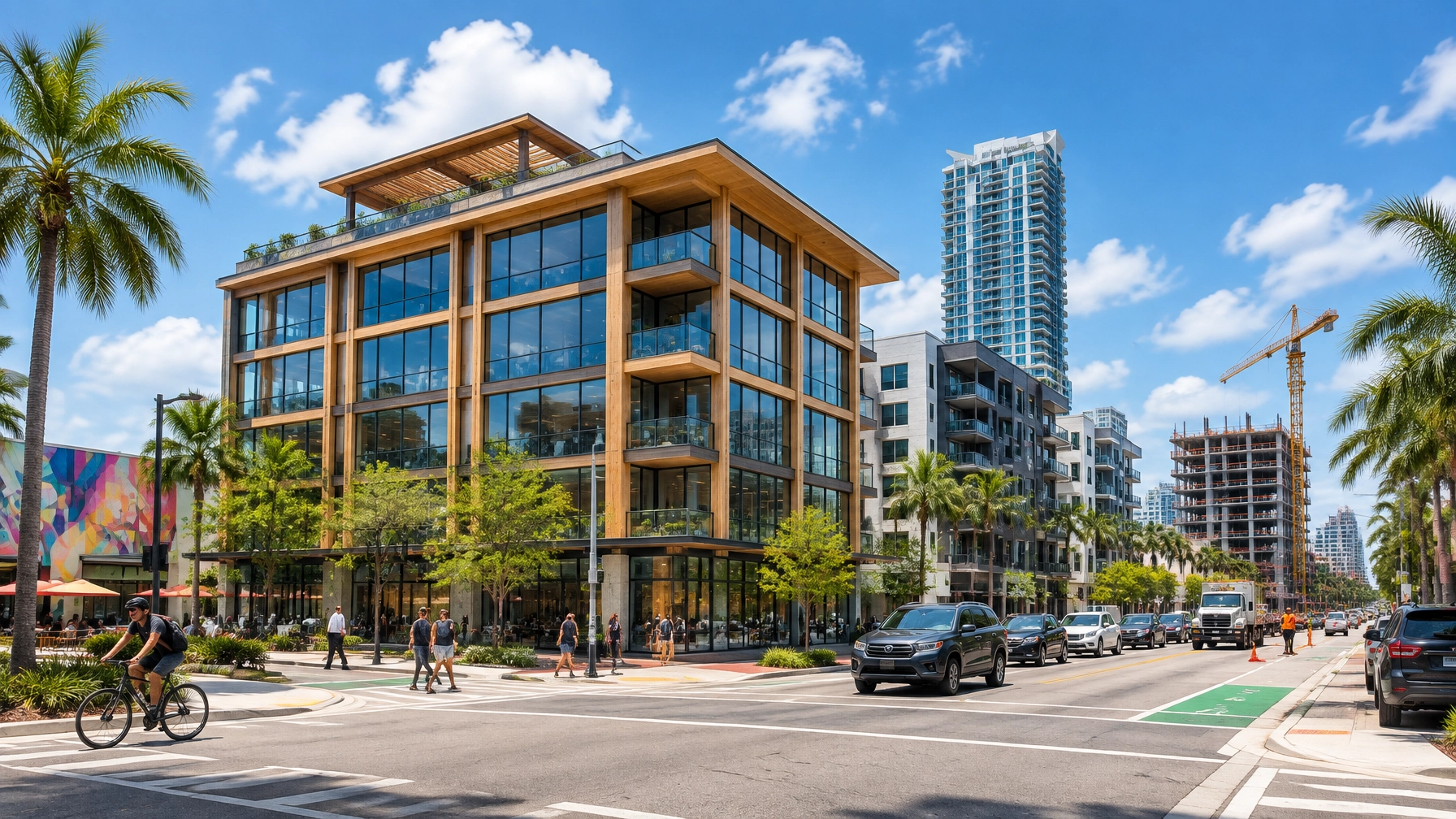
GXO’s arrival at T3 FAT Village is putting a global logistics company at the center of Broward County’s expanding corporate story.
The company has committed to a 35,000-square-foot regional office at the new Fort Lauderdale development, where it will support growth across its Americas and Asia-Pacific businesses. The move gives GXO a significant South Florida base and makes it the largest announced office tenant at T3 FAT Village.
The office is expected to become operational as tenants move into the building in 2027. Its arrival, alongside new public infrastructure and continued investment across Miami-Dade and Palm Beach counties, points to a South Florida business environment increasingly shaped by corporate expansion, specialized office demand and large-scale development.
GXO gives Flagler Village a major corporate tenant
GXO is a global contract logistics company with approximately 150,000 employees in 27 countries. Its operations rely on technology-driven supply chain services, including automation, robotics, artificial intelligence and machine learning.
The company serves roughly 30% of Fortune 100 companies, according to the Greater Fort Lauderdale Alliance, which assisted with GXO’s expansion.
GXO’s new office will be located at T3 FAT Village, 501 N. Andrews Avenue, in Flagler Village north of downtown Fort Lauderdale. The six-story building is being developed by Hines and Urban Street Development as the office centerpiece of the broader FAT Village redevelopment.
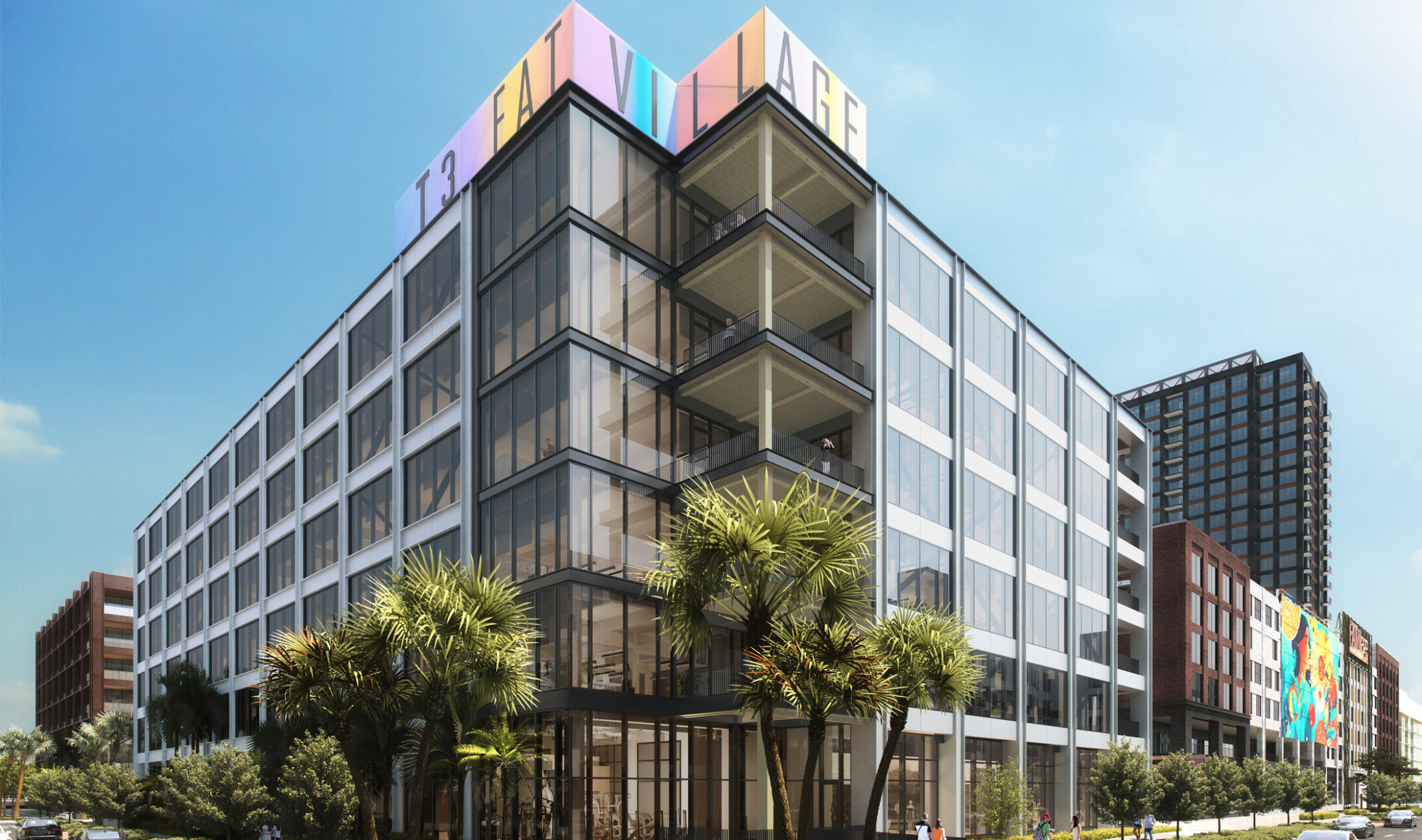
T3 will contain approximately 180,000 square feet of office space, with ground-floor retail, a conference center, gym, bike storage, balconies and large windows. Its mass-timber construction and mixed-use setting are designed to compete for companies that want more than a traditional suburban office park.
The building is also the first major new office project in Fort Lauderdale’s urban core since the completion of Main Las Olas in 2021. GXO and CBI Workplace Solutions are the first announced office tenants. CBI has leased 6,000 square feet and plans to relocate from its existing Las Olas Boulevard office.
That combination matters for Broward’s commercial real estate market. Large companies are still evaluating office space carefully, but the strongest demand is concentrating in new, amenity-rich buildings that can help attract and retain workers.
What the move could mean for hiring
GXO has not announced a specific number of new Fort Lauderdale positions tied to the office. Still, the company’s regional role suggests a workforce that could include corporate, technology, supply chain, finance and management professionals.
The Fort Lauderdale location also gives GXO access to a broad labor pool stretching across Broward and northern Miami-Dade. Employees can live in downtown Fort Lauderdale, Flagler Village, Oakland Park, Wilton Manors, Hollywood or communities farther west while remaining connected to the office.
The office’s location could be especially important as companies compete for workers who want shorter commutes and more flexibility in how they use office space. A mixed-use district with restaurants, apartments, retail and public gathering areas can offer a more convenient workday than a standalone office campus.
FAT Village is planned as a 5.6-acre neighborhood combining office space with residential buildings, dining, retail, art and entertainment. That development pattern gives employers access to nearby services while supporting a more active district outside traditional business hours.
For Fort Lauderdale, the GXO commitment also strengthens the city’s position as a destination for logistics and corporate operations. Broward already benefits from its proximity to Port Everglades, Fort Lauderdale-Hollywood International Airport, major highways and South Florida’s international trade networks.
Public investment is reinforcing the business environment
GXO’s office is arriving as Fort Lauderdale completes a major public-sector investment of its own.
The city recently opened its approximately $165 million police headquarters at 1300 West Broward Boulevard. The 191,000-square-foot facility includes a real-time crime center, forensic and digital investigation areas, training spaces and hardened construction designed to withstand a Category 5 hurricane.
The headquarters is intended to support more than 700 sworn and civilian employees. It replaces the city’s aging 1958 police facility and provides a modern operations base for public safety and emergency coordination.
That project is not an office-market transaction, but it is part of the same broader development picture. New civic facilities can help improve the perception of a city’s infrastructure, support downtown employment and contribute to long-term confidence among businesses considering relocation or expansion.
For employers, infrastructure investment can affect more than public safety. It can influence insurance considerations, resilience planning, business continuity and the overall quality of the urban environment.

The practical question for Broward will be how these projects affect daily movement. A larger downtown workforce can increase demand for parking, transit, sidewalks, restaurants and nearby housing. T3 FAT Village’s location near downtown and Flagler Village places it within an area already experiencing residential growth, which could reduce some commutes while adding pressure to local streets.
Miami-Dade is attracting a different kind of office demand
The corporate activity is not limited to Broward.
In Miami’s Design District, the new Sweetbird North project has landed prominent tenants including Atria Health and Research Institute, alternative asset manager 26North Partners and private equity firm Raycliff Capital.
The Snøhetta-designed project at 95 NE 40th Street will include approximately 92,000 square feet of office space and 22,500 square feet of retail. Atria is expected to serve as the anchor tenant with approximately 55,000 square feet, while 26North and Raycliff are each taking a full floor.
The leasing activity illustrates a different part of the South Florida office market: specialized, high-end space aimed at financial services, healthcare, investment and creative-sector companies. Miami-Dade continues to draw firms seeking proximity to capital, international business networks and the lifestyle amenities associated with neighborhoods such as the Design District, Brickell and Miami Beach.
For Broward, the comparison is useful. Fort Lauderdale is not trying to replicate Miami’s financial core. Instead, projects such as T3 FAT Village are positioning the city around logistics, technology, professional services and companies that want an urban setting without being in Miami’s most expensive office districts.
Residential and transportation projects will shape commuting patterns
Office expansion cannot be separated from housing and transportation.
In Delray Beach, a 26-residence condominium project secured a $25 million construction loan and is scheduled for completion in the third quarter of next year. While the project is outside Broward and Miami-Dade, it is another sign that construction financing remains available for well-positioned South Florida developments.
In Miami-Dade, transportation investment remains a more complicated story. Public records show that Miami-Dade approved an interim agreement connected to the proposed Miami-to-Miami Beach monorail in 2020. That preliminary agreement was valued at up to approximately $14 million for design and predevelopment work.
The frequently cited $600 million figure refers to an estimated overall construction cost, not a newly approved interim contract. The project would connect downtown Miami and Miami Beach along the MacArthur Causeway, but its final development and financing structure remains unresolved.
If built, such a system could alter commute patterns between Miami’s urban core and Miami Beach. For now, employers and workers must continue to plan around existing road congestion, Metrorail, Metromover, Brightline, Tri-Rail, buses and private vehicles.

Housing policy is also affecting the development pipeline. Crescent Heights revised its proposal at 824 Alton Road in Miami Beach under Florida’s Live Local Act. The latest plan calls for a tower approximately 525 feet tall with 149 residences, including 72 workforce housing units and 77 market-rate units.
That proposal reflects a regional pressure facing both employers and employees: new jobs are valuable only if workers can afford to live within a reasonable distance of them. Workforce housing, transit access and mixed-use development will increasingly influence where companies choose to locate and whether employees can remain in the region.
A broader signal for South Florida business
GXO’s 35,000-square-foot office is not proof that every South Florida office market is recovering equally. It is a more specific signal: Companies with regional or international functions are still willing to make substantial commitments when a building offers the right combination of location, design, infrastructure and access to talent.
In Broward, T3 FAT Village provides a high-profile test of that demand. Its success could encourage additional office investment in Flagler Village and downtown Fort Lauderdale, while increasing pressure for better transportation connections and more housing choices.
In Miami-Dade, the Design District’s leasing activity shows that demand is strongest in buildings with a clear identity and a targeted tenant strategy.
Together, the projects suggest that South Florida’s next phase of commercial growth will be less about broad office expansion and more about carefully positioned districts. The companies, workers and residents that follow will help determine whether those districts become durable employment centers, or simply isolated developments in an increasingly expensive region.