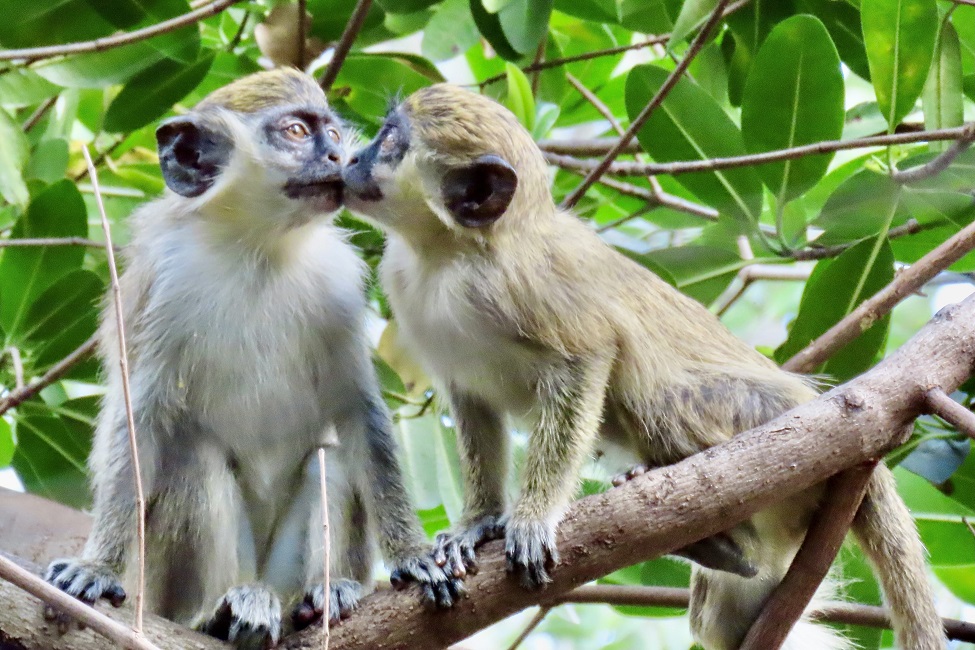
For nearly 80 years, a small troop of African vervet monkeys has lived in the mangroves, airport edges and parking lots of Dania Beach. The colony has survived highways, utility lines, construction and the steady expansion of South Florida’s urban landscape.
To many nearby residents and workers, the monkeys are familiar neighbors: and an unexpected piece of local identity. To Florida wildlife officials, however, they remain a nonnative population that cannot be treated like native wildlife simply because it has been here for decades.
That disagreement is at the center of a debate with no easy answer: Should Dania Beach’s vervet monkeys be protected as a distinctive local population, or should Florida continue to manage them under its rules for introduced species?
The question has become a notable piece of South Florida news, combining wildlife science, local history, public policy and the kind of unusual neighborhood story that has made the monkeys minor South Florida entertainment celebrities.
How African monkeys arrived in Dania Beach
The colony’s history begins with the Anthropoid Ape Research Foundation, a Dania Beach facility established in the 1940s by Leila Roosevelt Denis and Armand Dennis. The organization operated as both a research facility and a zoo, importing primates from Africa for biomedical research and public display.
According to research from Florida Atlantic University, the monkeys escaped from the facility around 1948. Historical records and interviews with longtime residents helped researchers connect that escape to the colony now living near Fort Lauderdale-Hollywood International Airport.
The facility was later known as the Dania Chimpanzee Farm. It closed in the 1950s after the property changed hands and Florida Power & Light acquired the land.
Genetic research eventually corrected an earlier assumption about the monkeys’ identity. Scientists had once believed they might be a hybrid population or related to East African vervets. DNA testing confirmed that the Dania Beach monkeys are Chlorocebus sabaeus, commonly called green monkeys, whose natural range extends across parts of West Africa, including Sierra Leone, Ghana and nearby regions.
The Dania Beach population, then, is not native to Florida. It is descended from animals brought to the state by people and later released: or escaped: into the wild.
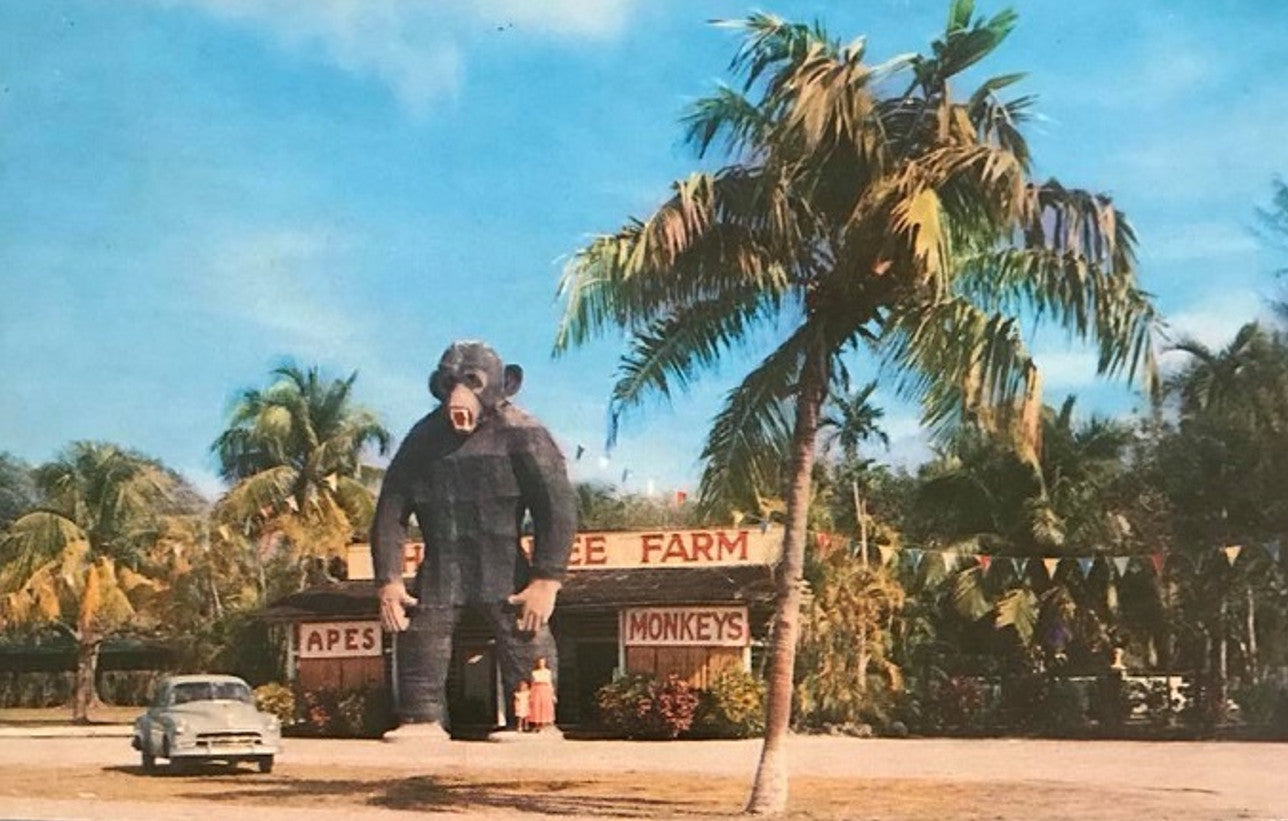
Historical context: the Dania Beach Vervet Project traces the colony to the former Dania Chimpanzee Farm.
A small colony that has barely grown
Population estimates have varied over the years, but detailed surveys point to a colony of roughly 35 to 41 monkeys divided among three or four social groups.
A study in the early 1990s counted approximately 36 animals. A later census conducted from 2014 through 2020 identified about 40 monkeys. Those figures suggest the colony has remained relatively stable for decades rather than expanding rapidly across Broward County.
That stability is one reason the Dania Beach debate differs from Florida’s more aggressive battles with Burmese pythons, iguanas and some populations of rhesus macaques. The vervets have not spread across large areas, established a significant agricultural presence or become a widespread nuisance.
They generally remain concentrated around mangrove habitat and nearby developed areas, including airport-related properties and parking lots. Their range is limited by roads, buildings and the fragmented nature of the remaining habitat.
But stable does not necessarily mean secure.
Research led by primatologist Deborah “Missy” Williams suggests that the colony’s small size creates serious risks. In the wild, young male vervets normally leave their birth groups and join other troops. That movement helps prevent inbreeding. In Dania Beach, the monkeys have fewer opportunities to disperse, and the colony’s limited genetic diversity could affect its long-term health.
Williams’ population models have suggested that the colony could disappear within roughly 50 to 100 years, with some projections placing extinction closer to 50 years if current conditions continue.
The threats are often human-made. Monkeys have been struck by vehicles, injured on electrical infrastructure and captured illegally for the exotic-pet trade. Some injured animals have been taken into captivity, where they cannot legally be returned to the wild under Florida’s rules for nonnative wildlife.
Why Florida officials resist calling them native
The definition of “native” is not based simply on how long a species has lived in one place.
A native species occurs naturally in a region without being introduced there by people. Florida has no native monkey species, which means the Dania Beach vervets do not meet the scientific definition of native wildlife, regardless of how many generations have been born in the mangroves.
The Florida Fish and Wildlife Conservation Commission treats the monkeys within the state’s broader nonnative and invasive-species framework. The distinction matters. A nonnative species has been introduced outside its natural range. It becomes invasive when it causes, or presents a meaningful risk of causing, harm to native species, ecosystems, agriculture or people.
Researchers have not documented major ecological damage caused by the Dania Beach vervets. The colony does not appear to be spreading quickly, and studies have not established that it is significantly reducing native wildlife populations.
Still, wildlife officials say the absence of clearly documented harm does not prove that no harm exists. The ecological effects of an introduced species can be subtle, delayed or difficult to measure: particularly in a sensitive mangrove ecosystem.
The commission has therefore taken a cautious position: The existing colony may remain, but captured monkeys cannot simply be released back into the wild. Officials have cited the uncertain environmental effects of the monkeys, as well as the risk of bites, scratches and disease transmission when people handle wildlife.
That position conflicts with the approach advocated by Williams and the Dania Beach Vervet Project. The group has sought more flexible policies that would allow rescued monkeys to return to the colony when appropriate, or would provide the population with a special form of local protection.

The monkeys regularly move between mangrove habitat and nearby developed areas. (AP Photo/Rebecca Blackwell, via CBS News Miami)
The proposal: protection, not a formal declaration of nativeness
The debate is sometimes described as a proposal to make the monkeys native. That wording can be misleading.
There is no known formal FWC action that has reclassified the Dania Beach vervets as a native species. Nor has the state granted them the same legal status as wildlife that evolved in Florida or arrived without human involvement.
Instead, advocates have called for a tailored management strategy: sometimes described as “grandfathering” the colony into a protected or heritage-wildlife category.
The requested changes have included:
- Allowing captured Dania Beach vervets to be released under carefully controlled circumstances.
- Protecting the existing colony from unnecessary removal.
- Supporting sanctuary space for injured, confiscated or unreleaseable animals.
- Continuing population, health and genetic monitoring.
- Recognizing the monkeys as part of Dania Beach’s modern cultural and environmental history.
The commission’s concern is precedent. Creating an exception for one popular nonnative species could make it harder to enforce broader policies designed to prevent the release and spread of introduced animals.
That puts the state and local advocates on opposite sides of the same practical problem. Both acknowledge that the population is unusual and geographically limited. They disagree over whether that should lead to special protection or stricter caution.
What locals think about their monkey neighbors
In Dania Beach, public opinion has generally been more welcoming than the state’s policy language.
The monkeys are occasionally spotted climbing fences, crossing parking areas or moving through the mangroves. Airport workers and nearby businesses have grown accustomed to them, and visitors sometimes arrive hoping to take photographs.
A survey conducted by Williams between 2015 and 2018 found that about 70 percent of more than 230 respondents said the monkeys were openly welcomed. Only about 7 percent said the animals should not receive protection because they are nonnative, according to Science News.
Some local businesses have embraced the colony’s unusual appeal. LauderAle Brewery, which sits near areas where the monkeys roam, has hosted fundraisers for sanctuary efforts. Residents have also contacted local officials to report concerns about injured monkeys or possible trapping.
The affection has a downside. Feeding the monkeys has made them unusually comfortable around people. The city of Dania Beach passed an ordinance prohibiting the practice in 1993, and Florida law also restricts feeding wild monkeys. Human food can alter animal behavior, encourage aggressive encounters and draw the monkeys into dangerous areas.
The safest response for residents and visitors is to observe from a distance, avoid feeding them and never attempt to touch, capture or transport a monkey.
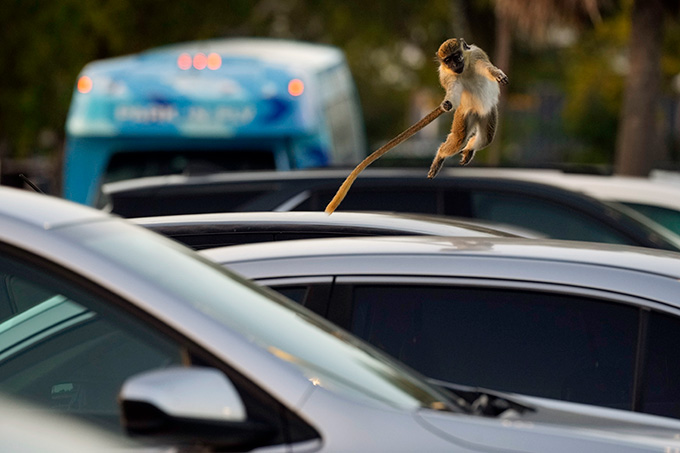
The colony’s proximity to roads, parking areas and people creates both its local visibility and many of its risks.
Can a species become “local” without becoming native?
That may be the more useful question.
The Dania Beach vervets are clearly nonnative by scientific definition. But they are also an established population with a documented history, recognizable social groups and a relationship with the surrounding community.
Those facts do not erase ecological concerns. They do, however, complicate the idea that management must be limited to removal, captivity or eventual extinction.
The strongest case for protection is based on the colony’s small size, limited range and vulnerability to human activity. The strongest case against reclassification is based on uncertainty: Florida cannot know with complete confidence how the monkeys may affect native wildlife over time, especially as the region’s landscape changes.
For now, the practical compromise remains uneasy. The monkeys are tolerated where they are, but they are not considered native. Injured animals may receive care, but they generally cannot return to the wild after being taken into possession. Residents may value the colony, while wildlife officials continue to view it through the lens of invasive-species policy.
Dania Beach’s monkeys may never become legally native. But their future will likely depend on whether Florida can develop a management policy that recognizes both sides of the debate: the risks of introduced wildlife and the responsibility people bear for animals whose presence began with human actions nearly eight decades ago.
Read the University of Florida’s overview of nonnative monkey populations in Florida and learn more about the Dania Beach Vervet Project.