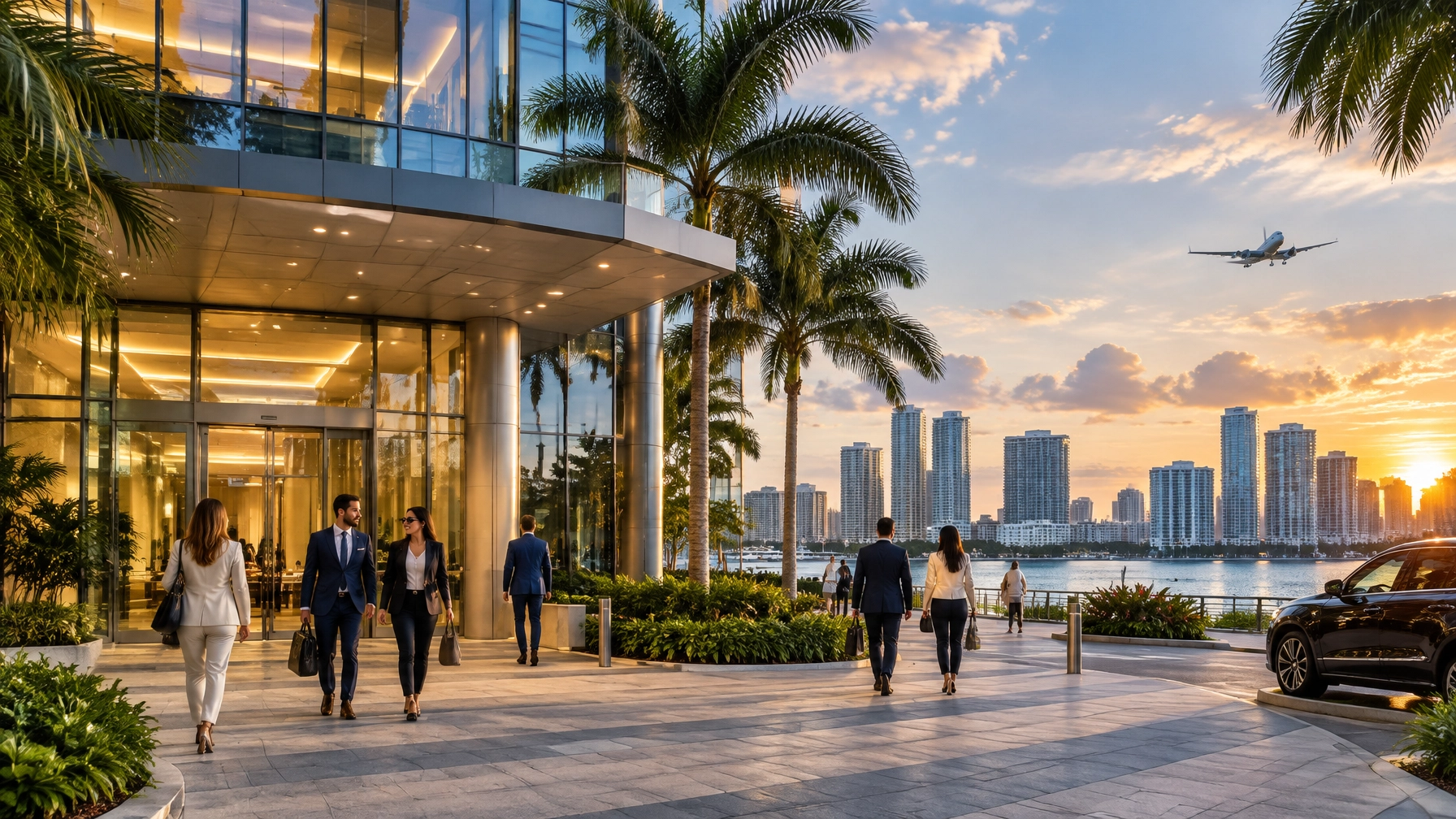
South Florida is closing out the first week of October with a concentrated run of corporate expansions, new offices, aviation investments and mixed-use development announcements.
The activity is spread across different industries, but the geography is consistent: Broward’s FAT Village and downtown Fort Lauderdale are attracting regional offices and established operators, while Miami’s Brickell and Wynwood districts continue to draw luxury-service companies, professional firms and development capital.
The announcements do not represent a single corporate relocation cycle. Instead, they show a diversified expansion pattern involving logistics, private aviation, cruise operations, law, construction, luxury transportation and real estate.
That combination is important for the region’s economy. It suggests that companies are not only seeking South Florida’s consumer market. They are also looking for access to international trade routes, aviation infrastructure, specialized talent, affluent customers and high-quality office environments.
GXO Logistics gives FAT Village a major corporate anchor
The most significant office announcement came from GXO Logistics, which said October 5 that it is opening a 35,000-square-foot regional office at T3 FAT Village in Fort Lauderdale.
GXO is the world’s largest pure-play contract logistics provider, with approximately 150,000 employees in 27 countries. The company serves major corporate customers through technology-driven supply-chain operations that include automation, robotics, artificial intelligence and machine learning.
The Fort Lauderdale office will support GXO’s Americas and Asia-Pacific business.
T3 FAT Village is the office centerpiece of the broader FAT Village redevelopment in Flagler Village. The mixed-use project is designed to combine office space with residential, retail, restaurants, public gathering areas and immersive art installations.
The GXO announcement gives the development a substantial corporate tenant and strengthens Fort Lauderdale’s position as a location for regional operations. It also supports Broward’s long-standing effort to attract logistics and trade-related companies that can use the county’s access to Port Everglades, Fort Lauderdale-Hollywood International Airport and major interstate corridors.
As covered in South Florida Digest’s business reporting, the region’s strongest office demand has increasingly concentrated in newer, amenity-rich projects. T3 FAT Village fits that pattern by offering modern office space in a walkable district close to housing, restaurants and entertainment.
Fort Lauderdale’s aviation cluster is expanding
Private aviation is another major driver of the Broward expansion story.
Capital Jets opened a Fort Lauderdale location on October 6 as it expands its South Florida operations. The company provides aircraft management, acquisition support and on-demand charter services. Its local strategy is designed to serve clients and aircraft owners in Miami, Palm Beach and surrounding markets while reducing the need to reposition charter aircraft over longer distances.
The move adds another operator to a regional aviation ecosystem that already includes executive airports, fixed-base operators, aircraft management companies, maintenance providers and private charter businesses.
Ocean Aviation is making an even larger commitment in Miami-Dade. Backed by Kennedy Lewis Investment Management, the company broke ground this week on a flagship campus at Miami Executive Airport.
The planned $67 million development is expected to include up to 400,000 square feet of communal and private hangar space, a premium terminal, a fuel farm and a common-use taxi lane and ramp supporting international general aviation operations. The project also includes plans to relocate the Wings Over Miami Air Museum.
Ocean Aviation holds a 40-year, 40-acre ground lease at Miami Executive Airport. The company also acquired National Jets at Fort Lauderdale-Hollywood International Airport in September, giving it a planned operating network that connects the Miami Executive and Fort Lauderdale airports.
The scale of the project reflects demand from corporate flight departments, aircraft owners, international operators and high-net-worth travelers. It also creates potential work for construction companies, aviation specialists, hospitality providers and airport-support businesses.
South Florida’s aviation growth, however, comes with environmental and infrastructure considerations. Miami Executive Airport sits within a region shaped by the Everglades, sensitive wetlands and complex flood-control systems. New aviation facilities require careful attention to stormwater, fuel management, drainage, traffic and resilience as extreme heat and heavy rainfall become more important planning factors.
The same environmental backdrop affects logistics facilities and industrial projects across the region. Companies may be attracted by South Florida’s connectivity, but their long-term operating decisions increasingly depend on flood protection, insurance costs, backup power and the reliability of water and transportation infrastructure.
Cruise operations and construction services reinforce Broward’s appeal
Atlas Ocean Voyages is expanding its Fort Lauderdale headquarters through an office expansion and long-term lease renewal at 1 East Broward Boulevard.
The luxury expedition-cruise company’s office footprint will reach 15,000 square feet after the expansion. Atlas is part of Portugal-based Mystic Invest Holding and operates its U.S. headquarters in Fort Lauderdale.
The company’s decision to expand rather than relocate reinforces the city’s role as a base for cruise, marine and tourism businesses. Fort Lauderdale’s proximity to Port Everglades, the airport and the broader South Florida hospitality workforce remains a central advantage for those companies.

Miller & Myers Demolition Group is also expanding north from Miami-Dade. The company opened a Broward office at 200 South Andrews Avenue in Fort Lauderdale to serve the local demolition market.
Its services include residential and commercial interior demolition, full teardowns and site clearance. The Broward office positions the company to compete for work tied to redevelopment, tenant improvements and new construction throughout Fort Lauderdale and surrounding communities.
The expansion is a sign of how larger development cycles spread through the business ecosystem. A new office tower, apartment building or mixed-use project creates demand not only for architects, lenders and contractors, but also for demolition firms, surveyors, engineers, legal advisers and specialized trades.
Miami adds legal and luxury-service capacity
Miami-Dade’s expansion activity is more concentrated around professional services, high-end consumers and urban development.
Global labor and employment law firm Fisher Phillips launched its Miami office on October 1 with a team from Miami-based Zumpano Castro. The office initially operates as Fisher Phillips Zumpano, the Miami office of Fisher & Phillips LLP.
The firm has nearly 900 attorneys globally. Its Miami team brings experience in employment litigation, compliance, workplace counseling, commercial disputes and professional employer organization services. Fisher Phillips also plans to hire 13 additional lawyers as it builds its Miami presence.
The expansion reflects the demand created by South Florida’s increasingly complex employer base. As companies establish offices, hire employees and operate across multiple jurisdictions, they require counsel on labor regulations, employee disputes, compliance and business risk.
The firm’s local leadership also illustrates why national companies often enter Miami through established regional teams. Local relationships, cultural fluency and knowledge of the South Florida business community can be as important as the size of a national platform.
Octane Rent is taking a different route into Miami. The Dubai-based luxury car rental company launched its U.S. operations in Brickell on October 7.
The company is entering a market supported by international tourism, luxury hotels, nightlife, major events and an existing customer base that travels between Dubai and South Florida. Its fleet model includes vehicles from more than 30 brands, with inventory ranging from standard cars to high-end models such as Lamborghini, Bentley and Rolls-Royce.
Brickell offers Octane Rent direct access to a dense concentration of hotels, offices, restaurants, residential towers and financial firms. The location also places the company within the customer and visitor network that supports Miami’s broader luxury economy.
Wynwood’s development pipeline continues to grow
Rilea Group broke ground on Mohawk at Wynwood, a mixed-use project at 50 Northeast 29th Street.
The development is planned to include 300 rental apartments and approximately 29,000 square feet of ground-floor retail. It will feature two residential towers, an open-air pedestrian paseo and retail spaces designed for restaurants and flagship stores.
Mohawk is positioned between the Wynwood Arts District and Midtown Miami, near a corridor where significant office, residential and institutional development is underway.

The project is also connected to the region’s expanding employment base. Rilea Group has said Mohawk is close to Amazon’s Miami offices and within a broader district attracting technology, finance, retail and creative-sector businesses.
With its residential and retail components, Mohawk reflects the type of development that companies increasingly seek around their offices: housing, services, restaurants and walkable public spaces in the same district.
What the expansion wave says about South Florida
The October announcements point to several distinct trends.
First, Broward is competing through quality and connectivity. FAT Village and downtown Fort Lauderdale are attracting companies that want modern offices without operating in Miami’s most expensive and congested business districts. Broward also offers proximity to Port Everglades, major airports, industrial corridors and a growing downtown workforce.
Second, Miami remains the region’s strongest platform for luxury and international services. Brickell and Wynwood provide access to affluent customers, global visitors, financial firms, technology companies and a dense urban talent pool.
Third, aviation and logistics are mutually reinforcing. Companies that move goods, aircraft, passengers and high-value services benefit from South Florida’s position between the United States, Latin America, the Caribbean and international markets.
Fourth, hiring could extend well beyond the companies opening offices. GXO’s regional operation, Fisher Phillips’ planned legal hiring and Ocean Aviation’s construction and future airport operations are direct examples. Indirect demand will reach contractors, property managers, hospitality businesses, aviation technicians, attorneys and other professional-service providers.
The outlook is not without constraints. Housing affordability, insurance costs, traffic, airport capacity, climate resilience and water management will continue to influence expansion decisions. The Everglades and the region’s engineered water system remain part of that economic calculation, particularly for logistics, aviation and industrial development.
For now, the pattern is clear: South Florida’s corporate growth is becoming more distributed, more specialized and more closely tied to the infrastructure of Broward and Miami-Dade. Fort Lauderdale is building a stronger platform for regional offices and operating companies, while Miami continues to attract global brands, luxury services and high-value professional firms.