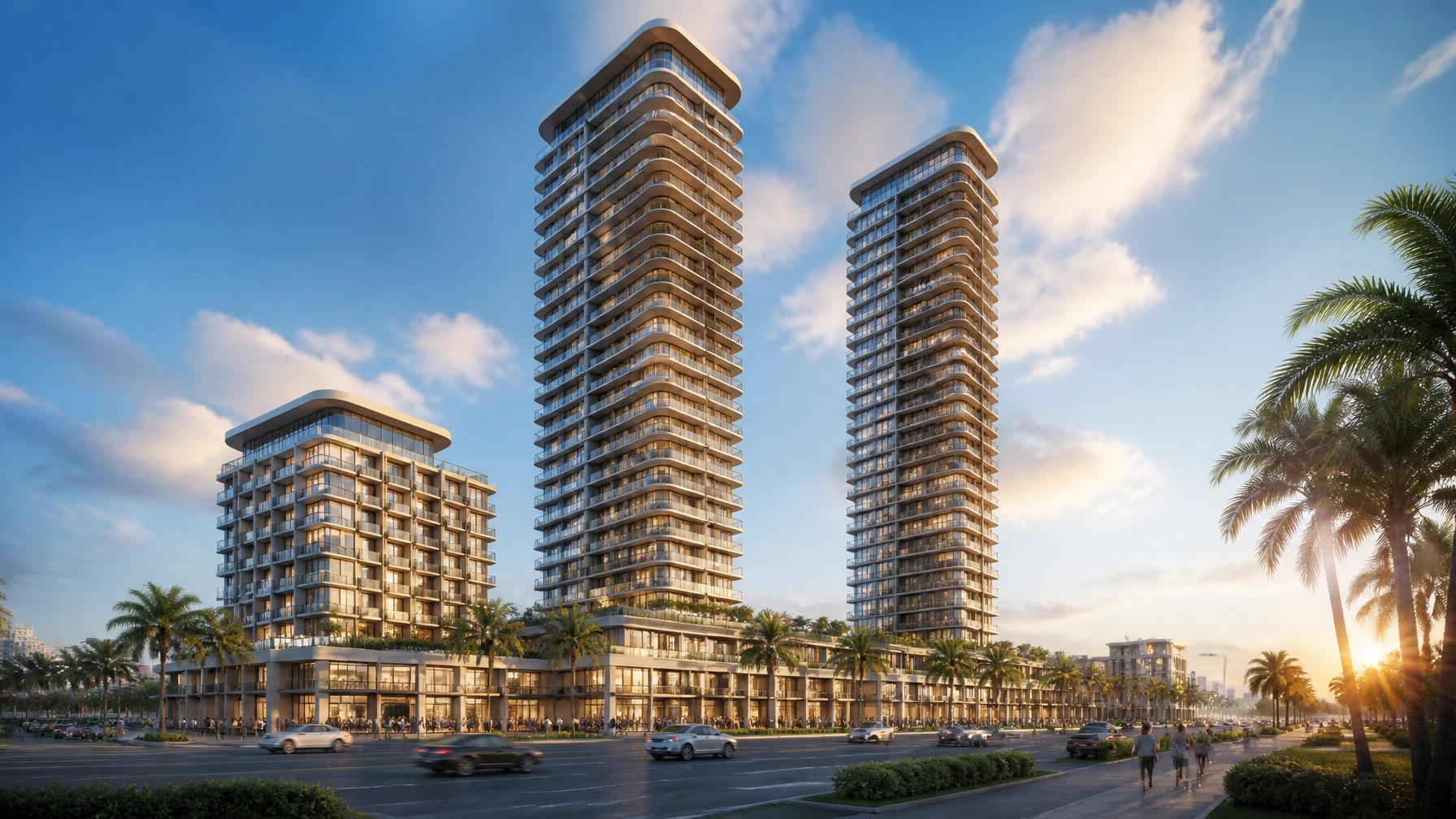
A proposed residential development on Fort Lauderdale’s Cordova Road is poised to become one of the city’s largest projects built under Florida’s Live Local Act.
Called Terrasse, the project would bring 765 apartments in three towers to a 3.1-acre site at 1625 and 1645 Cordova Road, the former Winn-Dixie property near the 17th Street Causeway. The proposal includes two 36-story towers, a 19-story building, approximately 3,200 square feet of commercial space and about 1,230 parking spaces.
The application is significant not only because of its size, but because it shows how the Live Local Act is changing the development process in South Florida. A commercial site that would not ordinarily support this scale of residential density could qualify for administrative approval if the project meets the law’s affordability requirements.
The proposal remains subject to city review. There is no reported construction start date, final site-plan approval or building-permit issuance at this stage.
What is planned for the Cordova Road site?
The Terrasse application divides the 765 apartments into an affordable or workforce-housing component and a market-rate component.
The project includes:
- 765 total apartments
- 306 workforce-housing units
- 459 market-rate units
- Two 36-story towers
- One 19-story building
- Approximately 3,200 square feet of commercial space
- Approximately 1,230 parking spaces
- A 3.1-acre development site
The market-rate portion reportedly includes 106 studios, 217 one-bedroom apartments, 81 three-bedroom apartments and 55 four-bedroom apartments.
The 306 workforce units represent exactly 40% of the project, the threshold generally required for a qualifying multifamily development under the Live Local Act.

How the affordability commitment works
Florida’s Live Local Act requires qualifying developments to reserve at least 40% of their residential units for affordable rental housing for a minimum of 30 years.
For Terrasse, those 306 units are reportedly intended for households earning up to 120% of area median income, or AMI. The proposal references an area median income of approximately $97,600, although income limits can vary based on the year, household size and the agency administering the program.
That distinction matters. “Affordable housing” under the law does not necessarily mean units reserved exclusively for the lowest-income households. The 120% AMI ceiling generally reaches moderate-income and workforce households, including some teachers, health care workers, public employees, hospitality workers and other employees whose incomes may be too high for traditional subsidized housing but too low to comfortably afford new market-rate apartments.
The affordability restriction is also not a short-term incentive. Units must remain within the program’s affordability requirements for at least three decades to retain Live Local eligibility.
For Fort Lauderdale, the central policy question is whether projects such as Terrasse will produce housing that is genuinely attainable for local workers while also adding enough market-rate revenue to make large-scale construction financially feasible.
Why the project can reach 36 stories
The Live Local Act gives qualifying developments substantial protection from local zoning restrictions.
In general, the law applies to multifamily or mixed-use residential projects proposed on land zoned for commercial, industrial or mixed-use purposes. If the project satisfies the statute, local governments must process it administratively rather than treating it as a conventional rezoning request.
The law also limits how cities can regulate height and density. A qualifying project may build to the highest density allowed in the city’s residential zoning districts. Its height generally cannot be restricted below the highest currently allowed height for a commercial or residential building within one mile of the site, subject to the statutory framework.
That is the mechanism behind Terrasse’s proposed height. The Cordova Road site is not being presented as a conventional rezoning request for three towers. Instead, the developer is using the project’s 40% workforce-housing commitment to seek the density and height available through the state law.
The 2026 legislative changes further addressed how local governments may apply dimensional standards. The Florida Senate’s summary of HB 1389 says local governments may not use other dimensional requirements, such as setbacks or stepbacks, to constructively restrict the height of a project authorized under the Live Local Act.
The state’s approach is designed to prevent cities from approving a project in name while using secondary rules to make the permitted height or density impractical.
Administrative review means a different public process
Traditional high-rise proposals often require a rezoning, land-use change or discretionary vote before a city commission. Those steps create formal opportunities for residents, neighborhood groups and elected officials to weigh in.
Qualifying Live Local projects operate differently.
Fort Lauderdale city staff still review site plans, infrastructure, building-code issues, stormwater requirements, access, parking and other land-development regulations. However, the city’s ability to deny a compliant project based on height, density or residential use is sharply limited.
That means Terrasse is expected to move through an administrative review rather than a conventional public hearing process focused on whether the city should allow a 36-story development at the site.
Fort Lauderdale’s affordable housing incentives information provides local context for the city’s housing policies and incentive programs.
The difference is important for both sides. Developers receive a more predictable approval path, while residents have fewer opportunities to challenge the fundamental scale of a project after an application qualifies under state law.
Community concerns center on scale, traffic and local control
Detailed public reaction specifically to Terrasse has not yet been widely documented. However, the proposal arrives amid a broader Fort Lauderdale debate over Live Local projects and the state’s limits on local zoning authority.
Residents and neighborhood leaders have raised concerns about:
- Traffic on already busy corridors
- Parking and loading capacity
- Pressure on water, sewer and emergency services
- The effect of towers near lower-rise neighborhoods
- Construction impacts
- Whether 40% affordability is sufficient to justify the additional height
- The loss of public hearings and local discretion
In a 2025 South Florida Sun Sentinel report, Fort Lauderdale officials and neighborhood representatives described concerns about high-rise construction along commercial corridors. The same report also included the developers’ argument that the law could accelerate badly needed workforce housing and that not every site will support a viable high-rise project.
That tension is likely to continue as more applications move forward. The law may produce additional housing, but it also shifts major decisions from local elected bodies to state-defined eligibility standards and administrative review.
What it could mean for nearby businesses and restaurants
The Cordova Road site is positioned near one of Fort Lauderdale’s busiest commercial and dining areas. The 17th Street Causeway connects the property to marinas, hotels, retail centers and restaurants serving residents, visitors and cruise-related traffic.

A completed 765-unit project could bring a substantial new customer base to nearby businesses. Restaurants, cafés, grocery stores, personal-service providers and retailers along Cordova Road and the 17th Street corridor could benefit from more residents living within walking or short-driving distance.
The project’s planned commercial space is relatively small compared with the residential component, so Terrasse is unlikely to function as a major new dining destination on its own. Its larger business impact would come from the number of households added to the surrounding market.
That could support existing Fort Lauderdale restaurants while increasing demand for better sidewalks, safer crossings, bicycle access and more reliable traffic management. For businesses, the development represents both an opportunity and a challenge: more potential customers, but also more competition for parking and greater pressure on the corridor’s infrastructure.
The area’s proximity to the 17th Street Causeway, the waterfront and Fort Lauderdale’s broader restaurant network also makes the site attractive to renters seeking access to established commercial districts rather than an isolated apartment complex.
The larger South Florida real estate picture
Terrasse is part of a wider development trend across South Florida, where rising rents, limited land and state housing incentives are encouraging developers to pursue dense multifamily projects.
Fort Lauderdale has already seen Live Local proposals and approvals involving Federal Highway, Andrews Avenue, Cypress Creek, downtown-adjacent corridors and the Galleria area. Some are mid-rise developments; others contemplate towers several hundred feet tall.
The projects differ in size and financing, but the underlying strategy is similar: provide the required affordable units, then use the law’s zoning protections to increase density, speed approvals or improve the economics of construction.
That makes Fort Lauderdale an important case study for the region’s real estate and business communities. The city is testing whether state-directed housing policy can deliver workforce apartments at scale without overwhelming local infrastructure or eroding neighborhood planning.
For residents, the immediate question is not only how many units will be built. It is also whether those units will be priced for people who work in Fort Lauderdale, whether transportation systems can absorb the growth and whether the city can maintain meaningful oversight of projects that reshape major corridors.
What happens next
Terrasse must still proceed through city review, design development and permitting. The project’s application and Live Local eligibility will need to be evaluated against applicable state and local requirements.
At this point, the proposal should be viewed as a major development plan: not a completed project. Its final design, approval conditions, construction schedule, rents and commercial tenants could change as the review process continues.
If approved and built as proposed, Terrasse would add hundreds of apartments near one of Fort Lauderdale’s most active business and restaurant corridors. It would also demonstrate, in a highly visible way, how Florida’s Live Local Act is redefining the relationship between affordable housing, private development and local zoning authority.
In South Florida real estate, that precedent may be as consequential as the towers themselves.
Sources
- The Real Deal: Massive Live Local Act project planned for Fort Lauderdale
- Florida Senate: CS/CS/HB 1389 : Affordable Housing
- City of Fort Lauderdale: Affordable Housing Incentives
- South Florida Sun Sentinel: Live Local Act backlash grows in Fort Lauderdale
- Visit Lauderdale: Fort Lauderdale restaurants
- South Florida Digest