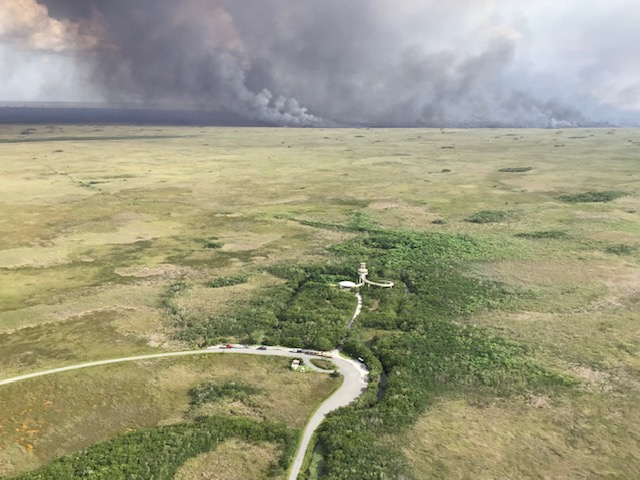
Four lightning-sparked wildfires have burned nearly 24,000 acres across Everglades National Park and the surrounding marshes, but firefighters have brought the largest blaze mostly under control.
The Chipmunk Fire, which accounts for roughly 17,000 to 18,000 acres of the burned area, reached approximately 90% containment by Wednesday, Aug. 26, with only minimal fire activity reported. The other fires in the cluster were fully contained, and the National Park Service has reopened the Shark Valley District.
The immediate threat has eased. The environmental effects of the fires, however, may last much longer: particularly in areas where drought-dried peat soil burned beneath the sawgrass.
Latest status of the Everglades fires
The fires began during an unusually dry stretch of the wet season. All four were sparked naturally by lightning, according to reports from park officials and regional environmental journalists.
The largest, the Chipmunk Fire, was first reported Aug. 21 southwest of Shark Valley. It spread rapidly through sawgrass prairie and dry organic soils before firefighters began making significant progress.
The latest reported figures include:
- Chipmunk Fire: Approximately 17,000 to 18,000 acres burned and 90% contained, with minimal activity.
- Movie Dome Fire: Approximately 6,200 acres burned and fully contained.
- Vulture Fire: Approximately 347 acres burned and fully contained.
- Fourth lightning-caused fire: A smaller fire in the broader Everglades landscape contributed to the combined total of nearly 24,000 acres.
Acreage estimates changed as fire managers mapped the perimeters and containment lines. The total reported by regional coverage represents the combined footprint of the four fires, rather than the size of the Chipmunk Fire alone.
The National Park Service’s current conditions page remains the best source for updated containment figures, fire behavior and park access.
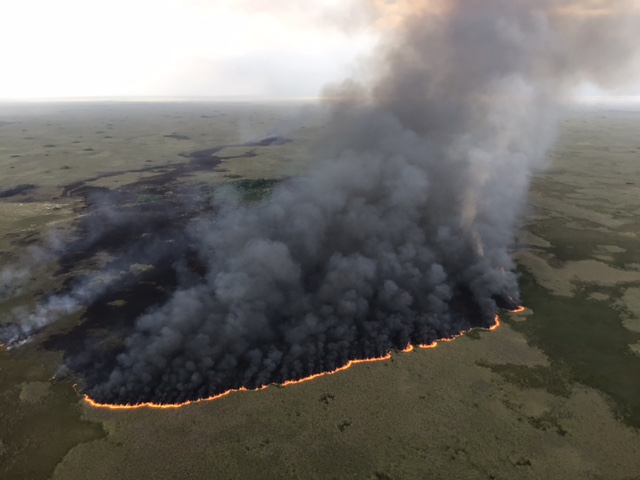
The Vulture Fire was one of several lightning-caused fires that burned during extreme drought conditions. Photo courtesy of the U.S. Wildland Fire Service.
Shark Valley has reopened
The Shark Valley District was temporarily closed as crews worked to contain the Chipmunk and Vulture fires.
The emergency closure covered the Shark Valley Visitor Center, trails, parking areas and the Shark Valley Tram Road. Officials said the closure was necessary to protect visitors, safeguard park resources and give firefighting crews room to operate.
The National Park Service lifted the closure at 1 p.m. on Aug. 24. According to the agency’s reopening announcement, public and administrative use could resume after the area was assessed.
The reopening did not mean the Chipmunk Fire was fully extinguished. At that point, the fire had burned approximately 17,000 acres and was about 60% contained. Firefighters continued suppression and monitoring work as the fire burned in sawgrass prairie several miles south-southwest of the Shark Valley Observation Tower.
Park visitors should still check the official alerts and conditions page before traveling. Fire conditions can change quickly, and the park continues to list unrelated construction, maintenance and resource-protection closures.
Smoke was visible from portions of Main Park Road and U.S. Highway 41 during the most active phase of the fires. No highway closure was expected in the National Park Service’s initial update, and airboat concessions remained operational.
Why drought made the fires more dangerous
Wildfire is a natural part of Everglades ecology. Lightning regularly ignites fires in the marsh, particularly near the end of the dry season. Periodic surface fires can clear old sawgrass, limit woody vegetation and create a shifting pattern of habitat for wildlife.
This year’s conditions were different because the central Everglades entered the rainy season in extreme drought.
Water levels across the sawgrass marshes remained well below normal, and some areas were dry beneath the surface. The drought left tall grasses and organic soils unusually vulnerable to ignition and allowed fire to spread across a landscape that would typically be wetter during this time of year.
In its reporting on the fires, WLRN noted that the central Everglades remained in extreme drought, even as other parts of South Florida began to see some relief.
The lack of water is also affecting areas beyond the fire lines. Wading birds may have less prey available during the upcoming nesting season, while portions of Florida Bay remain more saline than normal because too little freshwater is moving south through the Everglades.
That means the fires are occurring within a broader hydrological crisis. The long-term question is not only how much vegetation burned, but how dry the underlying marsh became before the flames arrived.
Peat soil could take decades or longer to recover
The Everglades is built on peat: a thick layer of partially decomposed plant material that accumulated over centuries or millennia in wet, low-oxygen conditions.
Peat serves several important functions. It stores carbon, supports marsh vegetation, helps filter freshwater and provides a buffer against saltwater intrusion. When it remains saturated, peat can limit how deeply a fire burns.
During extreme drought, that protection weakens.
A surface grass fire may move quickly through sawgrass while leaving much of the soil intact. A peat fire can smolder below ground, consume the organic layer and continue burning after flames are no longer visible. It can also be difficult for firefighters to reach and extinguish.
In WLRN’s reporting on the fires and drought, John Kominoski, a biology professor at Florida International University and principal investigator with the National Science Foundation’s long-term Everglades research program, described peat wetlands as major carbon sinks.
Kominoski said rebuilding the lost peat could take “decades to hundreds to thousands of years,” depending on the extent of the damage and whether wet conditions return.
The loss of peat can also change the landscape physically. When the organic layer burns or collapses, the ground surface can sink. In places where limestone lies close beneath the peat, the resulting depressions may become too deep for sawgrass to easily reestablish. Water can collect in open pockets, altering the local pattern of flooding and drying.
That creates a difficult cycle: drought makes peat more likely to burn, and peat loss can make portions of the marsh more vulnerable during future dry periods.
What recovery may look like
The outlook will vary across the nearly 24,000 acres affected.
Where the fires mainly burned aboveground sawgrass, vegetation may begin returning after rainfall and seasonal flooding restore moisture to the marsh. The Everglades’ native plant communities are adapted to periodic fire, and many can recover over several growing seasons.
Recovery will likely be slower where flames burned into peat or where drought has already stressed the root systems and soil. Scientists will need field surveys to determine how deeply the fires penetrated and whether the organic soil layer remains intact.
Researchers are expected to watch several indicators in the months and years ahead:
- Regrowth of sawgrass and other marsh plants
- Changes in water depth and the duration of seasonal flooding
- Loss of peat thickness and elevation
- Shifts in wildlife use of burned areas
- Evidence of smoldering or renewed fire activity
- Changes in carbon and nutrient levels in the soil
The National Park Service’s wildland fire program recognizes that fire is both a natural ecological process and a public-safety concern. Under normal conditions, managers may use prescribed burns or allow naturally ignited fires to burn within carefully monitored boundaries. Extreme drought reduces that flexibility.
For now, the immediate emergency has diminished. The Chipmunk Fire is mostly contained, the smaller fires are out or fully contained, and Shark Valley is open again.
But the effects of this episode will not be measured only by containment percentages. The more important assessment will come later, when scientists determine how much of the Everglades’ living vegetation returns: and how much of its ancient peat soil was lost.