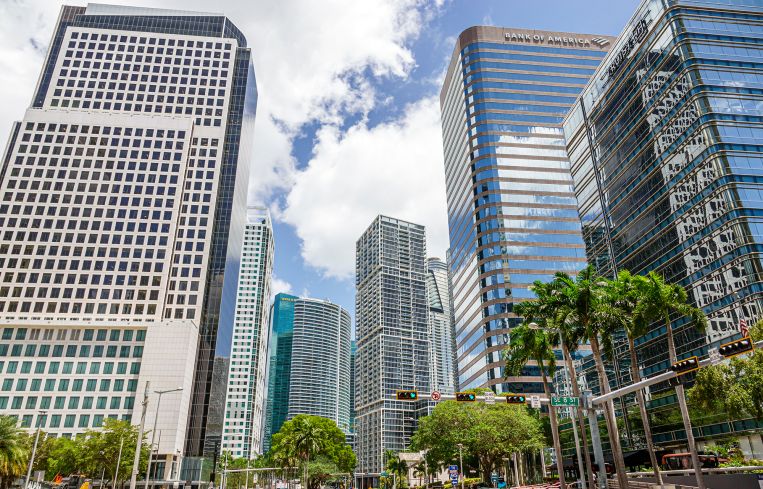
Miami’s technology economy is moving beyond startup headlines and venture-capital announcements. In 2026, the region is attracting corporate headquarters, signing larger office leases and pulling in capital across fintech, artificial intelligence, cybersecurity and enterprise software.
Two companies illustrate that shift. Palantir Technologies moved its headquarters from Denver to Aventura in February, while cybersecurity company Varonis established its Miami headquarters in Brickell. Together, the moves reinforce a larger trend: South Florida is becoming a place where technology companies build durable operating bases: not simply satellite offices for executives passing through.
The region’s startup ecosystem is often cited at roughly $95 billion, based on broader, 2024-era ecosystem estimates. Startup Genome’s more recent 2026 rolling-window measure puts Miami’s ecosystem value at approximately $48.4 billion, underscoring how methodology and time frame affect the headline figure. Both measurements point to a market with significant scale, but the distinction matters when evaluating current growth.
Palantir puts Aventura on the corporate map
Palantir announced in February that it was moving its headquarters from Denver to Miami. The company subsequently listed Aventura as its headquarters on its official office locations page.
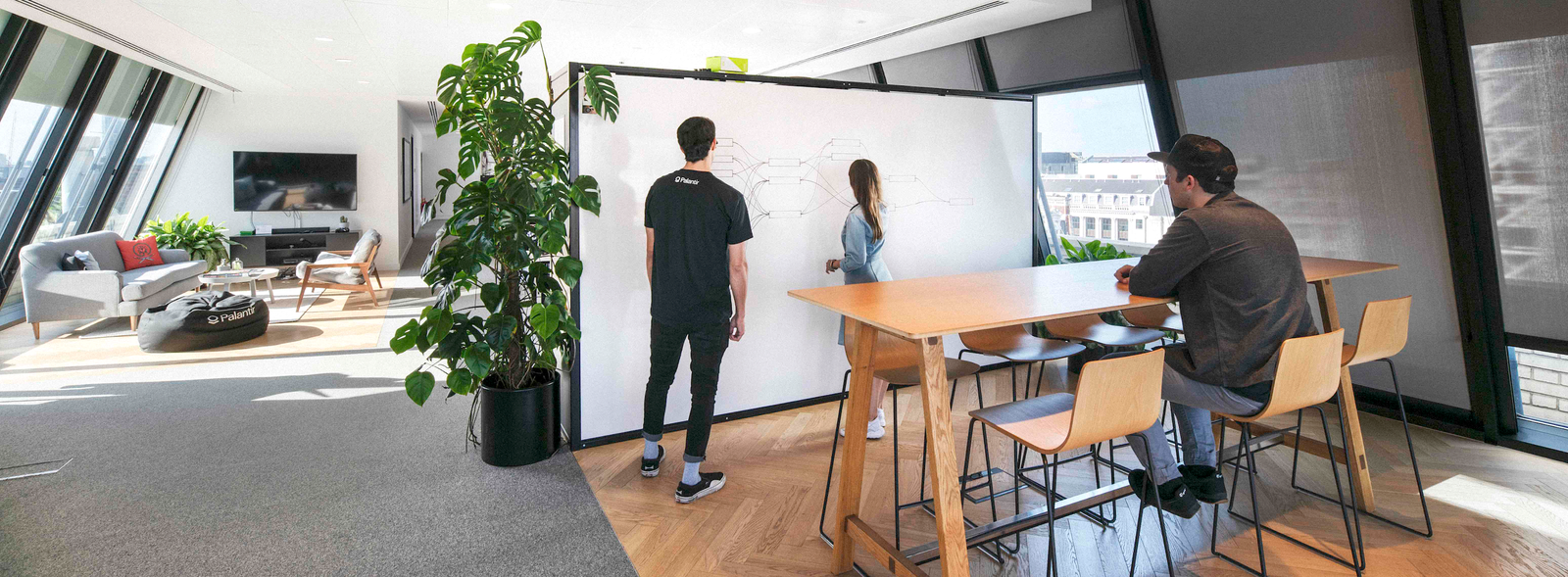
The relocation is notable because Palantir is not an early-stage company experimenting with a new market. It is a publicly traded software company with government and commercial customers around the world. CNBC reported that the company had 4,429 full-time employees at the end of 2025 and maintained significant offices in Palo Alto, New York, Washington, D.C. and London.
The move also has a geographic nuance. Palantir’s new headquarters is in Aventura, roughly 17 to 20 miles north of downtown Miami, rather than in Brickell or the city’s central business districts. That distinction broadens the definition of the Miami tech market. The regional ecosystem now stretches from Aventura and Miami-Dade’s northern suburbs through Brickell, Wynwood, Coral Gables, Fort Lauderdale and Palm Beach County.
Public reporting identified Palantir’s initial registered office at 19505 Biscayne Boulevard in Aventura. The company’s official contact page now lists Aventura among its North American locations and identifies it as the headquarters.
The move does not mean Palantir’s other offices are disappearing. Instead, it gives South Florida a corporate center of gravity for one of the most influential companies in data analytics and artificial intelligence.
Varonis makes Brickell its cybersecurity base
Varonis represents a different but equally important part of the story. The cybersecurity company relocated its headquarters from New York to Miami and now lists 801 Brickell Avenue, 11th Floor, Miami, Florida, as its Miami headquarters.

The company signed a lease for approximately 17,900 square feet, taking the entire 11th floor at 801 Brickell. The relocation was planned during the 2024–2025 period and was firmly established by 2026.
Varonis is a significant addition to Brickell’s technology and financial-services cluster because its business is closely tied to the infrastructure of modern enterprises. The company provides data-security and governance tools used by organizations managing sensitive information across cloud systems, file platforms and business applications.
Its presence also illustrates the type of technology business increasingly finding a natural fit in South Florida. Brickell offers proximity to banks, investment firms, multinational companies and Latin American markets: all important relationships for cybersecurity and enterprise software providers.
The Palantir and Varonis moves differ in timing, location and operating model. Palantir’s move is newer and places a major public technology company in Aventura. Varonis’ relocation predates 2026 and gives Brickell an established cybersecurity headquarters. Their significance is similar, however: both companies have identified South Florida as a strategic base for corporate operations.
Office absorption reaches a post-2022 high
The headquarters announcements arrive as Miami-Dade’s office market records its strongest performance in several years.
JLL data cited by The Real Deal showed approximately 327,000 square feet of positive net absorption in the second quarter of 2026, the highest quarterly total since late 2022. CBRE reported a comparable figure of approximately 344,000 square feet, reflecting differences in the firms’ market boundaries and methodologies.
Net absorption measures the amount of occupied office space gained or lost during a period after accounting for move-ins and move-outs. It is one of the clearest indicators of whether companies are expanding their physical footprint.
Savills data reported by Commercial Observer showed 1.3 million square feet of leasing activity in Q2, up nearly 45% year over year. Miami-Dade office availability declined to 14.9%, compared with 17.1% a year earlier. Average asking rent reached $67.12 per square foot, a 7% increase from the prior year and nearly 57% higher than five years earlier.
Class A buildings are commanding even more. Average Class A asking rents reached $80.85 per square foot, while top-tier Brickell and trophy properties have moved above $100 per square foot. The figures reflect demand for newer buildings with upgraded technology, high-end amenities, resiliency features and access to executive housing and transportation.
Technology companies are part of that demand, although they are not acting alone. Financial firms, family offices, law firms and professional-services companies are also competing for premium space. That combination is important because it gives Miami’s office recovery a broader base than a single-sector expansion.
The market’s largest leasing activity during the quarter was concentrated in Airport West, Downtown Miami and Coral Gables. Brickell remains the most visible symbol of the region’s corporate transformation, but the data show that demand is spreading across multiple submarkets.

Venture capital adds another layer of momentum
Office leasing is only one measure of the technology economy. Venture funding offers another view of how companies are forming and scaling.
According to PitchBook data reported by Refresh Miami, startups in the Miami–Fort Lauderdale metro area raised $832 million across 100 deals in Q2 2026. Combined with approximately $1.1 billion raised during the first quarter, South Florida startups attracted nearly $2 billion during the first half of the year.
The metro ranked fifth nationally for venture deal count in the second quarter, tied with Austin, and ninth for total deal value among major U.S. technology hubs.
The largest Q2 deals included:
- Syncromune: $145 million
- Karta: $140 million in equity and debt financing
- Hydra Host: $100 million
- EB5 United: $60.3 million
- Flex: $50.1 million
- Canals: $35 million
- FundKite: $31.4 million
The mix spans biotechnology, fintech, artificial intelligence, software and financial services. That diversification reduces Miami’s dependence on a single technology category and connects the startup economy to industries already prominent in South Florida, including international commerce, real estate, healthcare and logistics.
Still, the funding data requires context. National venture investment in 2026 has been heavily concentrated in artificial intelligence and megadeals. South Florida is participating in that growth, but it remains smaller than Silicon Valley, New York, Los Angeles and other major U.S. markets in absolute funding.
What the $95 billion figure really means
The commonly cited $95 billion valuation for Miami’s startup ecosystem should not be treated as a fresh 2026 appraisal of every local startup.
Startup Genome’s methodology uses a rolling two-and-a-half-year window measuring exits, startup valuations and active unicorns. Its 2026 Miami profile reports an ecosystem value of approximately $48 billion, with $2.4 billion in total early-stage funding during the measurement period and $49 billion in exit value from 2021 through 2025.
The higher $95 billion figure is associated with broader, earlier ecosystem estimates and blended references to data from Startup Genome, PitchBook and Dealroom. It remains useful as a measure of Miami’s accumulated technology and startup activity, but it is not directly comparable with the narrower GSER 2026 number.
That difference does not undermine the larger trend. Miami has remained in Startup Genome’s global top 40 ecosystems throughout the 2020–2026 ranking cycle, reaching No. 16 in 2024 and ranking No. 25 in 2026.
A more established phase for Miami tech
Palantir’s headquarters move, Varonis’ Brickell base, rising office absorption and continued venture activity point to a more established phase for Miami tech.
The next test will be whether the region can convert corporate arrivals and funding rounds into sustained local hiring, research, product development and successful exits. The office market suggests that businesses are committing to physical space. The venture data suggests that founders and investors continue to see opportunity. The headquarters relocations indicate that some major companies are willing to place meaningful operations here.
For South Florida business, the implications extend beyond the technology sector. More technology employers can support higher-wage jobs, increase demand for specialized services and create new partnerships with financial institutions, healthcare providers, real estate companies and international businesses.
Miami is no longer competing only on lifestyle or tax policy. Its emerging advantage is the combination of capital, global connectivity, corporate infrastructure and access to industries that increasingly depend on software and data.
The boom is not without weaknesses, and the $95 billion headline requires careful interpretation. But the evidence from Q2 2026 shows a market that is gaining institutional depth: and taking up more office space while doing it.
Sources and methodology
- Palantir official contact page and office locations
- CNBC: Palantir moving its headquarters from Denver to Miami
- Varonis official contact page
- Commercial Observer: Miami’s office leasing jumps nearly 45% in Q2
- CBRE Miami Office Figures, Q2 2026
- Refresh Miami: South Florida startups attract $832 million in Q2 venture capital
- Startup Genome Miami ecosystem profile
- Startup Genome Miami ecosystem briefing
- South Florida Digest: Miami tech startups raise millions