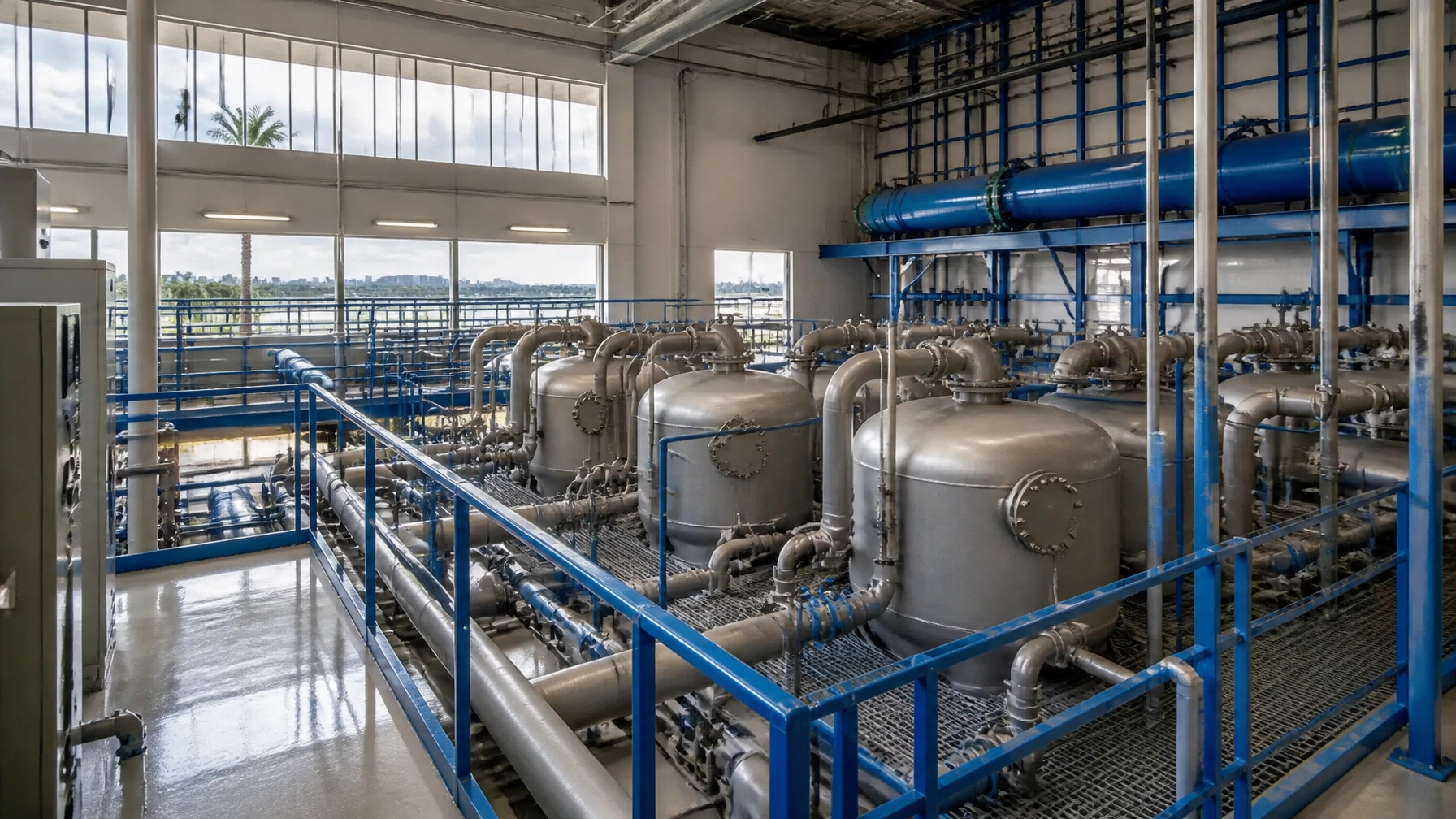
Miami-Dade County is testing several technologies to remove PFAS from drinking water as utilities across South Florida prepare for stricter federal requirements and a potentially expensive infrastructure buildout.
PFAS: short for per- and polyfluoroalkyl substances: are a large family of manufactured chemicals used for decades in products that resist heat, oil, grease, stains and water. They have been used in applications ranging from nonstick cookware and water-resistant clothing to industrial processes and firefighting foams.
Because many PFAS break down extremely slowly, they are commonly known as “forever chemicals.” They can persist in soil and groundwater, move through water systems and accumulate in people and the environment.
For Miami-Dade, the issue is no longer limited to testing. The county’s Water and Sewer Department is conducting treatment demonstrations at several plants to determine what can reliably reduce PFAS to extremely low concentrations without destabilizing the rest of the water system.
What the federal PFAS rule requires
The U.S. Environmental Protection Agency finalized the first national drinking-water standards for PFAS in April 2024. The rule established enforceable maximum contaminant levels of:
- 4 parts per trillion for PFOA
- 4 parts per trillion for PFOS
- 10 parts per trillion for PFHxS
- 10 parts per trillion for PFNA
- 10 parts per trillion for HFPO-DA, commonly known as GenX chemicals
- A hazard-index limit for certain mixtures containing PFHxS, PFNA, HFPO-DA and PFBS
One part per trillion is roughly equivalent to one drop of water in 20 Olympic-size swimming pools. At those concentrations, routine treatment processes are not necessarily enough.
Under the 2024 rule, public water systems must complete initial monitoring by 2027, begin providing information to the public and implement corrective measures by 2029 if PFAS levels exceed the federal limits.
The regulatory picture remains unsettled in 2026. On May 18, the EPA announced proposed changes that would preserve the 4-parts-per-trillion limits for PFOA and PFOS while allowing eligible systems to request up to two additional years: through 2031: to comply. The agency also proposed rescinding the federal limits for PFHxS, PFNA, GenX and the related hazard-index standard.
Those changes are proposals, not final rules. Until they are finalized, the 2024 framework remains the governing standard. Miami-Dade and other utilities therefore have to design projects while tracking a federal process that could change the scope and timing of their obligations.
Why health officials are concerned
Research has linked exposure to some PFAS, particularly PFOA and PFOS, with health effects that may include changes in cholesterol, reduced immune response, developmental effects and certain cancers. The level and duration of exposure matter, and scientists continue to study the health effects of thousands of individual PFAS compounds.
The EPA says the drinking-water rule is intended to reduce long-term exposure for millions of Americans. The agency has also made federal funding available to help utilities test for and remove PFAS, including nearly $1 billion announced in 2026 for emerging contaminants in small and disadvantaged communities.
For residents, the important distinction is that the presence of PFAS in source water does not automatically mean tap water is unsafe under an immediate-emergency standard. The concern is chronic exposure over time and whether finished water consistently meets the enforceable limits.
Miami-Dade’s treatment tests
Miami-Dade WASD has been monitoring PFAS across its water system since 2019. The county’s water supply relies heavily on the Biscayne Aquifer, with more than 90 wells distributed across multiple wellfields.
The county’s treatment challenge varies from plant to plant. Water quality studies have identified elevated PFAS in some local wellfields, while western wellfields can have lower PFAS concentrations but higher levels of total organic carbon, or TOC. TOC can interfere with treatment media, contribute to fouling and create precursors for disinfectant byproducts.
That variability means Miami-Dade cannot necessarily install one identical solution at every plant.
A 24-month testing and engineering program is evaluating options at:
- Hialeah-Preston Water Treatment Plant
- Alexander Orr Water Treatment Plant
- South Dade wellfields and related facilities
The demonstrations are examining several treatment approaches:
- Granular activated carbon, commonly called GAC
- Ion-exchange resins
- Reverse osmosis
- Nanofiltration
- Pretreatment systems designed to reduce organic carbon before PFAS treatment
The county is also studying whether treatment should occur across an entire plant, at individual wellheads or through a hybrid system that combines targeted treatment with blending.

The goal is not simply to find a process that removes PFAS in a laboratory sample. Engineers must determine how the technology performs over time, how often treatment media must be replaced or regenerated, how residuals will be handled and whether the finished water remains chemically stable in thousands of miles of distribution mains.
That last issue is especially important. Changing hardness, alkalinity or organic-carbon levels can affect corrosion control and alter the balance that has developed inside an established distribution system.
Preliminary testing presented by the county and its engineering partners indicates that high-pressure membrane systems can provide broad PFAS removal, including for shorter-chain compounds that can be more difficult for some sorption-based technologies. But membranes can require more energy, produce a concentrated waste stream and require careful post-treatment.
The price tag is still moving
Miami-Dade’s FY 2025-26 adopted budget says PFAS compliance will have future impacts on the department’s capital plan and that all major treatment options under consideration involve significant costs.
The county’s proposed capital planning documents place the preliminary cost of PFAS treatment and removal projects between $1 billion and $4 billion. The range is broad because the county has not yet selected a final systemwide approach. A separate $75 million placeholder appears in the capital plan for PFAS compliance work, but that figure should not be confused with the estimated total cost of eventual construction.
The county’s water and sewer system already faces major expenses unrelated to PFAS, including aging infrastructure, EPA consent-decree projects, wastewater improvements, ocean-outfall requirements, lead-and-copper compliance and system expansion.
Miami-Dade serves approximately 2.8 million people through retail and wholesale accounts. Its water system includes regional and local treatment plants, a shared Hialeah reverse-osmosis plant, 95 wells and more than 8,500 miles of distribution mains. Any treatment solution must be built into that large and complicated network.
The county’s FY 2025-26 budget included a 3.5% retail rate increase. That increase supports multiple capital and operating needs, including the broader infrastructure program and anticipated regulatory requirements. It is not a standalone PFAS surcharge.

Broward faces the same financial pressure
Broward County and municipal utilities are preparing for the same federal requirements. Regional reporting has described more than $350 million in planned or discussed drinking-water upgrades across Broward, including a pilot project evaluating nanofiltration.
The county and cities such as Fort Lauderdale and Hollywood operate systems with different water sources, treatment configurations and customer bases. Their final costs will depend on PFAS concentrations, the number of facilities requiring upgrades, the technology selected and whether blending or source changes can reduce the need for full-scale treatment.
That makes a direct comparison between Broward’s reported figure and Miami-Dade’s $1 billion-to-$4 billion estimate difficult. The figures may cover different facilities, timelines and project scopes.
What ratepayers should expect
PFAS treatment expenses generally fall into several categories:
- Testing and monitoring: Parts-per-trillion laboratory analysis, sampling programs, data management and public reporting.
- Design and construction: New treatment vessels, membrane systems, pumps, piping, electrical work and site improvements.
- Operations: Energy, chemicals, labor, maintenance and replacement of activated carbon or ion-exchange media.
- Residuals management: Disposal or treatment of PFAS-concentrated media, brine or reject water.
- Debt service: Long-term financing through revenue bonds, state revolving funds, federal loans or other funding sources.
The EPA has identified billions of dollars in federal funding programs that may help offset local costs. Miami-Dade also has experience using revenue bonds, state loans and federal WIFIA financing for major water and wastewater projects.
Even with outside assistance, utilities are likely to recover at least part of their costs through rates. That does not mean residents will see a specific “forever chemicals” line item on their bills. More likely, PFAS work will be folded into broader capital programs and future water and sewer rate decisions.

The precise impact on a typical household cannot be calculated until Miami-Dade finishes its demonstrations, selects treatment strategies and develops construction and financing schedules. For now, the clearest conclusion is that PFAS is becoming a significant long-term cost driver for South Florida utilities.
What happens next
Miami-Dade’s immediate priorities are to complete pilot testing, compare performance and operating costs, determine how to handle treatment residuals and identify a systemwide compliance plan.
The county must also continue monitoring federal rulemaking. If the EPA’s proposed changes are finalized, utilities could have more time to meet the PFOA and PFOS limits and may face narrower federal requirements. If the 2024 rule remains unchanged, the original 2029 compliance deadline and six-PFAS framework will continue to shape local planning.
Either way, the technology decisions made in Miami-Dade and Broward over the next several years will affect public health, utility operations, construction schedules and household water bills.
For residents following South Florida news and South Florida business, PFAS is both an environmental-health story and an infrastructure-finance story: what is removed from the water will be determined in treatment plants, but how the work is paid for will reach every customer connected to the system.
Sources
- EPA: Final PFAS National Primary Drinking Water Regulation
- EPA: 2026 proposed PFAS compliance and rescission rules
- Miami-Dade County FY 2025-26 Water and Sewer budget
- Miami-Dade’s PFAS treatment demonstration presentation
- Miami Herald reporting on South Florida PFAS treatment planning
- South Florida Digest