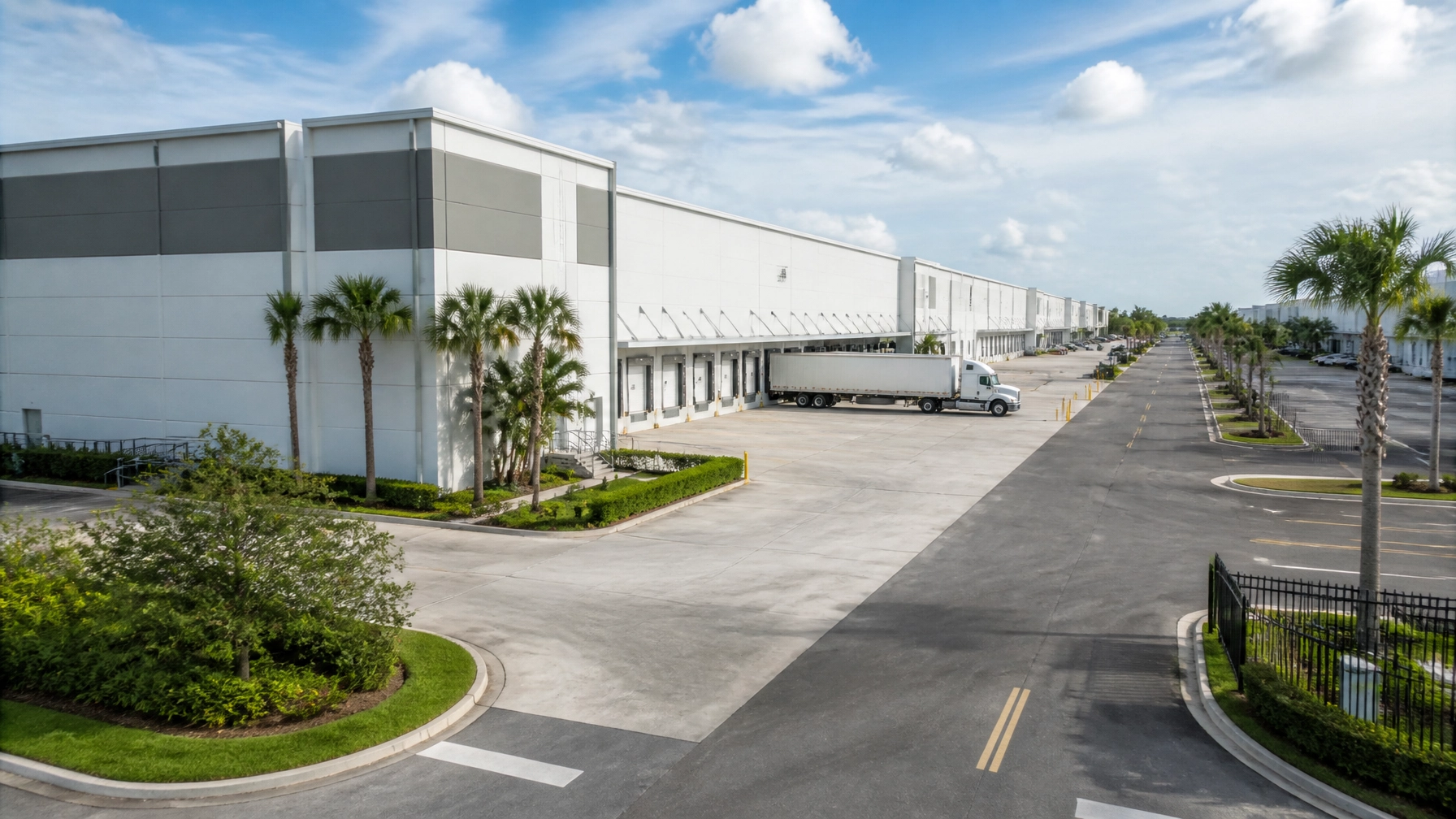
South Florida commercial real estate investment sales reached approximately $9.3 billion in the first half of 2026, a 19% increase from the same period last year, according to data from Avison Young cited in recent market reports.
Industrial properties accounted for much of the increase. The sector recorded approximately $3.3 billion in sales across 193 transactions, representing a 130.5% year-over-year jump in industrial investment volume and the strongest performance of any major property type in the region.
The figures cover the three-county South Florida market: Miami-Dade, Broward and Palm Beach counties.
Industrial Leads a Divided Investment Market
The overall increase in deal volume masks a sharp divide among property types.
Industrial was the largest investment category during the first half of the year, followed by multifamily, which recorded approximately $2.5 billion in sales, up about 19.4% year over year. Retail, office and development land transactions all declined compared with the first half of 2025.
Retail investment volume fell by nearly 20%, while office transactions dropped by more than 11%. Development land posted an even steeper decline of more than 23%.
The result is a market in which the headline numbers suggest a recovery in commercial real estate trading, but the underlying activity remains concentrated in a small number of sectors: particularly industrial and, to a lesser extent, multifamily.

Industrial properties are attracting buyers because they remain closely tied to operating demand. Warehouses, distribution centers and logistics facilities support e-commerce, manufacturing, food distribution, import-export businesses and last-mile delivery networks.
South Florida’s location also gives the sector a distinct regional advantage. Miami-Dade, Broward and Palm Beach serve as important gateways for trade with Latin America and the Caribbean, with goods moving through the region’s seaports, airports, highways and distribution networks.
That demand has helped industrial real estate remain comparatively resilient despite elevated borrowing costs and uncertainty around interest rates.
Two Large Deals Highlight the Surge
Several major transactions helped define the first half of 2026.
In June, Prologis acquired the Davie Business Center in Broward County for approximately $352.2 million. The property includes seven industrial buildings totaling roughly 1.2 million square feet. The transaction was described in market reporting as one of the largest industrial sales in South Florida this year.
In April, Kurv Industrial purchased a five-warehouse portfolio in Pompano Beach for approximately $219.7 million. The East Pompano Industrial Center portfolio contains about 818,611 square feet, according to Lee & Associates data cited in market coverage.
Combined, those two purchases represented more than $570 million in industrial investment: roughly 17% of the sector’s total first-half sales volume.
The deals also demonstrate the type of assets drawing institutional and private capital: large, functional properties located near major population centers, transportation corridors and established industrial clusters.
The concentration of volume in major transactions does not mean smaller properties were absent from the market. Rather, it shows that well-capitalized buyers continue to compete aggressively for scale and location when the asset’s income profile is considered durable.
Tight Cap Rates Signal Investor Confidence
Reported capitalization rates for closed industrial transactions ranged from approximately 4.12% to 4.64%, among the tightest rates recorded across South Florida’s major commercial property sectors.
A lower cap rate generally reflects stronger investor confidence in an asset’s income stream, although the metric can vary significantly based on property quality, lease terms, tenant credit, location and transaction structure.
Other market reports have produced higher industrial cap-rate estimates for earlier periods. Those differences may reflect variations in the properties included, the timing of the transactions and the methodologies used by different research firms.
Even with those variations, the broader trend is consistent: buyers are accepting relatively low initial yields for high-quality industrial properties because they expect demand for well-located logistics space to remain durable.
Pricing has also remained firm. One Avison Young-based summary placed reported industrial sale prices at roughly $230 to $340 per square foot during the first half of the year, depending on the asset and location.

Leasing Conditions Are Normalizing, Not Collapsing
Investment activity is strengthening even as the industrial leasing market works through a period of normalization.
South Florida has approximately 498.2 million square feet of industrial inventory, according to market data cited in recent reports. New construction delivered over the past several years has expanded the available supply, giving tenants more options than they had during the market’s most competitive period.
Several research firms placed industrial vacancy in the mid- to high-single digits during the first quarter of 2026. Matthews reported a regional vacancy rate of approximately 5.8%, while Lee & Associates reported a rate closer to 6.3%. Miami-Dade has generally been softer than Broward, while Broward’s vacancy rate has shown signs of stabilizing.
Net absorption has also varied. Some reports show negative absorption as newly delivered space is being leased, while other midyear analyses point to stronger demand for newer, higher-quality facilities.
The differences are important because they show that the market is not moving uniformly. Older buildings, large-format spaces and properties in locations with heavier new supply may face more leasing pressure. Modern facilities with efficient layouts, strong access and proximity to major transportation routes continue to attract greater interest.
Rents have also remained near peak levels in several submarkets, even as vacancy has risen from its tightest point. That combination: more available space but firm asking rents: suggests landlords are not broadly cutting prices, particularly for newer or strategically located properties.
Why Capital Is Favoring Industrial
Interest-rate uncertainty continues to affect commercial real estate investment decisions. Higher financing costs have made it more difficult for buyers and sellers to agree on pricing, particularly for office, retail and land assets whose future income is harder to underwrite.
Industrial properties offer investors a clearer operating story. Their performance is linked to the movement and storage of goods, rather than primarily to workplace occupancy or discretionary consumer spending.
For investors, that distinction matters. Office buildings remain exposed to changes in corporate space requirements and hybrid work. Retail properties depend heavily on tenant sales, consumer traffic and the performance of individual retailers. Development land requires buyers to make long-term assumptions about construction costs, financing and future demand.
Industrial assets still carry risks, including supply growth, tenant contraction and slowing economic activity. But their connection to logistics and trade has made them more attractive in a market where investors are prioritizing predictable cash flow.

What to Watch in the Second Half
The next phase of the market will depend on whether industrial demand can absorb existing inventory while new construction slows.
Investors will be watching vacancy and absorption figures in Miami-Dade, Broward and Palm Beach, as well as the volume of new warehouse space entering the pipeline. A decline in speculative development could support existing properties over time, particularly in submarkets where transportation access and land constraints limit new supply.
Interest-rate policy will remain another critical factor. Lower borrowing costs could bring more institutional capital back into office, retail and land transactions, narrowing the gap between buyers’ and sellers’ price expectations. Conversely, continued rate pressure could keep investment activity concentrated in industrial and multifamily properties.
For now, South Florida’s commercial real estate market is active; but not broadly recovered across every category. The first-half data points to a selective investment rebound led by industrial properties, with buyers placing a premium on logistics infrastructure, modern warehouse space and locations connected to regional and international trade.
Sources: The Real Deal’s report on South Florida investment sales, South Florida Business Owner’s analysis of the Avison Young data, Matthews’ South Florida industrial market report, and Lee & Associates’ South Florida industrial report.