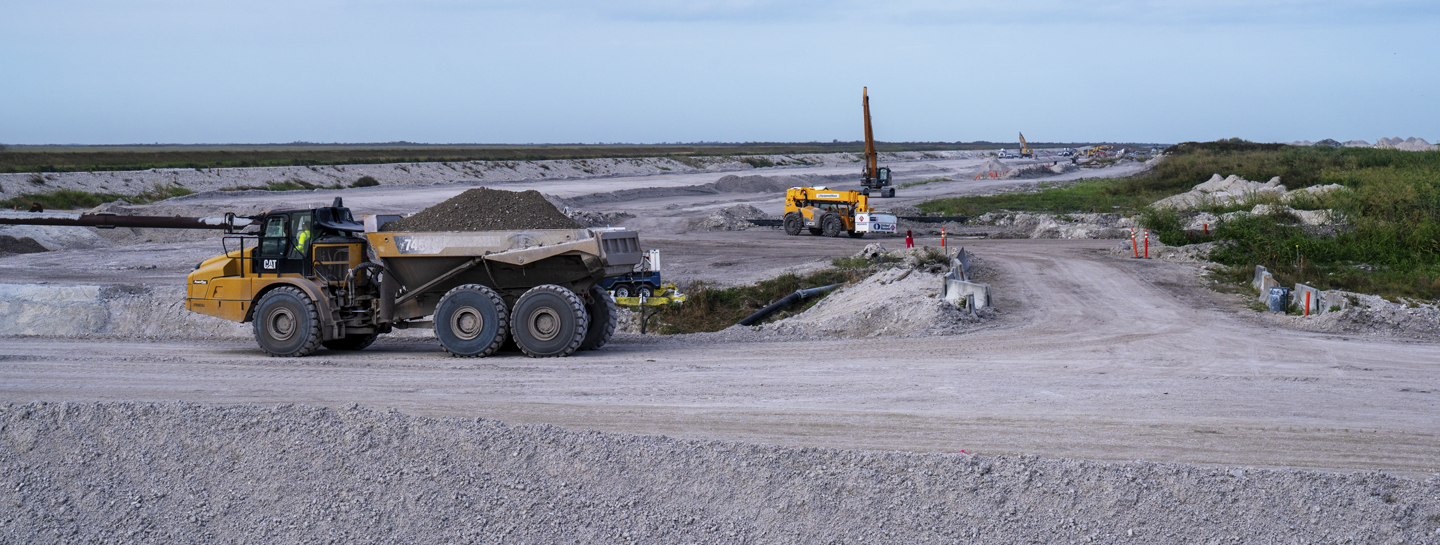
Florida and the U.S. Army Corps of Engineers have moved the completion target for the Everglades Agricultural Area Reservoir from 2034 to December 2029, accelerating one of the largest remaining projects in the Comprehensive Everglades Restoration Plan.
The revised schedule follows a 2025 agreement that shifts responsibility for several major “plumbing” components: including pump stations, seepage infrastructure and the Blue Shanty Flow Way: to the State of Florida and the South Florida Water Management District. The Army Corps will concentrate on the reservoir’s core basin, foundation, embankments and related canals.
State officials and federal officials announced in April that all federally funded contracts required to meet the accelerated deadline had been executed. The change is intended to reduce federal permitting and contracting delays while allowing Florida to move more quickly on the infrastructure needed to bring water into, through and out of the reservoir.
A five-year acceleration
The EAA Reservoir is a central feature of Everglades restoration efforts south of Lake Okeechobee. The project is designed to capture and store excess water, reduce damaging discharges to the St. Lucie and Caloosahatchee estuaries, and send more treated water south toward the central and southern Everglades.
The South Florida Water Management District says the reservoir will store more than 78 billion gallons of water and deliver up to 470 billion gallons annually to the Everglades and Florida Bay. The reservoir component will hold approximately 240,000 acre-feet of water across a 10,500-acre site.
The broader EAA Reservoir Project also includes a 6,500-acre stormwater treatment area. That treatment wetland is intended to remove nutrients from water before it moves farther south through the Everglades system.
Under the original schedule, the reservoir was expected to be completed in 2034. The 2025 agreement set a new target of 2029: five years earlier.
Why Florida is taking the lead on the “plumbing”
The reservoir basin is only one part of a functioning water-storage system. Water must be pumped into the reservoir, managed around its perimeter, released at controlled rates and conveyed south to restoration areas.
Those supporting systems are often described as the project’s “plumbing.” Under the agreement, Florida: primarily through the South Florida Water Management District: will lead the delivery of several of those components.
The state’s responsibilities include:
- The EAA Reservoir inflow pump station.
- The outflow pump station and related works.
- Seepage management infrastructure.
- The Blue Shanty Flow Way.
- Other auxiliary structures and connecting features needed to move water through the system.
The state-led approach is intended to streamline design, permitting, contracting and construction. Instead of requiring every component to move through the same federal process, the agreement gives Florida greater authority to execute projects using federal funding while coordinating with the Army Corps.
The arrangement does not remove the Army Corps from the project. Rather, it divides the work so the Corps can focus on the main reservoir while the state advances the supporting infrastructure on a parallel track.
The Florida Department of Environmental Protection said the agreement allows Florida to take a leading role in executing federally funded components of the Comprehensive Everglades Restoration Plan.
Federal contracts remain focused on the reservoir core
The Army Corps’ work is organized around three principal contracts.
Contract 10A covers the reservoir’s inflow, outflow and seepage canals, as well as an associated maintenance road. That contract has been completed.
Contract 11A covers the reservoir foundation. The target for completing that work is March 2028.
Contract 11B covers the reservoir embankment and water-control structures. Its required completion date is December 2029, making it the key federal contract tied to the accelerated schedule.
The division allows the federal construction program to concentrate on the physical basin and the structures that will hold and regulate stored water. At the same time, Florida can advance the pumps and flow-way projects that connect the reservoir to the larger Everglades water-management network.
According to the Army’s announcement, the federal contracts necessary to meet the 2029 target are now in place, with funding committed through completion.
Inflow pump station designed to move 3 billion gallons daily
The EAA Reservoir inflow pump station is one of the most important state-led components. The station is designed to move approximately 3 billion gallons of water per day from Lake Okeechobee into the reservoir.
Construction began in November 2025, according to the water management district. The pump station is expected to provide the capacity needed to capture water that might otherwise be discharged east or west to coastal estuaries during high-water events.
The system’s benefits will depend on how water is managed across the entire network. Water entering from Lake Okeechobee must be stored and treated before being released south. The reservoir, stormwater treatment area, canals and downstream conveyances are therefore being developed as connected parts of one restoration system rather than as isolated projects.
The outflow pump station is another state-led component. The Florida Department of Environmental Protection reported in April that agreements for the outflow station were nearing completion on a faster schedule than typical federal timelines.
Seepage management infrastructure is also included in the state’s responsibilities. These systems are intended to help manage water movement around the reservoir and limit unwanted seepage impacts as the reservoir begins operating.

Blue Shanty Flow Way provides the downstream connection
The Blue Shanty Flow Way is intended to serve as the final connection for moving treated water south from the EAA Reservoir system toward Everglades National Park and Florida Bay.
The project includes a series of levee and canal modifications, including work involving the L-67D, L-67C, L-29 and L-67 extension levees. Planned elements include a northern gap in the L-67C levee, partial lowering of portions of the levee system, backfilling the L-67 extension canal and construction of recreation sites.
The flow way is important because a completed reservoir cannot deliver its full restoration benefit without a reliable downstream pathway. The Blue Shanty system is expected to help carry water across and beyond the Tamiami Trail into the southern Everglades.
Florida assumed responsibility for the project under the 2025 agreement. The Department of Environmental Protection said construction began roughly two months after the memorandum was signed and that the state-led approach reduced the projected cost to approximately half of the original federal estimate.
The Army Corps has continued supporting the project by advancing design work and coordinating the federal and state schedules. The target is to have the flow-way construction aligned with the reservoir’s 2029 completion date.
What the accelerated project is intended to change
The EAA Reservoir is designed to address a basic problem created by decades of flood-control infrastructure: too much water is sent toward the coast during wet periods, while the Everglades receives too little water during dry periods.
The completed system is intended to:
- Store excess water from Lake Okeechobee.
- Reduce harmful discharges to the St. Lucie and Caloosahatchee estuaries.
- Treat water before it moves south.
- Increase freshwater deliveries to the Everglades and Florida Bay.
- Support the Biscayne Aquifer, South Florida’s primary drinking-water source.
- Improve the timing and distribution of water across the Everglades ecosystem.
The state and federal governments now face a compressed construction schedule across multiple agencies and project components. The reservoir’s core basin, pump stations, seepage facilities and Blue Shanty Flow Way must advance together for the 2029 target to deliver a functioning system rather than a partially completed one.
The accelerated timeline also keeps attention on oversight, funding and environmental performance. Faster construction must still comply with water-quality requirements, permitting conditions and the operational rules governing how water is stored, treated and released.
For now, the official target is December 2029. Contract 10A is complete, foundation work under Contract 11A is scheduled for completion in 2028, and the embankment and water-control work under Contract 11B remains tied to the end-of-2029 deadline. Florida’s takeover of the connected pump and flow-way projects is intended to keep those pieces moving on the same schedule.
Sources: South Florida Water Management District: EAA Reservoir · Florida Department of Environmental Protection: Accelerated EAA Reservoir Contracts · U.S. Army Corps of Engineers: Expedited EAA Reservoir Completion · Audubon Florida: Faster Timeline for the EAA Reservoir