October 12, 2026
South Florida’s commercial property market is moving against the cooling trend in parts of the region’s residential market. In Miami-Dade, office asking rents reached a new high in the third quarter, while retail construction climbed to its strongest pace in three years.
But those headline numbers mask a more complicated picture: leasing activity has slowed, new projects remain difficult to deliver, and the gap is widening between sought-after, amenity-rich districts and older or less competitive buildings. For tenants and workers, a booming market does not necessarily mean easier access to space, or a shorter commute.
Office rents climb as leasing slows
Miami-Dade office asking rents averaged $68.50 per square foot per year in Q3 2026, up 8.4% year over year and a record, according to Savills figures reported by Commercial Observer. Availability fell to 14.6%, down 1.2 percentage points from a year earlier.
Yet leasing activity totaled 1.1 million square feet, down from about 1.3 million square feet in the previous quarter. That is the defining tension: rents are rising even as deals are slowing.
The activity that did occur clustered in very different markets. Airport West accounted for 28% of Miami-Dade leasing, while Brickell represented 25.2%. In Brickell and Coconut Grove, reported asking rents averaged more than $90 per square foot, putting those neighborhoods beyond the reach of many cost-conscious tenants.
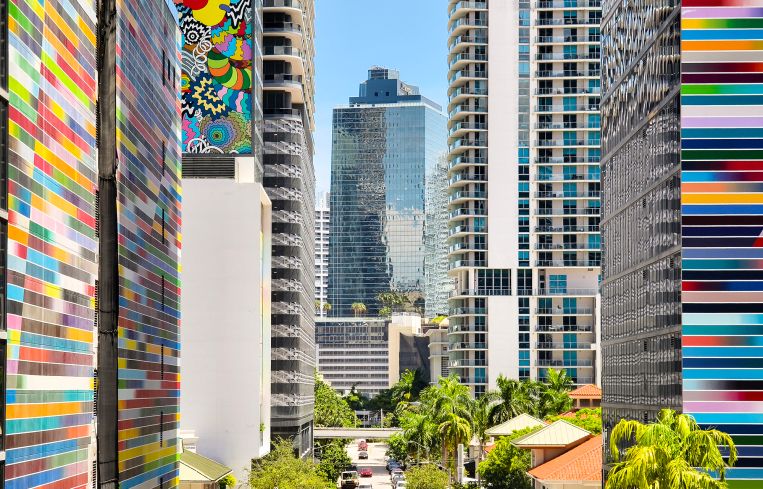
Brickell’s office district illustrates the premium placed on high-demand urban locations. Photo: Getty Images via Commercial Observer.
The figures describe a market separating into tiers. Newer, well-located buildings with strong amenities and access to restaurants, transit and services can attract companies willing to pay for a particular setting. Older suburban inventory may compete on price, but can face pressure to upgrade or offer concessions to keep tenants.
The slowdown may also reflect limited options for larger tenants: Commercial Observer, citing Savills, reported only about a dozen available blocks of space exceeding 50,000 square feet. When companies cannot find the right size, quality and location, high demand does not automatically translate into more signed leases.
Fort Lauderdale is experiencing rent pressure, too. CBRE’s Q3 2026 figures show asking rents up 8.3% year over year. The increase reinforces that this is a regional commercial story, even as rents and availability vary by submarket and building.
Retail construction reaches a three-year high
Miami-Dade’s retail pipeline is expanding at the same time. The county had 1.3 million square feet of retail space under construction in Q3, double the level a year earlier and the highest since early 2023, according to Colliers data reported by Bisnow on October 12.
That pipeline is a sign of developer confidence, not proof that retail space is suddenly abundant. Direct vacancy stood at about 3%, while triple-net asking rents reached a record $44.34 per square foot. Leasing activity slowed during the quarter, Bisnow reported, even as asking rents continued to rise.
The construction total includes a varied mix of projects, from large mixed-use developments to grocery-anchored centers. Some are moving forward with substantial preleasing, giving developers more confidence that tenants will occupy the space. But more construction takes time to become open storefronts, and the region’s development process remains challenging.
High interest rates, labor shortages and permitting delays are among the obstacles discussed in The Real Deal’s October 11 report, “South Florida Dirt: Why It’s Difficult to Build Right Now”. Those headwinds help explain why a construction pipeline can grow without quickly easing the pressure on existing tenants.

The projects underway are not all interchangeable. A new center in a growing neighborhood may serve a different customer base from a storefront in an established urban district. Even when additional supply arrives, it may not be in the location, or at the rent, that works for a particular small business.
What higher rents mean for small businesses
For independent retailers, cafés, service providers and restaurants, rising asking rents narrow the margin for error. At $44.34 per square foot, a 2,000-square-foot space implies about $88,680 a year in base asking rent, before additional costs that can apply under a triple-net lease, such as property taxes, insurance and maintenance.
That calculation is illustrative, not a quote for any particular storefront. Actual lease terms vary. But it shows why a strong market can still be hard on local operators: a business must weigh not just whether customers are nearby, but whether sales can cover rent, build-out, payroll and other expenses.
New supply could eventually give tenants more choices. For now, low vacancy and high asking rents mean businesses may need to consider alternative neighborhoods, smaller footprints or flexible lease terms. Bisnow’s reporting also notes that retailers seeking a specific destination may have to look beyond their first-choice district.
That reshuffling affects the character of commercial streets. If small operators cannot afford established neighborhoods, newer tenants may take their place, or storefronts may remain out of reach until a viable use can support the cost. A three-year construction high is encouraging for future supply, but it does not guarantee affordability today.
A changing market reshapes the commute
Office growth also has a daily consequence for workers. When companies cluster in premium districts, employees may face greater competition for housing nearby, while workers priced out of central neighborhoods commute from farther away. Where businesses choose more affordable suburban offices, workers’ travel patterns can shift in another direction.
More retail and mixed-use development can bring shops and services closer to homes and workplaces. But a new project does not, by itself, solve regional traffic, parking or transit challenges. The usefulness of commercial growth depends partly on how well jobs, housing and transportation connect.
South Florida Digest has covered how companies are placing new bets across Broward and Miami-Dade. The latest market figures add a real estate dimension: the location and quality of new space will shape not only where businesses operate, but also where employees travel and which neighborhoods receive new investment.
Growth and land use at the Everglades’ edge
The commercial story also meets a larger regional question: where can South Florida grow, and what infrastructure must support it? As development pressure reaches westward, land-use choices matter around the Everglades and the communities at the region’s edge. Commercial expansion depends on roads, drainage and reliable water systems, while the remaining landscape is not simply vacant land waiting for construction.
The trade-offs are particularly relevant in a region balancing growth with water management and conservation. South Florida Digest’s coverage of the Everglades reservoir provides further context on the infrastructure shaping those decisions. It is not a direct explanation for Q3 rent trends; it is part of the broader land and resource picture that development planning must take into account.
The bottom line
South Florida’s commercial market is not rising evenly. Miami-Dade office rents have hit a record while leasing cooled; Fort Lauderdale rents are also climbing; and Miami-Dade retail construction has reached a three-year high despite high costs and delivery hurdles.
For property owners and developers, the figures point to continuing demand in select locations. For small businesses, they mean careful lease math and potentially broader location searches. For workers, the distribution of new offices, retail and housing will influence daily travel as much as the headline construction totals.
The market is defying gravity, but not escaping its limits. Availability, affordability, construction costs and land-use decisions will determine who can participate in South Florida’s next phase of commercial growth.