Illustrative image; it does not depict a specific street covered in this week’s flooding.
South Florida’s latest round of coastal flooding brought record water levels without a hurricane or tropical storm. The peak arrived Tuesday, Oct. 27, and its effects continued across the region through Wednesday and into Thursday: streets were inundated, new neighborhoods saw flooding and some residents struggled to leave home.
The National Hurricane Center’s 8 a.m. EDT Tropical Weather Outlook, issued Thursday by forecaster Reinhart, said tropical cyclone formation was not expected in the North Atlantic, Caribbean Sea or Gulf of Mexico during the next seven days. The flooding was part of a non-tropical coastal event, as king tides and onshore winds pushed water into vulnerable areas.
Records at Virginia Key and Port Everglades
On Tuesday, the Virginia Key tide gauge in Miami reached 2.54 feet above mean higher high water. That was the third-highest reading at the gauge since records began in 1994, surpassed only by levels during Hurricanes Irma and Wilma, according to the Palm Beach Post and CBS Miami.
In Broward County, the Port Everglades gauge set its highest recorded water level since the station was installed in 2018, the same outlets reported.
The flooding did not stop with the Tuesday peak. Fort Lauderdale Chief Resilience Officer Dr. Nancy Gassman said Wednesday’s water was worse than Tuesday’s, running about six inches higher than any previous king tide.
“The number of tides has gone up, and the maximum height has gone up,” Gassman told CBS Miami. “In the last few days, we are 6 inches higher than the previous king tides.”
The flooding reached locations not usually associated with the worst impacts, including the Himarshee district near downtown and Mayan Drive near the beach. Near the shoreline, Church by the Sea was surrounded by water. Boat-show visitors Cory and Jared told CBS Miami: “It’s shocking; we don’t have boots.”
For some residents, the disruption was more than an inconvenience. Barbara Johnson, who said she could not leave her home to get food or visit a doctor, told CBS Miami: “Never to the point where I can’t go for food or to the doctor. It’s difficult for everyone.” She added: “The city is doing what they can do. Nature is nature.”
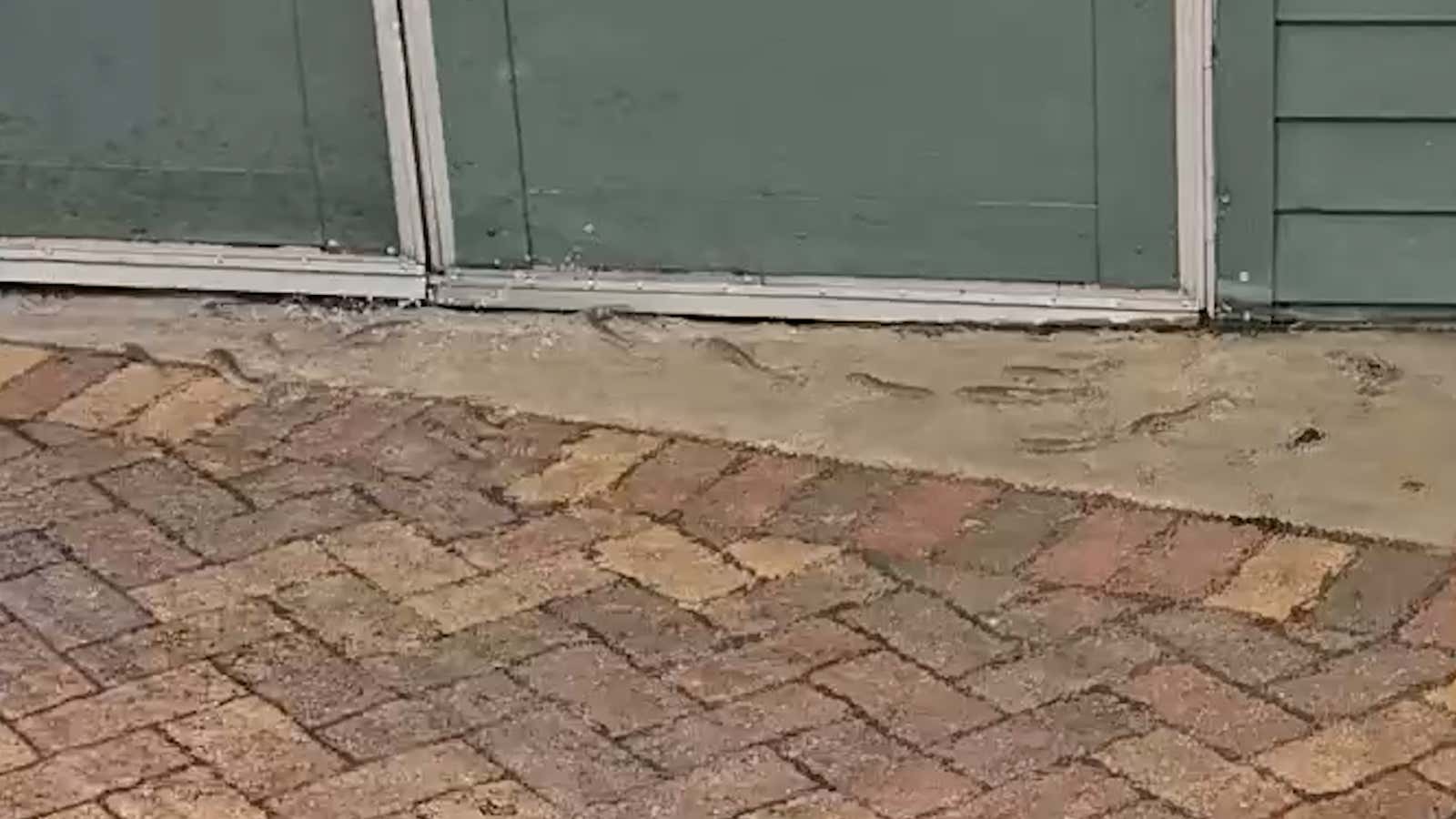
Weather.com published video of fish swimming across a flooded Fort Lauderdale driveway during the king tides.
One striking scene captured the unusual reach of the water: video published by Weather.com showed fish swimming across a flooded residential driveway.
The city’s response, and a warning about the future
Fort Lauderdale has raised miles of seawalls, installed tidal valves to help prevent backflow and is investing millions more in flood-prevention infrastructure, CBS Miami reported. But the city cannot simply pump the water away when ocean levels are already exceptionally high. As NBC 6 reported, water pumped into already elevated waterways may have nowhere to drain.
Gassman said the latest flooding is a reminder that current conditions could become more familiar as sea levels rise. “At some point permanent sea level rise is going to be at this level, and so we need to continue to plan for a rising sea,” she told CBS Miami, adding that it could happen as soon as 2040.
A Coastal Flood Advisory remains in effect through 8 p.m. Thursday, Oct. 29. Fort Lauderdale’s high tides are forecast for 11:15 a.m. and 11:30 p.m. Roadway flooding is possible, and some streets could become impassable around peak tide. Boaters should also watch for reduced bridge clearance.
The city advises residents to avoid flooded roads and report impassable streets through its FixIt FTL app or by calling 954-828-8000. Conditions are expected to ease gradually into the weekend as the astronomical tides become less extreme and winds weaken. Rain chances are expected to decrease, with highs in the mid-80s and overnight lows in the mid-to-upper 70s, according to CBS Miami’s forecast.
The Everglades: Big Cypress proposal draws scrutiny
The coastal flooding is one story; a separate proposal affecting the Everglades’ wider landscape is unfolding inland. The National Park Service has proposed extending its off-road vehicle (ORV) regulatory framework to roughly 147,000 acres of Big Cypress National Preserve’s Addition Lands. An area of about 230 square miles added to the preserve in 1988.
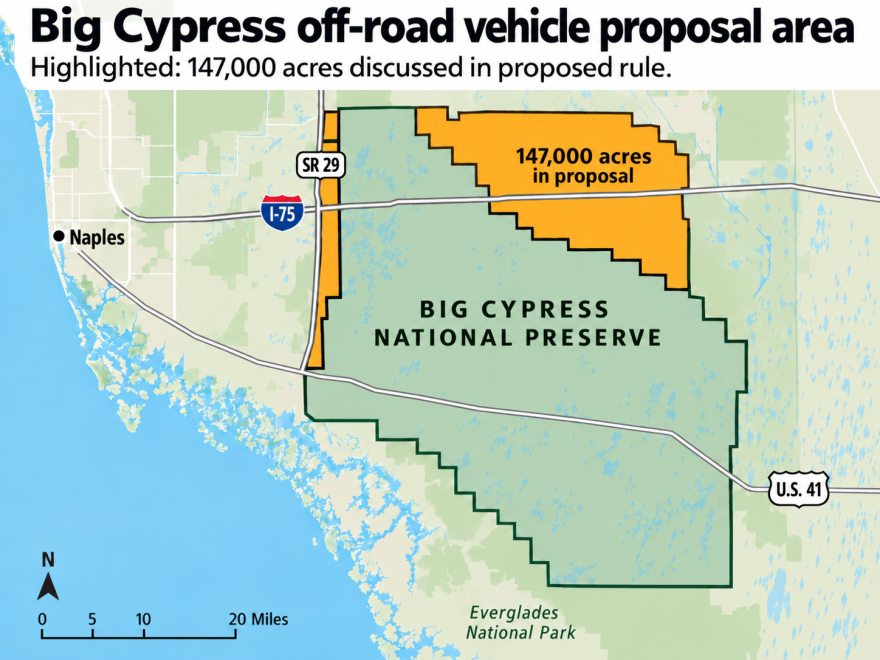
Map published by WGCU showing the area covered by the Big Cypress proposal.
The proposed rule would not authorize unrestricted cross-country driving. Instead, it would let the superintendent designate routes consistent with the 2024 Backcountry Access Plan. Superintendent Tom Forsyth told WGCU: “At Big Cypress National Preserve, we are committed to balancing public access with conservation.”
The proposal has drawn concern from conservation advocates. Elise Bennett, Florida and Caribbean director of the Center for Biological Diversity, told WGCU that Big Cypress is an “irreplaceable and vulnerable collection of ecosystems” supporting dozens of endangered and threatened species. She called the proposal “a wrong activity in the wrong place,” and raised concerns about the National Park Service’s capacity to oversee the added access.

Illustrative image of Big Cypress habitat; it does not depict a specific proposed route.
The debate has particular weight for Florida panthers. The western edge of the area proposed for access runs along State Road 29, already a hotspot for panther vehicle strikes. The 15th panther death reported this year was a two-year-old male struck Oct. 23 on Randall Boulevard in Collier County, according to WGCU and the Florida Fish and Wildlife Conservation Commission.
Comments on the Big Cypress proposal are due by 11:59 p.m. EDT Dec. 1, 2026. They can be submitted through the Federal Register notice or mailed to the Superintendent, Big Cypress National Preserve, 33100 Tamiami Trail E, Ochopee, FL 34141.